Showing posts with label Dayton. Show all posts

Tuesday, January 19, 2016

The genetic legacy of Appolonia Baker Stoecklein

Appolonia Baker Stoecklein
She looks young, and I wonder if she's pregnant
in this picture, perhaps with her first child, Cody.
Photo credit: Annabelle Leyes Clinger

My last post was about Appolonia Baker Stoecklein and her family background. I've been thinking about her recently because I'm grappling with her genetic legacy: gallbladder problems, and in particular, cancers of the biliary and digestive system (Spoiler: I don't have cancer!)

Appolonia died at the age of 41, after suffering for four years from an unknown disease. We don't know what that disease was - it could have been TB or MS - but if I had to guess, I'd say she died from some type of biliary cancer. Her descendants, certainly, have a sad history of succumbing to it. This type of medical history, in fact, is one of the practical applications of genealogy. It can be used for research on the genetic component of biliary cancers, and also as advanced warning for relatives.

What, exactly, is this family history?

First generation:

  • Appolonia Baker Stoecklein died in 1895 after four years from an unknown wasting disease, possibly (although it is unproven) cancer. Age 41.


Second generation: Appolonia had three daughters.

  • Her eldest, Cora Stoecklein, died of "stomach cancer" (no more specific information is available) in 1961, age 85
  • Her youngest, Irene Stoecklein Leyes (my direct maternal line great-grandmother) died of gallbladder cancer that spread to her liver, in 1967, age 76
  • Appolonia's middle daughter, Betty, died of a stroke.


Third generation: Appolonia had one granddaughter and one grandson.

  • My maternal grandmother, Mary Jane Leyes Cunningham, died of gallbladder cancer that spread to the liver and other organs, in 1972, age 56
  • Her brother, Bill, died of lung cancer, unrelated to the biliary system


Fourth generation: Appolonia has seven great-grandaughters and two great-grandsons (I won't give the names for privacy reasons). Joyfully, all but one member of this generation are still alive. 
  • My own mother had her gallbladder removed at the age of 27 after developing gallstones during her first pregnancy. The surgeon found no signs of cancer
  • Sadly, my mother's first cousin died of bile duct cancer in 2013, at the age of 46.

Fifth generation: 11 male and 10 female descendants. I'm one of the older ones, and one of the few to have reached the "danger zone" of middle age (I'm 42). Although I've known since I was quite young that I needed to watch for signs of gallbladder stones, it wasn't until December that I first experienced the classic symptoms of a gallstone attack. I quickly made a doctor's appointment and presented the family history above, at which time the medical-industrial complex swung into high gear. (The doctors were pretty bowled over by the family history. They hadn't seen anything like it.) Because of the cancer risk, I had my gallbladder removed at the nearest big city research hospital, where they could remove it without rupturing it, rush it to pathology to check for cancer while I was still on the operating table, and then - if necessary - remove part of my liver and bile ducts if it turned out I had cancer.

I am very happy to say that the surgery went as well as possible, and I have no signs of cancer. I did, however, have two huge gallstones (one was 3.5cm long!), and the surgeon assures me I'll feel much better once I've healed. Now that I've done more research on gallstone symptoms, I realize that I've been feeling their effects for years, I just hadn't recognized the low-level and constant pain in my side and back as "gallbladder problems" as opposed to "back pain" or "acid reflex" or other issues. I'm very grateful to have this problem taken care of before it could become worse.


To summarize, of the six deceased individuals who are direct descendants of Appolonia Stoecklein, four of them died of cancers of the gallbladder, liver, "stomach", or bile system (all closely related organs). There is clearly a genetic component here, but what is it? It is unlikely to be a simple Mendelian trait, but rather a suite of multiple genes that create high risk for her descendants. The good news, then, is that a suite of genes is likely diluted with each generation.

Lynch Syndrome is one possible hereditary link to bile duct cancers. This syndrome was mentioned to my cousin and her sisters, when she was diagnosed with bile duct cancer. To say someone has "Lynch Syndrome" is to say they carry a dominant variant of one (or more) of five genes. These variants are associated with high risk for colon cancer, in particular, but also pancreas, endomitrium, and liver. These risks can be insanely high (much higher than usual when we say someone has a genetic risk for a particular cancer). For example, individuals have a 52-82% lifetime risk of colorectal cancer, with a mean age diagnosis of 44-61 years, and 30% of individuals are diagnosed before age 40(1). We'll know more about my particular Lynch Syndrome genes soon, but our family history differs from Lynch Syndrome in that most Lynch Syndrome cancers are associated with the colon, pancreas, endometrium, and ovaries. We do not seem particularly prone to cancer in those organs, but rather related organs, such as the liver and gallbladder.

The genes particularly associated with a high risk for bile duct cancer are only now being identified, although initial work suggests they aren't the same genes as those associated with Lynch Syndrome(3). Gallbladder cancer, in particular, is extremely rare, so little research has been done on its heritability. Most gallbladder cancer is caused by gallstones. The constant irritation of the organ by the stones can lead to out-of-control cell growth. Once possibility, then, is that Appolonia Stoecklein handed down genes that made her descendants more likely to develop gallstones, and in particular large gallstones, which are more highly correlated to cancer(2). Certainly, a combination of Lynch Syndrome genes, plus genes associated with the growth of large gallstones, could account for the particular patterns of cancer seen in our family.

As I said, we'll know more soon. I received a personal gene testing kit for Christmas, and the results are due any time now. I look forward to delving into the full data and seeing what I can find. In the meantime, I'd urge any descendants of Appolonia Stoecklein to consult with a doctor to schedule periodic scans of their liver and gallbladder. These are silent cancers, and by the time you're aware of the problem, it can be too late.


References:
(1) Kohlman, Wendy, and Stephen Gruber. 2014. Lynch Syndrome. http://www.ncbi.nlm.nih.gov/books/NBK1211/
(2) Lowenfels, A.B., et al. 1989. Gallstone Growth, Size, and Risk of Gallbladder Cancer: An Interracial Study. International Journal of Epidemiology 18:50-54. http://www.ncbi.nlm.nih.gov/pubmed/2722383
(3) Maroni, Luca, et al. 2013. The Significance of Genetics for Cholangiocarcinoma Development. Annals of Translational Medicine Oct: 28. http://www.ncbi.nlm.nih.gov/pmc/articles/PMC4200671/

Thursday, January 7, 2016

Appolonia Baker Stoecklein

Photo from Mike Cunningham

My plan for the ancestral biosketches was to jump between family lines (that is, one from my mom's side, then one from my dad's side), but I find myself thinking about Appolonia Baker Stoecklein recently. Although my last biosketch was about her husband, John T. Stoecklein, I'm going to write a short sketch of what we know about her family for this week's post.

Appolonia died quite young, at the age of 41. Because her children had few memories of her, they weren't able to pass down much family lore. In fact, we didn't know her full name or anything about her birth family, which, as far as I know, had little contact with her children after she passed away.

I discussed her married life, children, and death in my post on her husband. Other than a few photographs handed down through the family, I have only public documents to shed light on her early life. Luckily, the name Appolonia is unusual enough that she can be easily traced, despite her common maiden name, which was Baker or Becker. Originally, the name was probably Baker with an umlaut over the a, and this got transliterated various ways in English-language documents. Baker is closer to the original spelling, but Becker is closer to the original pronunciation.

Appolonia Baker/Becker was the daughter of Casper and Anna Maria Baker. Casper Baker was born March 18, 1822, according to his tombstone, and his wife was born Feb 2, 1826(1). In census documents, they both list their birthplace as Saxony. Place names in Germany are difficult to interpret. The same town and region names can be used for a variety of different locations, and, of course, the boundaries of those regions could change over time. Saxony, in the period 1820-1860, most likely referred either to the Kingdom of Saxony (an independent member of the German Confederation that included the major cities of Dresden and Leipzig) or the Province of Saxony (a somewhat less coherent region annexed by Prussia and including areas that had previously been part of the Kingdom of Saxony, such as Wittenberg, but also Magdeburg, Halberstadt, and parts of the former territories of Brandenberg and Erfurt.) Where, exactly, Casper and Anna were from is unknown, but my best guess is that they were from the Kingdom of Saxony rather than the Province, since they would have been more likely to give their nation of birth as Prussia in the later case. On the other hand, the areas annexed by Prussia, particularly Upper Lusatia which used to be part of Brandenberg, had much higher Roman Catholic populations, and the Bakers were clearly Catholic, since they are buried in the Catholic Calvary cemetery in Dayton.


So far, I've given Appolonia's mother's name as "Anna Maria", but in fact, her name is a bit of a mystery. In the 1850 census, she is listed as "Mary Baker", 24, of Germany(2). In 1860, she is "Anna M. Becker" of Saxony, age 35(3). In the 1870 census, Casper's wife's name is given as Elizabeth, 41, from Saxony(4). In 1880, she's back to being "Mary Baker", born in Germany, aged 54(5). On her tombstone in Calvary Cemetery, her name is given as Anna M. Becker(1). Her name was probably Anna Maria, since German naming practices tended to give child a more formal first name and a less formal second name. Either one could be used in official documents, particularly in the United States. I'm not sure why she was called Elizabeth in the 1870 census. One possibility is that the 1870 census was mistake (perhaps a neighbor gave the information). This would explain why her age is incorrect in that census, as well. Alternatively, her full name was Anna Maria Elisabeta. 

Anna Maria's maiden name is unknown. On her son Casper's death certificate, it is listed as "Derorph", but I can find no records of this name in the U.S. or Germany. The name may have been imperfectly known by Casper's daughter (who was the source for the information on his death certificate), or it may have been poorly written by the clerk. I can only guess that her maiden name was actually something like Dierdorf.

Appolonia had a number of siblings recorded in the censuses of 1860 and 1870. All were born in Ohio, suggesting her parents were married in the U.S., or moved to the U.S. very soon after marriage, and that they arrived before 1849. The recorded children of Casper and Anna Baker are:
  • Mary E. (1849)
  • Casper (1852)
  • Appolonia (1854)
  • Joseph (1856)
  • Louis (1858)
  • Anne (1859)
  • Louisa (1860)
  • Katy (1862)
  • Emma (1865)
We know from the 1860 census, when Appolonia was 6 years old, that she and her family lived in the fourth ward of Dayton, Ohio. The fourth ward, defined in 1829, was "Bounded on the north by a line running due east from the river to the south line of Market Street and along that line to Jefferson Street; thence north to Third Street, and along Third Street to the corporation line; on the south by Fifth Street, and on the east by the corporation line."(6).  

According to the 1870 census, Casper was a stone cutter. He is also listed as such in a number of city directories. The oldest daughter, Mary, worked as a cigar maker, and the oldest son, Casper, was a shoe maker. Appolonia, 16, was living at home, her occupation listed as "helps mother". Two years later, she married. She would have been around 18 years old.

This was in a Stoecklein family album, so there must have
been some contact between the families.
Photograph from Mike Cunningham
Although Appolonia herself died young, in 1895, a number of her family members would have been in Dayton throughout the childhood of her own orphaned children. Her mother did not die until 1905, for example. I was not able to trace all of Appolonia's siblings, but her eldest brother, Casper Jr., was a shoemaker in Dayton. His wife, Barbara, and his children, Ralph and Carrie, lived in Dayton their whole lives. His married daughter, Daisy Baker Breen, was there at least part of her life.

Similarly, Appolinia's youngest sister, Emma, married Frederick Toby. She was widowed rather young, but lived in Dayton with her children, Frederick Toby and Florence Toby Plummer, (and later her orphaned grandson, Marvin Plummer) until 1950. Part of that time she lived with her sister, Katy Baker, and her sister's daughter, Beatrice Baker Poling. (As a side note, as far as I can tell, Beatrice was illegitimate.) Katy moved to New York in the 1920s with her daughter's family, but would have been in Dayton during the formative years of Appolonia's children.

Louisa Baker married Joseph Bennett, and she also lived in Dayton for her whole life. She had at least three children: Charles Bennett, Corrie Mountjoy, and Henrietta Geiger.

Do any of the Stoecklein descendants recognize these names? Was there ever contact between these Baker descendants and Appolonia's children or grandchildren?

To me, personally, the most pertinent legacy of Appolonia Baker Stoecklein is in her genetic contribution to subsequent generations, but that is a topic for another post, coming soon.

References:
1 -  http://www.findagrave.com/cgi-bin/fg.cgi?page=pv&GRid=56952586&PIpi=100987812
2 - "United States Census, 1850," index and images, FamilySearch (https://familysearch.org/pal:/MM9.1.1/MX3W-6GM : accessed 31 January 2015), Casper Baker, Dayton, ward 5, Montgomery, Ohio, United States; citing family 3261, NARA microfilm publication M432 (Washington, D.C.: National Archives and Records Administration, n.d.).
3 - 1860 census
4 - "United States Census, 1870," index and images, FamilySearch (https://familysearch.org/pal:/MM9.1.1/M6L8-NHY : accessed 31 January 2015), Joseph Baker in household of Casper Baker, Ohio, United States; citing p. 88, family 746, NARA microfilm publication M593 (Washington D.C.: National Archives and Records Administration, n.d.); FHL microfilm 552,748.
5 - "United States Census, 1880," index and images, FamilySearch (https://familysearch.org/pal:/MM9.1.1/M8S3-62R : accessed 15 January 2015), Casper Baker, Dayton, Montgomery, Ohio, United States; citing enumeration district 159, sheet 331D, NARA microfilm publication T9 (Washington D.C.: National Archives and Records Administration, n.d.), roll 1051; FHL microfilm 1,255,051.
6 - http://www.daytonhistorybooks.com/page/page/3428681.htm


Thursday, November 19, 2015

John Thomas Stoecklein

John T. Stoecklein
Photo from Mike Cunningham

Continuing with my series of biographical sketches, I wanted to focus on a member of my maternal line, since I featured Ammon Goode Hancock, my father's great-great grandfather, in my last post.

Photo from Mike Cunningham
John Thomas Stoecklein was my great-great grandfather. The Stoeckleins were about as different from the slave-owning Virginia gentry Hancocks as they could be. John T. was born December 10, 1851, in Dayton, Ohio. His family was Bavarian and Catholic. His father was Joseph C. Stoecklein, born in 1827 in the village of Stadt Prozelten, in the municipality of Faulbach, Bavaria, along the Main river, between Wurtzburg and Frankfurt. The town had about 150 inhabitants at the time of Joseph's birth, and there's not much there, even today, with fewer than 3,000 inhabitants in the whole municipality. John T.'s mother was Carolina Zwisler (also spelled Zwissler or Zwiesler), born around 1833, also in Faulbach, and most likely also in Stadt Prozelten(1).

Bavaria was in turmoil during the 1830s and 40s. In 1837, the Catholic clergy had supported a political movement to change the constitution (mostly the strip Protestants of civil rights), Eventually, political unrest led to the Revolutions of 1848, during which intellectual leaders called for greater freedom and rights for common people. The movement was defeated by the aristocracy, but Bavaria's king, Ludwig I, was forced to abdicate in 1848, replaced by his son, Maximilian II(2).

The unrest in the German states led to a wave of emigration to the United States, particularly among young men who otherwise would have been required to serve in the army during a period of nearly constant, and pointless, warfare. As was common at the time, the citizens of Stadt Prozelten stuck together, even in the New World. Joseph was the first to reach Dayton, sometime before 1849. It was a town of around 12,000 people with a large German population. He got a job at a meat-packing plant, wrote back home, and was soon joined by his brothers, John and Valentine, his father (his mother had died), and many other inhabitants of Faulbach, including the Zwisler family(1).

Joseph Stoecklein and Carolina Zwisler married February 18, 1851 (3). Joseph was 24, and Carolina
was 18. Whether or not they had been sweethearts in Bavaria, they no doubt were drawn to each other as familiar faces in a strange land. Undoubtedly, their families would have been happy to bless this marriage with a "known entity" at a time when they were still trying to find their bearings. Joseph and Carolina's first son, John T., was born 10 months after their wedding. Their second son, Joseph, was born around 1854, and their final child, Charles, in 1858.

Photo from Mike Cunningham
We do not have a lot of information about John T.'s childhood. The family was listed in the 1860 census, living in Harrison Township (part of Dayton) with their three boys and several German borders: Michael Frank, 23, from Bavaria; Christ Plocker, 19, from Wittenberg; and Adeline Feltman, 25, from Hanover(4). Joseph's occupation is listed as butcher, and he reports real estate worth $4000, and a personal estate of $800, which seems quite a fortune for someone who was less than 15 years off the boat. One of their borders, Michael Frank, was also a
butcher, and one wonders if he was an apprentice or employee. The census does not tell us exactly where the family lived, but in the 1864 Dayton city directory, their address is in Dayton View(5).The many spelling variants of their last name makes it difficult to find information about the family through on-line databases. The 1864 directory illustrates that perfectly, with its entries for the brothers "Valentine Steckland" and "Joseph Steocklein".*

John T. initially followed in his father's footsteps and became a butcher. In the 1871 city directory, John is listed as a butcher, living on Mad River Valley Pike in North Dayton(6). At least, I believe this is him. The extended Stoeckline family had a strong tendency to repeat the same first names. This, combined with the erratic spelling of their last name, makes it very difficult to track individuals unless they are listed with their immediate households.

Appolonia Stocklein
Photo from Mike Cunningham
However he was making a living, he must have been doing well, for the next year he married Appolonia Baker (or Becker) on November 12, 1872. Appolonia was born March 8, 1854, also in Dayton. She was the daughter of Casper and Anna Maria Baker, both of Saxony. Her father was a stone cutter, and Appolonia was the third of his eight children. Most documents refer to her as "Lena" or "Loney".


John T. does not appear in another city directory (as far as I can tell) until 1881. Other John Stoecklines are listed, but none of them are butchers, which appears to have been John T.'s occupation until 1882. He may have been working in his father's business. His extended Stoeckline family, meanwhile, was mostly in the brewing or saloon business. His uncle John had moved straight to Miamisburg from Bavaria, in the late 1840s, in order to take a job with an old colleague, Karl Schrouder, who had opened his own brewery(1). And by 1862, John T's uncle Valentine is listed as a saloon keeper on the northwest corner of Williams St. and the Germantown Pike in Miami City (Miamisburg, I assume). By 1871, his uncle John's saloon and brewery is listed in the city directory at
Cora Stoecklein
Photo from Mike Cunningham
429 W. 3rd St. By 1874, Uncle Valentine was prosperous enough to have his name in large print in the city directory as the owner of a wine and beer saloon(6).

John T. and Appolonia's first child, Cora (known as "Cody") was born July 5, 1875 (7). In 1877, on October 31, John T's father, Joseph, died of consumption (8). He was buried in Calvary Cemetery, where a substantial number of my maternal relatives rest. Sometime during that year, John T. and Appolonia's second child, Marie Antoinette (who understandably preferred the name "Betty") was born. In the 1880 U.S. Census of Dayton, John T.'s occupation is listed as "butcher", and his family consists of Lena, little Cora and Nettie, and an 11-month old boy named Willie who had been born in July of 1879. Willie must have died shortly thereafter, as there are no more records of him. Family stories suggest that John T. and Appolonia lost at least two other children (9). We know that there was a daughter named Laura, born around 1882, because we have a newspaper account that she was saved from drowning by her older sister, Cora, at the age of five. Unfortunately, she did not survive much longer, although I have found no record of her death.

From family album, Mike Cunningham
It is possible that John T. and his brother Joseph took over their father's butcher shop after his death. By 1881, they are listed in the city directory as "J. Stoeckline and Bro. (Jos. and John T.) daily market, 327 E. 3rd", with John T.'s personal residence listed as Covington Pike (6). The rest of the family continued to work in the saloon and brewery business, however. Although John T.'s Uncle Valentine appeared to have passed on by 1881, his widow, Sophia, continued to run his saloon at the corner of Williams and Germantown Pile, and at least one John Stoeckline was working as a bar tender. By 1887, John T.'s youngest brother, Charles, had also opened a saloon, and a Joseph Stoeckline (not clear if it's his brother or a nephew/cousin) owned "The Turf" and "The Office" sample bar, billiard hall and lunch counter. (A "sample bar" was another name for a saloon).
Betty Stoecklein
Photo from Mike Cunningham

In 1882, John T. changed his occupation. For the next fourteen years, he is listed in the city directory as a "driver", although his brother continues to be listed as a butcher. John T. may have been a driver for his brother's butcher shop, or he may have begun making deliveries for breweries and saloons. Since he later opened a saloon of his own, that would be my best guess. John T.'s address is given as SE River, between Central Av. and Salem, Dayton View. Later editions of the city directory give the address as 102 W. River. (6).


John T., on the far left, in his driver days?
(photograph from Mike Cunningham)

During this time, John T. and Appolonia's youngest child (and my great-grandmother), Irene Stoeckline was born, on January 12, 1891. Around this time, Appolonia took ill. She died on May 29, 1895, after an illness of four years. She was only 41. We do not know the cause of death, but given the long illness and the subsequent family history, I wonder if she died of liver cancer, like her daughter and granddaughter, as well as one great-granddaughter.

Her death may have spurred John T. to make a change in his career, because in the 1896 city

Irene Stoecklein
Photo from Mike Cunningham
directory, John T. is co-owner of a new business, Shartel and Stoeckline (John L. Shartel and John T. Stoecklein), "LaMascotte Lunch and Sample Room" at 33 S. Main. John T. had joined his family in the brewing and saloon business. He also moved his residence to 731 W. North Ave.(6). John Shartel left the business fairly quickly, for by the next year, the business was listed as "Stoecklein and Brehm (John T. S. and Wm. B.), sample room (same address). His listing appears next to the Stoecklein Brothers saloon (run by Henry and John J.), as well as Charles's saloon and "The Office" sample room, run by Joseph. From 1898 through 1902, John T. appears in the city directory as the sole owner of "The Mascotte Saloon, Restaurant, and Billiard Room", living at 744 S. Main (6).

Irene Stoecklein
Meanwhile, his daughters were growing up. On Oct 18, 1899, John T. married Mary A. Boga (10). She was 35, he was 48. The marriage must have been a significant change for Cody, who was 24 and had presumably been running her father's household since her mother's death. Irene, only eight, would have been most affected. Her grandchildren remember her saying that she never liked her stepmother. The least-affected daughter was Betty, aged 22, who married Earle Hack two years later and left the household (11). John T. and Mary had no children of their own.

By 1902, John T. was successful enough that his name appears in big letters in the city directory. He is living in the same place, but he is now proprietor of "The Mint" Sample Room, 210 S. Main, and proud owner of a rare telephone (number Main 1422) (6).  Not until 1904 does The Mint move to its final location at 136 S. Ludlow. Around the same time, John T. moved his family residence to 334 E. Hickory.

The early 1900s were a period of stability for the Stoecklines. They stopped moving so frequently. Cody remained with her father until his death, so she was there to care for her little sister. The Mint prospered, and Dayton was growing. The calm was short-lived, however.

The Mint, John T. on left
Photo from Mike Cunningham
On March 25, 1913, after storms dropped 8-12 inches of rain on the already saturated Miami River Valley, one of the worst natural disasters in Ohio history hit Dayton. The Great Dayton Flood broke through the levees and sent water up to 20 feet deep through downtown Dayton. Houses were swept away, killing their occupants. Families were stranded on their roofs, some dying during rescue attempts. Gas lines exploded, causing fires that could not be contained because the fire department was unable to navigate the streets. People walked the telegraph
The Mint, on Ludlow St., during the flood
Photo from Mike Cunningham
and electrical wires to safety, balancing high above the flood waters. 360 people died, and 65,000 were driven from their homes.

The Mint was in the middle of the flood. Family history says that John T. lost a number of barrels of expensive whiskey to the waters. Undoubtedly there was a great deal of property damage, as well.

The family home, on Hickory St., was at the very edge of the flood. I have never heard if the family had to evacuate, or if there was any damage to their home. The picture below was taken from the top of a school building in the 500 block of Hickory St, only a few blocks from the Stoeckline home. It seems likely the flood had some effect on their home.

Northward view of flooding taken from the Hickory Street School,
 formerly located at 501 Hickory Street in Dayton. Downtown.

The Stoecklein home was two blocks west of this location.
Dayton is visible in the upper righthand corner. March 26, 1913. from 
http://ecommons.udayton.edu/archives_flood_images/1/
After the devastation of the flood, the Stoeckline family must have been happy to celebrate the marriage of Irene on June 2, 1914, to Louis Leyes, and the birth of their first child, Mary Jane (my grandmother) on December 8, 1915. We can imagine that John T. was thrilled to finally have a grandchild (Cody never married and Betty had no children).

Louis Leyes with his delivery horses, c. 1913
Photo from Mike Cunningham
I don't know how Irene and Louis met. Louis lived on W. Bruen St., a street which intersected
Ludlow, but which no longer exists under that name. He was also a driver by profession, so he may have met Irene through her father, making deliveries to The Mint. They also, of course, may have met through church or any number of family connections.


John T. and Mary Jane Leyes
from Mike Cunningham

John T. and Mary Jane Leyes
from Mike Cunningham


Irene Stoecklein Leyes and
Mary Jane
Photo from Mike Cunningham
By 1919, John T. closed The Mint (6). Prohibition was approved by the U.S. Congress in January of 1919. Although the law did not take affect until January of 1920, John T. must have seen the writing on the wall. His saloon could survive a flood, but not the prohibition of alcohol. Besides, he was 68 and retirement may have been welcome.

John T. and Cody moved to 1800 E. Wyoming by 1919. Around that time, Mary died, leaving John T. a widower again (12). He lived with Cody until his death, December 21, 1926 (13).


________
*To clarify, the family may have always spelled their name "Stoecklein", but as is common at that time, the written records reflect a variety of ways that names were spelled. Frequently, census records, marriage licenses, city directories, and other documents were created by an English-speaking clerk writing down the name as he heard it spoken by the person in question. Even if that person was literate, his or her own preferred spelling of the name was not taken into consideration most of the time. Hence, a wide variety of variations in spelling.


References:

(1) Brown, Ashley. 1899. Stoecklein Family History. Compiled by Colleen Cunningham, 1993.

(2) https://en.wikipedia.org/wiki/History_of_Bavaria#Constitution_and_Revolution

(3) "Ohio, County Marriages, 1789-1997," index and images, FamilySearch (https://familysearch.org/pal:/MM9.1.1/XD2X-HP2 : accessed 6 January 2015), Joseph Stockling and Caroline Zwissler, 18 Feb 1851; citing Montgomery, Ohio, United States, reference Vol B2 pg 468; county courthouses, Ohio; FHL microfilm 1,030,835.

(4) "United States Census, 1860," index, FamilySearch (https://familysearch.org/pal:/MM9.1.1/MCGJ-84G : accessed 31 January 2015), Joseph Steckline, Harrison Township, Montgomery, Ohio, United States; from "1860 U.S. Federal Census - Population," Fold3.com; citing p. 42, household ID 289, NARA microfilm publication M653, National Archives and Records Administration, Washington, D.C.; FHL microfilm 805,013.

(5) http://interactive.ancestry.com/2469/4286615?backurl=http%3a%2f%2fsearch.ancestry.com%2fsearch%2fdb.aspx%3fdbid%3d2469%26path%3d&ssrc=&backlabel=ReturnBrowsing#?imageId=4286722

(6)  Ancestry.com. U.S. City Directories, 1822-1989 [database on-line]. Provo, UT, USA: Ancestry.com Operations, Inc., 2011.

(7) "Ohio, County Births, 1841-2003," index and images, FamilySearch (https://familysearch.org/pal:/MM9.1.1/X67L-5SH : accessed 17 January 2015), John F. Stoecklein in entry for Stoecklein, 05 Jul 1875; citing Birth, Dayton, Montgomery, Ohio, reference v 2 p 179, county courthouses, Ohio; FHL microfilm 1,030,824.

(8) ("Ohio, County Death Records, 1840-2001," index and images, FamilySearch (https://familysearch.org/pal:/MM9.1.1/F6VZ-CM1 : accessed 13 February 2015), Joseph Stoecklein, 31 Oct 1877; citing Death, Randolph Township, Montgomery, Ohio, United States, source ID v 2 p 179, County courthouses, Ohio; FHL microfilm 1,030,827.

(9) 1880; Census Place: Randolph, Montgomery, Ohio; Roll: 1052; Family History Film: 1255052; Page:755B; Enumeration District: 175; Image: 0672

(10) "Ohio, Marriages, 1800-1958," index, FamilySearch (https://familysearch.org/pal:/MM9.1.1/XDD6-NJ6 : accessed 6 January 2015), Joseph Stoecklein in entry for John T. Stoecklein Or Stocklein and Mary A. Boga, 18 Oct 1899; citing Montgomery Co., Ohio, reference 2:3Q13VCV; FHL microfilm 1,030,845.

(11) "Ohio, Marriages, 1800-1958," index, FamilySearch (https://familysearch.org/pal:/MM9.1.1/XDDX-947 : accessed 5 January 2015), Appolonia Baker in entry for Earle Mócowen Hack and Marie Antoinette Stoecklein, 19 Jun 1901; citing Montgomery Co., Ohio, reference 2:3Q163H5; FHL microfilm 1,030,845.

(12) "United States Census, 1920," database with images, FamilySearch (https://familysearch.org/ark:/61903/1:1:MDBM-CYS : accessed 9 November 2015), John T Stoecklein, Dayton Ward 10, Montgomery, Ohio, United States; citing sheet 10A, family 211, NARA microfilm publication T625 (Washington D.C.: National Archives and Records Administration, n.d.); FHL microfilm 1,821,422.

(13) "Ohio Death Index, 1908-1932, 1938-1944, and 1958-2007," database, FamilySearch (https://familysearch.org/ark:/61903/1:1:VKY7-3T1 : accessed 9 November 2015), John T Stoecklein, 21 Dec 1926; from "Ohio, Deaths, 1908-1932, 1938-2007," database and images, Ancestry (http://www.ancestry.com : 2010); citing vol. , certificate number , Ohio Historical Society, Columbus; Ohio Department of Health, State Vital Statistics Unit, Columbus.

Thursday, June 11, 2015

Clan, Community, and Migration


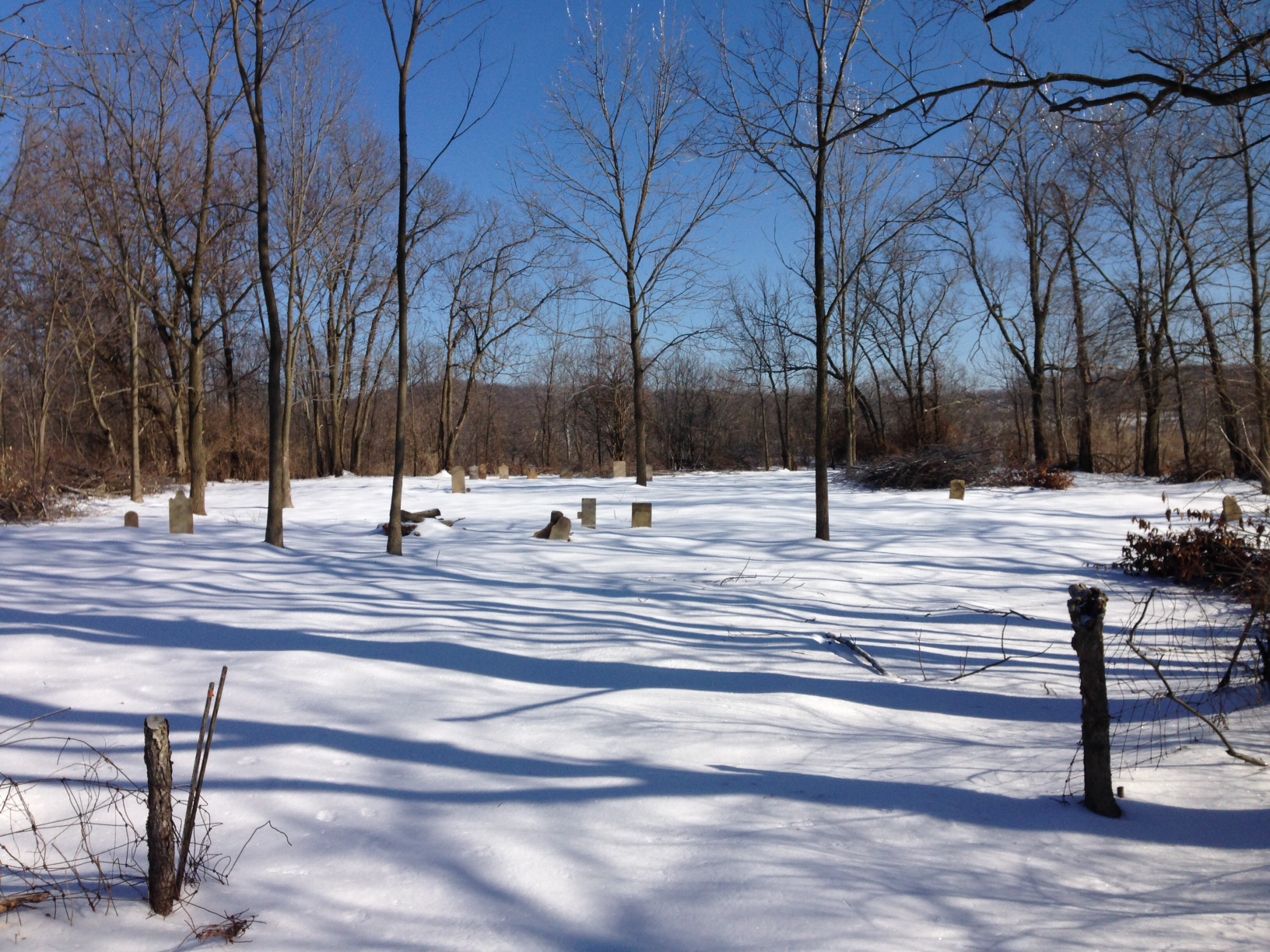
Dean Cemetery, South Salem, Ohio.
Photograph by http://image2.findagrave.com/photos/2014/46/CEM2317245_1392597580.jpg

Since I began working on genealogy, I've been struck by the family migration patterns of my ancestors. We're aware that European colonists moved frequently, spreading out across the continent. But unlike modern migration patterns (for example, my brother and I both moved away from Michigan for jobs), the earlier migrants moved with their large, extended families.

For example, Abraham Dean was born in western Pennsylvania in 1763. In the early 1800's, he moved with his family to South Salem, Ohio. But it wasn't just his immediate family who moved. He moved with his wife's family, including most of Sarah Stewart Dean's siblings. These were adults with their own households, spouses, and children, but they all moved to Ohio together. (Abraham only had one sibling, Margary Dean Canan, and she remained in Pennsylvania, along with her husband and children.) In the next generation, the children and grandchildren of Abraham moved to Des Moines, Iowa. Again, this was not just one nuclear family but the majority of his children, their own spouses, sisters- and brothers-in-law, and children. It was a clan migration.

Clan migrations weren't only typical of Scotch-Irish families in the early 19th century. On the other side of my family, Irish-Catholic Robert Cunningham, born in New York in 1850, spent his childhood in Columbus, Wisconsin. Robert married Elizabeth Rooney, and around 1890 they moved to Minneapolis, Minnesota. They moved with the entire Rooney family, including Elizabeth's parents, and most of her brothers and sisters, along with their families. This is how my great-great-great grandparents came to be buried less than an hour from where I now live.

Not all clan migrations were even based on kinship. One of my students told me that her surname is a town in Germany. Many of the towns' inhabitants emigrated together, and they took their town as their last name, so they could find each other in their new country. Something similar (without the name change) occurred in the Stoecklein branch of my mother's family. The Stoeckleins moved to Dayton, Ohio, from Faulbach, Bavaria. A number of families from that small town moved together, and remained close. Although my 3xgreat-grandfather, Joseph Stoecklein, married in Dayton, his wife, Carolina Zwisler, was the daughter of schoolmates of his parents back in Faulbach.

Surely these migration patterns were based on practicalities, as well as affection. Family members could help each other in a strange new place, whether they were negotiating a newly-conquered landscape or an alien city. It is an important reminder that, as a species, we were never meant to go it alone. We are social animals, and highly dependent on our family, however that is defined.

It's pretty common for academics to end up far from their families, and I personally can attest to the high cost of that separation. Just a couple weeks ago, my mother showed me a picture of her mother, surrounded by a plethora of female relatives - aunts, cousins, and sisters-in-law. Her remark was "Look how much help she had." Certainly, the large family sizes of previous generations were not possible if one woman did it all. As a society, we seem to have forgotten the importance of extended family.