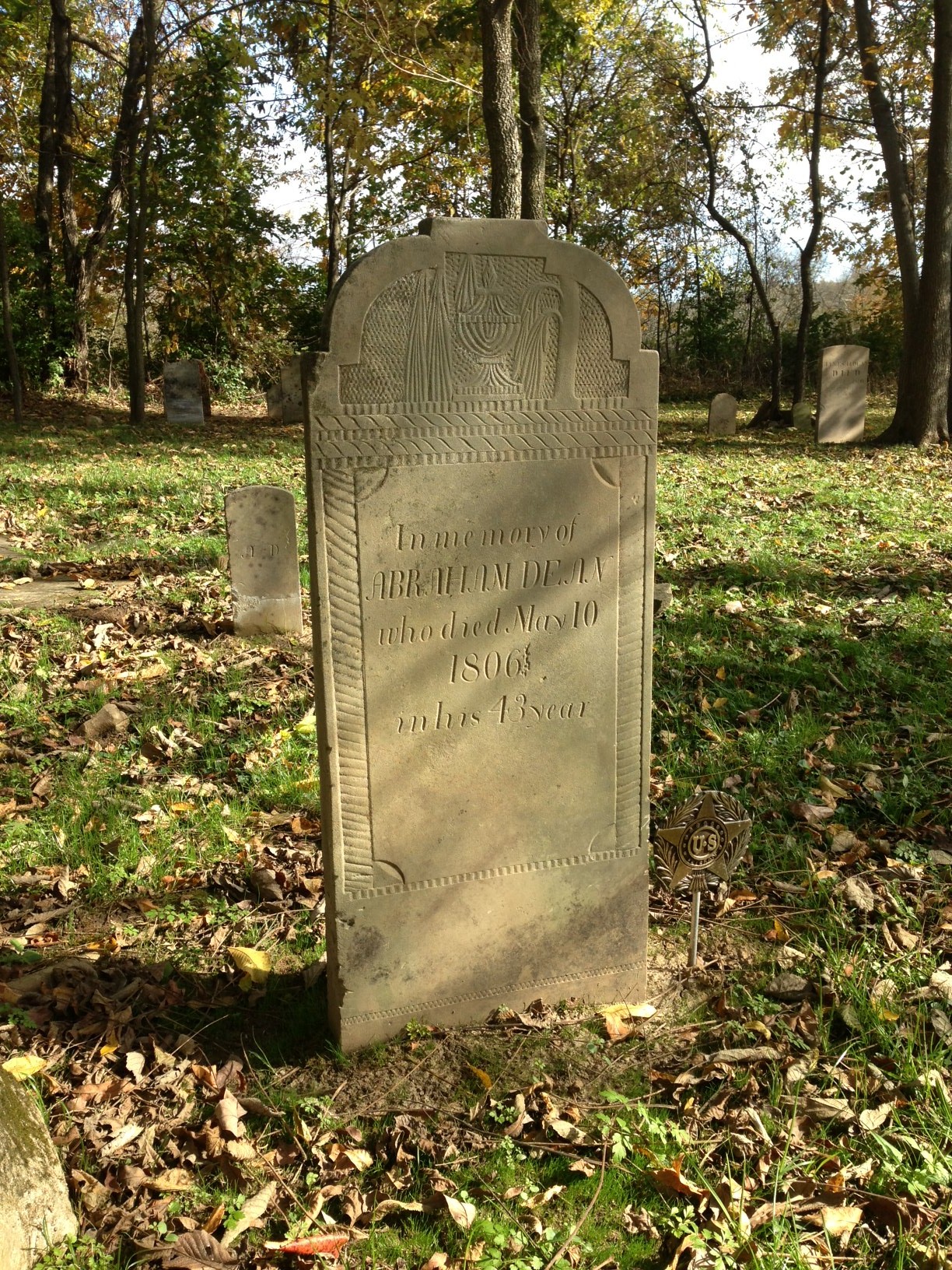
There are other Deans in the same area at that time, some of whom may be relatives and others who may have been wholly unconnected. Evidence for these relationships tend to be more tentative, but I lay it out below. As with the previous post, this one is aimed at the two or three people in the world who actually care about the details of this topic. And, as with the previous post, most of this information comes from the research by Larry Dean, with a few items of my own thrown in.
The Connection Between Abraham and Robert Dean
Abraham is listed in the U.S. Direct Tax Lists for Huntingdon and Somerset Counties, Pennsylvania, in 1798. Abraham is listed as Occupant #14, in Baree Township, "on head waters of Shavers and Stone Creek". Occupant #15 is Robert Dean, with the exact same location information. Occupant #16 is James Dean, also located in the same area. No other families are listed with that location. James, and I already discussed, was Abraham's father. However, this James seems likely to be his brother, since James Sr.'s death was recorded in the Canan family bible in 1795. Robert is another likely brother.
The Connection Between Abraham and William Dean
William Dean was the only other Dean whose name was directly connected to Abraham's in the primary literature. Abraham was appointed the administrator of William Dean's estate in Pitt Township, Allegheny County, on April 21, 1789, after William died without a will. Abraham's co-administrator was Jane Dean, William's wife (1). Allegheny County is significantly farther west than Huntingdon, where James and Abraham lived.
Larry Dean's post covers this case in detail, and includes an email from the local Genealogy Society which claims that the Abraham Dean who administrated William Dean's estate was the son of William and Jane Dean. However, there are no other Abraham Deans who appear in the 1790 census, other than the one in Huntingdon County (2) (well, there is the one in Maine, but that seems a stretch). If William Dean had a son named Abraham, then he was not the head of his household in 1790, yet the fact that he was administering William Dean's will suggests he was of age. So, assuming the Abraham who administered William Dean's will is the same Abraham who is our direct ancestor, what relationship did Abraham have with William and Jane Dean?
The previous blog post includes the evidence that Abraham was James's son, not William's. The genealogy that was cited in Larry's post included no sources to collaborate the suggested relationships or the dates, but it claimed that William was born in 1735 and had received land in Pitt Township for his service in the Revolutionary War. The war ended in 1783, so William could have been elsewhere in Pennsylvania before that time.
In the mid-1770s, multiple Deans appear in Hopewell Township of what was then Bedford County. At that time, what is now Huntingdon County was part of Bedford County, and Hopewell Township was created in 1773 from Barree (about 10 miles north of Alexandria, PA) (3). James Dean paid taxes on 300 acres in Hopewell township in 1779. A William and a John Dean paid taxes there in 1775, 1776, and 1779 (4). In 1784, there was a William Dean listed as an inhabitant of Huntingdon, where James Dean was also living. (Abraham was not listed, but he may not have bought his land until later that year.) William's household consisted of 7 white persons (4). In other words, IF this is the same William Dean, then James, William, and Abraham Dean lived in the same area in the 1770s and early 1780s, after which William and his wife Jane moved farther west when they were granted land in Pitt Township. William appears to be in the same generation as James, as far as we can tell from the land records. Certainly, he is at least ten years older than Abraham, as he begins buying land and paying taxes in 1775.
It is possible, then, that William was the father of Abraham. We cannot disprove this on the basis of the primary documents. However, the secondary evidence more strongly suggests James is Abraham's father, and Abraham never named any of his children William or Jane (see my previous post for discussion of Scotch-Irish naming practices). My suspicion - which I am unable to prove - is that William was Abraham's uncle, a brother of James. Abraham, as a relatively young and fit man (compared to, say, his father, who was around 50 at a time when life expectancy was much lower), was sent to his Aunt Jane's side when his uncle died unexpectedly, and helped her set the estate in order.
However, just to make things more complicated, the William Dean who died in Allegheny County may not have been the same William Dean who lived in Huntingdon! Larry Dean makes a good case that that William Dean, in fact, moved to Kentucky. Which, if either, or these Williams were related to our line remains frustratingly uncertain.
The Connection between Abraham Dean and Matthew and John Dean
And finally, I descend far into the realms of speculation.
Matthew Dean and his son John lived in in Frankstown Township in what was then Bedford County. This area was later divided into Bedford and Baree Townships (which we've heard of before) and is located in Blair County, just southwest of Alexandria, PA (3). Their lives are fairly well documented because much of their family was killed in a border raid by Native people who were angry at the incursion of white settlers onto their land (4, 5, 6, 7). Matthew, his oldest son John, and his three oldest daughters (Margaret, Rebecca, and Elizabeth) were in the fields and missed the attack on his farmstead/fort that killed Matthew's wife Rebecca and their five other children.
There is only circumstantial evidence that Matthew and John Dean are related to James and Abraham Dean:
- Matthew and James Dean lived very close to the area where James and Abraham lived, and at the same times. Matthew is first listed on the tax roles for Frankstown Township in 1776, and lived there until he died in 1781 (8).
- In his will, Matthew Dean named John Canan as executor. John Canan was James Dean's son-in-law (he had married James Dean's daughter, Margery) (9).
- John Dean (son of Matthew), James Dean, and John Canan were all founding members of Hart's Log Presbyterian church (5).
- According to secondary sources, Matthew and James Dean came to the United States around the same time. Matthew Dean's great-grandson said that “Matthew Dean came to Pennsylvania about the year 1760 from Ireland.” (7). As discussed in my previous post, James Dean's great-grandson claimed he, too, had come from Ireland in 1760.
- A number of family names are shared in common, although unfortunately they are also very common names from the period, so the fact that both families have Margaret/Margery or Elizabeth, John, etc., is not very convincing.
My suspicion - again, not provable - is that Matthew and James Dean were brothers. William may have been another brother.
If this is true, then one other intriguing piece of information may help clarify the Dean families of Pennsylvania: John Dean listed his birth city as York, PA, in his Revolutionary War pension file (10). If Matthew and James (and William?) Dean arrived in Pennsylvania in 1760, but they are first found on the tax rolls in the mid-1770s, what were they doing between those dates? Of course, they may have been working as laborers, and therefore not showing up in the records until they had saved enough to become men of property. But John's birthdate of 1763 in York suggests they spent some time there. York is south-southeast of Harrisburg, The Clerk of Courts Quarterly for York County record an Elizabeth and a Hans Dean living in the town in October of 1768, when they were brought in for a court case (I believe they were witnesses) (11). Elizabeth Dean was also tried for stealing in York in July of 1775. Obviously, Dean is a rather common name, but it's possible that these Deans were somehow related to the (three?) Dean brothers who arrived in Pennsylvania from Ireland in 1760.
References:
1) American Revolutionary Soldiers of Franklin county, Pennsylvania compiled by Virginia Shannon Fendrick, published 1969 by the Historical Works Committee of the Franklin County Chapter of the Daughters of the American Revolution.
2) "United States Census, 1790," database with images, FamilySearch (https://familysearch.org/ark:/61903/1:1:XHKJ-8MR : accessed 17 July 2015), James Dean, Huntingdon, Pennsylvania, United States; citing p. , NARA microfilm publication , (Washington D.C.: National Archives and Records Administration, n.d.), roll ; FHL microfilm .
3) http://www.pa-roots.com/bedford/history/originoftownships.html
4) History of the Early Settlement of the Juniata Valley by U. J. Jones, published by Floyd G. Hoenstine, Holidaysburg, Pennsylvania
5) History of Huntingdon County, Pennsylvania Volume I, by J. Simpson Africa, published by Louis H. Everts 1883 at Philadelphia, Pennsylvania
6) History of Blair County, Pennsylvania Volume II, by J. Simpson Africa, published by Louis H. Everts 1883 at Philadelphia, Pennsylvania
7) A History of Blair County by Tarring S. Davis, published 1931
8) The Pennsylvania Archives Third Series, Vol. 22, p. 121, 200, 267, 297
9) Ancestry.com. Pennsylvania, Wills and Probate Records, 1683-1993 [database on-line]. Provo, UT, USA: Ancestry.com Operations, Inc., 2015.
10) Genealogical Abstracts of Revolutionary War Pension Files by Virgil D. White, pub 1990, National Historical Publishing Company
11) http://www.yorkcountyarchives.org/search.asp
References:
1) American Revolutionary Soldiers of Franklin county, Pennsylvania compiled by Virginia Shannon Fendrick, published 1969 by the Historical Works Committee of the Franklin County Chapter of the Daughters of the American Revolution.
2) "United States Census, 1790," database with images, FamilySearch (https://familysearch.org/ark:/61903/1:1:XHKJ-8MR : accessed 17 July 2015), James Dean, Huntingdon, Pennsylvania, United States; citing p. , NARA microfilm publication , (Washington D.C.: National Archives and Records Administration, n.d.), roll ; FHL microfilm .
3) http://www.pa-roots.com/bedford/history/originoftownships.html
4) History of the Early Settlement of the Juniata Valley by U. J. Jones, published by Floyd G. Hoenstine, Holidaysburg, Pennsylvania
5) History of Huntingdon County, Pennsylvania Volume I, by J. Simpson Africa, published by Louis H. Everts 1883 at Philadelphia, Pennsylvania
6) History of Blair County, Pennsylvania Volume II, by J. Simpson Africa, published by Louis H. Everts 1883 at Philadelphia, Pennsylvania
7) A History of Blair County by Tarring S. Davis, published 1931
8) The Pennsylvania Archives Third Series, Vol. 22, p. 121, 200, 267, 297
9) Ancestry.com. Pennsylvania, Wills and Probate Records, 1683-1993 [database on-line]. Provo, UT, USA: Ancestry.com Operations, Inc., 2015.
10) Genealogical Abstracts of Revolutionary War Pension Files by Virgil D. White, pub 1990, National Historical Publishing Company
11) http://www.yorkcountyarchives.org/search.asp