Showing posts with label Ireland. Show all posts
Tuesday, March 15, 2016
How Irish Are We?
Lá ‘le Pádraig sona dhaoibh!
That, according to this webpage, at least, means "Happy St. Patrick's Day". My apologies to all Irish Gaelic speakers if it actually says something profane.
In honor of the patron saint of Ireland, today's post will focus on "How Irish Are We?" This is a surprising difficult question because the answer depends on what you mean by "Irish". Does this term refer to everyone born or raised on the island? Does it require a particular ancestry, such as native or gaelic Irish (as opposed to, say, Scotch-Irish)? Does it require a particular religion?
The Feast of St. Patrick is an acknowledged holy day for the Catholic church, but also for the Anglican Church of Ireland, the Lutherans, and some other protestant sects. It is an official holiday both in the Republic of Ireland and in Northern Ireland (still part of Great Britain). Therefore, one could argue that it is a holiday that belongs to all Irish.
That one would not be me, however. The celebration of St. Patrick developed among the (particularly American) diaspora as a celebration of native or Gaelic Irish culture and the Irish Catholic religious traditions. St. Patrick's day was a nationalist holiday, mostly celebrated, for obvious political reasons, by those who no longer lived in the nation in question.
The majority of Irish Catholic, or Gaelic Irish, to immigrate to this country came during or after the Potato Famine, an Gorta Mór (the Great Hunger), during which at least one million people died (many estimates put it closer to two million) and another million found their way to the Americas on the famine ships. My mother, who is 1/4 Gaelic Irish, has one line that exemplifies this history. Her great-great-grandparents, Joseph and Elizabeth Rooney, sailed into New York, in steerage, on a dangerously over-crowded ship, in 1848. Their eldest (surviving) child was born at sea.
The Rooneys spent relatively little time in New York. They soon moved to Wisconsin where they farmed and their eldest daughter, Elizabeth, married Robert Cunningham. Robert and Elizabeth (Rooney) Cunningham were my mother's great-grandparents.
The Cunninghams represent a different path of Irish immigration. Maurice and Elizabeth Cunningham were born and raised in County Cork, but came to this country in 1828, well before the Great Hunger forced so many Irish from their homes. I don't know why they chose to come to this country, but unlike most Irish immigrants of the Famine period, Maurice Cunningham was a skilled worker. He gave his occupation as carpenter at immigration, and he was soon head gardener on a very large and successful estate in New York. I assume, like many immigrants before and after, Maurice and Elizabeth Cunningham came to the United States for new opportunities they were denied back home.
Those two families are the only immigrants from Ireland on my mother's side, making her, as I said, 1/4 Gaelic Irish. My brother and I are, then, 1/8 Gaelic Irish.
On my father's side, the question is harder to answer because most of his Irish ancestry is more remote, and we don't always know their ethnic or religious affiliations. In most cases, however, his Irish ancestry is clearly Scotch-Irish. The Deans, for example, were Ulster Scots who immigrated to the mid-Atlantic region in the early 1700s. In fact, the only possible exception is the Houghton family, whose origins might be in County Cork and who might have been Catholic. That line, however, is not well researched. If we expand the definition of Irish to include all those who immigrated from the island (which I don't necessary advocate, as I said above), then my father is between 11 and 15% Irish, mostly through his mother's Manary line.
How did I calculate that? If we go back to his 6th great-grandparents, then we have (mostly) gone back to or past the first immigrants to the U.S. I can't actually trace every one of his lines back that far, but I assume that an immigrant 5th great-grandparent born in Ireland had parents from Ireland. That might not be true (in particular, they my have been Scots), but it's a reasonable assumption. Unfortunately, I can't trace every one of his lines back to the country of origin. Some of his family lines I know for certain came from Ireland (such as the Deans and the Manarys), but others, like the Dooleys, I'm guessing based on their last name. My father has 28 6xgreat-grandparents who were certainly from Ireland, and another 11 who were probably from Ireland. Since he has 256 6xgreat-grandparents, that makes him 11-15% Irish.
My brother and I, then, are 18-20% Irish.
Tabhair póg dom, táim Éireannach! (supposedly, "Kiss me, I'm Irish". Again with the apologies.)
Wednesday, September 9, 2015
The Deans in a Nutshell
I've been going back through the WikiTree pages and filling in the siblings and their first-generation children for every one of my direct ancestors. I've finished the Deans (that is, the straight patronymic line, not including all of the wives who married in), so this seems a good time to summarize the Deans in America.*
The Deans were Scotch-Irish, an ethnic/religious group mostly from northern England and southern Scotland. They were Protestant dissenters, strong Calvinists, who were first settled in Ulster in the 1500s (because they were causing too much trouble as border raiders in England), and later encouraged or forced to migrate to the American colonies, particularly in the 1700s. Over 300,000 Scotch-Irish migrated from Ulster to the Americas between 1710 and 1810, mostly to Pennsylvania, which had the most welcoming religious laws, or south along the Appalachian mountains, particularly into the Carolinas.
James Dean (about 1740-?) and Catherine Gamble (about 1740-?): These were the first Deans in the Americas. They were both born in Ireland, almost certainly in Ulster, and settled in Pennsylvania. They were married after their arrival in the Americas, which suggests that Catherine's parents and siblings could also be somewhere in Pennsylvania, although I haven't found them. They arrived sometime before 1760, since that was the year their first child, Margary, was born. In History of Huntingdon and Blair Counties, Pennsylvania, by J. Simpson Africa (p. 329), James is listed under the pioneers of Oneida Township, with his son, Abraham. This is an area of central Pennsylvania that was badly hit during the Seven Years War (aka French and Indian War). In the generation before, it had been largely cleared of people, Native and European alike. When the war ended, the Scotch-Irish were particularly prevalent among the new settlers. The same source says James was a member of the first board of elders elected by the congregation of Hart's Log Church, Sept. 10, 1787. He and Catherine may very well have settled elsewhere in Pennsylvania earlier, but there is no record of them before their arrival in Oneida Township. His farm was located near what is today Alexandria, Pennsylvania.
We only have records of two children, Margary and Abraham (see below). Margary married Colonel John Canan, who was also Scotch-Irish, and stayed near her parents in Pennsylvania. I blogged about the Canan family previously. John Canan was a Revolutionary War soldier and served in the General Assembly and as state senator for Pennsylvania. He developed coal and iron deposits, building one of the first furnaces in the region. Small families were very rare at this time, although childhood mortality was high. It is possible/likely that there were other children born to James and Catherine, but we have no record of them.
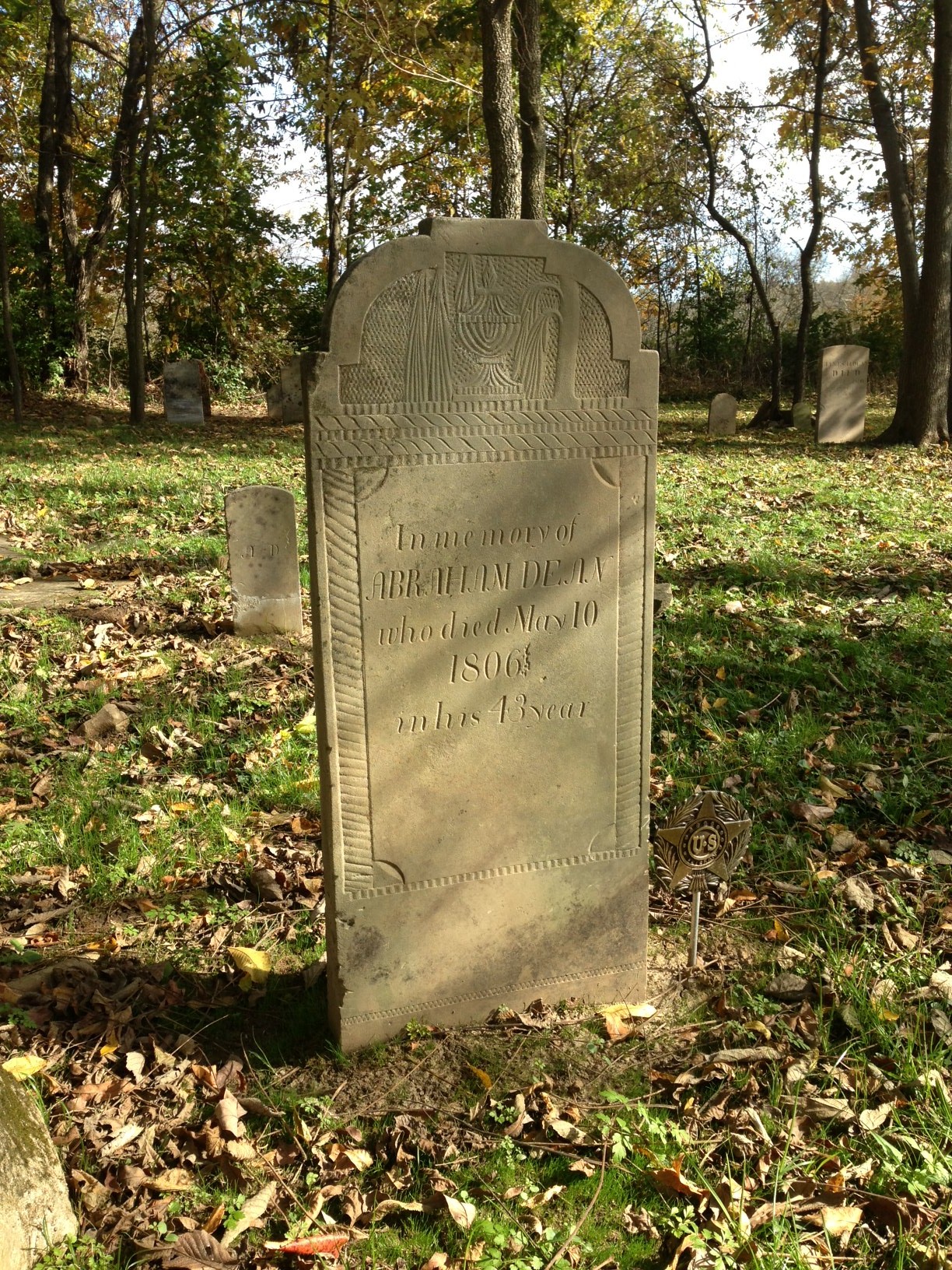
Abraham Dean (1763-1806) and Sarah Stewart (1766-1837): Abraham and Sarah were both born in Pennsylvania to Scotch-Irish families. He served as a private 3rd class in the 7th company, 1st battalion, of the Cumberland County Militia during the Revolutionary War (1). In 1784 he bought land north of present-day Alexandria, Pennsylvania, and named the tract "Mexico" (2). He and Sarah were married sometime around 1790. By 1811, however, they had moved their family to South Salem, in Ross County, Ohio. Ohio had been Shawnee and Lenape land (along with other tribes), and under military occupation by the French until the Revolutionary War. Freed from restraint by the British government, the new United States started pushing westward soon after independence. The first major Euro-American colony in Ohio was at Marietta in 1788, with statehood following in 1803 (after decades of war to enforce Euro-American rule). The Deans entered an Ohio that was only recently conquered and sparsely inhabited by Euro-Americans.
At least one of Sarah Stewart's sisters, Margaret Stewart Brown, and her family, also moved to South Salem. More of her siblings may have joined them. As I mentioned in a previous post, this type of clan migration was common. Abraham and Sarah had eight children who scattered throughout the Midwest. Their fifth child (and second son) was John Stewart Dean.
John Stewart Dean (1792-1872) and Hannah Baird (1800-1828): John was born in Lancaster County, Pennsylvania. He was a child when his family moved to Ohio. Hannah was probably born in Lincoln County, North Carolina, near King's Mountain, where her father fought during the Revolutionary War (3). In fact, he was one of the original signers of the Tryon Resolves, an early declaration of resistance to British rule. The Bairds were another Scotch-Irish family that had originally been from Pennsylvania. The Bairds moved into Ohio in the early 1800s, partly because of their opposition to slavery, Many Bairds were participants in abolitionist activities.
Hannah and John were married in Brown County, Ohio, in 1819. Hannah's older brother, John Hill Baird, was a good friend of John Stewart Dean. They served together during the war of 1812 (3). After returning to their homes (they had to walk across Ohio after being discharged), John Hill Baird married the eldest Dean sister, Catharine, and John Stewart Dean married his friend's sister, Hannah. Hannah and John had three children, the oldest of whom was Abram Stewart Dean. Unfortunately, Hannah died quite young and was buried in the Dean cemetery in South Salem, Ohio. John went on to marry twice more.
In 1847, John led a group of five families (mostly his relatives) from South Salem to Polk County, Iowa(4). They were among the first families to settle in the area. The U.S. Army had built a fort on the Des Moines River in 1843. (Fun fact, the fort was originally going to be called Fort Raccoon, after the other river that joins the Des Moines at that point. Only by the grace of the War Department was Iowa saved from having Raccoon as its state capital.) The fort was there to control the Sauk and Meskwaki tribes, who had been forcibly resettled there from eastern Iowa. It wasn't long, however, before the army moved the tribes farther west, and in 1846 the fort was abandoned as Native people were denied land rights in Iowa. The city was opened to settlement as the seat of Polk County in May of 1846, and the Deans arrived in November of 1847.
The John Stewart Dean became a leading man in Des Moines (4). He was known as "Uncle Johnny" throughout the area. He and his family settled on the east side of the river, and were founders of the Presbyterian church, which met for the first time in his home. He was instrumental in getting the state capital located in east Des Moines, donating some of his land to the project. To this day, the state capital sits at the end of Dean Street, just to the west of Dean Lake. The Dean's original homestead was in downtown Des Moines, along the river. In 1851 a massive flood destroyed much of the area. The Deans resettled a few miles east, closer to where John's son, Abram, had placed his farm.
Abram Stuart Dean (1820-1859) and Anne Retta Welsheimer (1819-1905): Abram was born in Ohio, where he met and married Anne Welsheimer. Anne was a first in the direct Dean line: a wife who was not primarily of Scotch-Irish stock. In fact, her mother was probably Scotch-Irish (there's very little known about her), but her father was German (5). The Welsheimers had settled in Pennsylvania in the 1760's. They came from Berlin, probably for religious reasons (they were Calvinists). Anne's grandfather and great-grandfather had fought in the Revolutionary War, then her father had moved westward into Ohio.
Abram and Anne had five known children, three born while they still lived in Ohio. They were about 27 when they moved to Des Moines. They spent the first winter in an old barracks, then built a log cabin on the north shore of Dean Lake (6). Their last two children were born there. Like his father, Abram was a devout Presbyterian and founding member of the church in Des Moines. Unfortunately, he only lived about a decade after their move to Iowa. He was 39 when he died in 1859. He lived long enough to see the city incorporated in 1851, and the capital moved to part of the land he donated in 1857. Anne never remarried. They and many of their children are buried in Sims Cemetery in Des Moines.
David Philip Dean (1852-1941) and Sarah Jane "Jennie" Brattain (1855-1919): David was the youngest child of Abram and Anne, born after their move to Des Moines. His father died just before his 7th birthday. Luckily, he had an extensive network of cousins, aunts, uncles, and grandparents in Iowa. I wonder if that is what turned him into such an avid genealogist.
The Brattains deserve their own blog post, but, briefly, they were another Scotch-Irish family. The Brattains, like the Deans, had married into Protestant German families. Jennie Brattain was born and raised in Henry County, Indiana, then married David in Des Moines, Iowa in 1876. I don't know how she met David. Jennie's father, Hiram, had spent time in Iowa as a child. In the 1850 census, he was living with his family in Van Buren County. Perhaps the families had met then, but Van Buren is not very close to Des Moines. My guess is that David was working in Indiana and met Jennie there.
However they met, their marriage was very successful. They had fourteen children, nine of whom survived past early childhood. Sometime between 1910 and 1919, the family moved to Coupeville, Washington, where they stayed until the current generation. Honestly, I have no idea why they moved there. One of the things I've learned from genealogy is that, in some ways, I know more about my distant ancestors than my more recent ones. David, his children, and his grandchildren were so busy discovering the Deans of the distant past that they didn't always document the Deans of the 20th century. Either that, or the documentation was gathered by my great aunt, Lillian Dean Huffstetler (David's granddaughter) whose materials I have not yet had a chance to see.
References:
1. American Revolutionary Soldiers of Franklin County Pennsylvania, by Virginia Shannon Fendrick, p. 59
2. History of Huntingdon and Blair Counties, Pennsylvania, by J. Simpson Africa, p. 329
3. "Wilson-Baird History" by Fran C. Shepherd, 1942 (exerpt on page2 here: http://baird-bard-beard.org/BB/downloads/Volume5-March1995.pdf):
4. From "Portrait and Biographical Album of Polk County, Iowa", 1890, p. 428, (https://archive.org/stream/portraitbiograph08chic#page/428/mode/2up)
5. "A History of the Welsheimer Family", by Edith Welsheimer, Bronson Printing, Las Cruces, New Mexico, 1969.https://dcms.lds.org/delivery/DeliveryManagerServlet?dps_pid=IE97573
6. Portrait and biographical album of Polk County, Iowa, Lake City Publishing Co., Chicago, 1890
_____
*I can't summarize the Deans before America because I have nothing in the way of records prior to their arrival here.
The Deans were Scotch-Irish, an ethnic/religious group mostly from northern England and southern Scotland. They were Protestant dissenters, strong Calvinists, who were first settled in Ulster in the 1500s (because they were causing too much trouble as border raiders in England), and later encouraged or forced to migrate to the American colonies, particularly in the 1700s. Over 300,000 Scotch-Irish migrated from Ulster to the Americas between 1710 and 1810, mostly to Pennsylvania, which had the most welcoming religious laws, or south along the Appalachian mountains, particularly into the Carolinas.
James Dean (about 1740-?) and Catherine Gamble (about 1740-?): These were the first Deans in the Americas. They were both born in Ireland, almost certainly in Ulster, and settled in Pennsylvania. They were married after their arrival in the Americas, which suggests that Catherine's parents and siblings could also be somewhere in Pennsylvania, although I haven't found them. They arrived sometime before 1760, since that was the year their first child, Margary, was born. In History of Huntingdon and Blair Counties, Pennsylvania, by J. Simpson Africa (p. 329), James is listed under the pioneers of Oneida Township, with his son, Abraham. This is an area of central Pennsylvania that was badly hit during the Seven Years War (aka French and Indian War). In the generation before, it had been largely cleared of people, Native and European alike. When the war ended, the Scotch-Irish were particularly prevalent among the new settlers. The same source says James was a member of the first board of elders elected by the congregation of Hart's Log Church, Sept. 10, 1787. He and Catherine may very well have settled elsewhere in Pennsylvania earlier, but there is no record of them before their arrival in Oneida Township. His farm was located near what is today Alexandria, Pennsylvania.
![]() |
| Old Hartslog Church |
| Tombstone of Abraham Dean, Ross County, Ohio photograph by Scott http://www.findagrave.com/cgi-bin/fg.cgi?page=mr&MRid=47082416 |
At least one of Sarah Stewart's sisters, Margaret Stewart Brown, and her family, also moved to South Salem. More of her siblings may have joined them. As I mentioned in a previous post, this type of clan migration was common. Abraham and Sarah had eight children who scattered throughout the Midwest. Their fifth child (and second son) was John Stewart Dean.
John Stewart Dean (1792-1872) and Hannah Baird (1800-1828): John was born in Lancaster County, Pennsylvania. He was a child when his family moved to Ohio. Hannah was probably born in Lincoln County, North Carolina, near King's Mountain, where her father fought during the Revolutionary War (3). In fact, he was one of the original signers of the Tryon Resolves, an early declaration of resistance to British rule. The Bairds were another Scotch-Irish family that had originally been from Pennsylvania. The Bairds moved into Ohio in the early 1800s, partly because of their opposition to slavery, Many Bairds were participants in abolitionist activities.
Hannah and John were married in Brown County, Ohio, in 1819. Hannah's older brother, John Hill Baird, was a good friend of John Stewart Dean. They served together during the war of 1812 (3). After returning to their homes (they had to walk across Ohio after being discharged), John Hill Baird married the eldest Dean sister, Catharine, and John Stewart Dean married his friend's sister, Hannah. Hannah and John had three children, the oldest of whom was Abram Stewart Dean. Unfortunately, Hannah died quite young and was buried in the Dean cemetery in South Salem, Ohio. John went on to marry twice more.
In 1847, John led a group of five families (mostly his relatives) from South Salem to Polk County, Iowa(4). They were among the first families to settle in the area. The U.S. Army had built a fort on the Des Moines River in 1843. (Fun fact, the fort was originally going to be called Fort Raccoon, after the other river that joins the Des Moines at that point. Only by the grace of the War Department was Iowa saved from having Raccoon as its state capital.) The fort was there to control the Sauk and Meskwaki tribes, who had been forcibly resettled there from eastern Iowa. It wasn't long, however, before the army moved the tribes farther west, and in 1846 the fort was abandoned as Native people were denied land rights in Iowa. The city was opened to settlement as the seat of Polk County in May of 1846, and the Deans arrived in November of 1847.
![]() |
| Walnut Street Bridge, Des Moines, Iowa, 1866 On the far side of the bridge was the site of the original Dean household in Iowa. |
Abram Stuart Dean (1820-1859) and Anne Retta Welsheimer (1819-1905): Abram was born in Ohio, where he met and married Anne Welsheimer. Anne was a first in the direct Dean line: a wife who was not primarily of Scotch-Irish stock. In fact, her mother was probably Scotch-Irish (there's very little known about her), but her father was German (5). The Welsheimers had settled in Pennsylvania in the 1760's. They came from Berlin, probably for religious reasons (they were Calvinists). Anne's grandfather and great-grandfather had fought in the Revolutionary War, then her father had moved westward into Ohio.
![]() |
| The Dean plot in Sims cemetery, Des Moines |
David Philip Dean (1852-1941) and Sarah Jane "Jennie" Brattain (1855-1919): David was the youngest child of Abram and Anne, born after their move to Des Moines. His father died just before his 7th birthday. Luckily, he had an extensive network of cousins, aunts, uncles, and grandparents in Iowa. I wonder if that is what turned him into such an avid genealogist.
The Brattains deserve their own blog post, but, briefly, they were another Scotch-Irish family. The Brattains, like the Deans, had married into Protestant German families. Jennie Brattain was born and raised in Henry County, Indiana, then married David in Des Moines, Iowa in 1876. I don't know how she met David. Jennie's father, Hiram, had spent time in Iowa as a child. In the 1850 census, he was living with his family in Van Buren County. Perhaps the families had met then, but Van Buren is not very close to Des Moines. My guess is that David was working in Indiana and met Jennie there.
However they met, their marriage was very successful. They had fourteen children, nine of whom survived past early childhood. Sometime between 1910 and 1919, the family moved to Coupeville, Washington, where they stayed until the current generation. Honestly, I have no idea why they moved there. One of the things I've learned from genealogy is that, in some ways, I know more about my distant ancestors than my more recent ones. David, his children, and his grandchildren were so busy discovering the Deans of the distant past that they didn't always document the Deans of the 20th century. Either that, or the documentation was gathered by my great aunt, Lillian Dean Huffstetler (David's granddaughter) whose materials I have not yet had a chance to see.
References:
1. American Revolutionary Soldiers of Franklin County Pennsylvania, by Virginia Shannon Fendrick, p. 59
2. History of Huntingdon and Blair Counties, Pennsylvania, by J. Simpson Africa, p. 329
3. "Wilson-Baird History" by Fran C. Shepherd, 1942 (exerpt on page2 here: http://baird-bard-beard.org/BB/downloads/Volume5-March1995.pdf):
4. From "Portrait and Biographical Album of Polk County, Iowa", 1890, p. 428, (https://archive.org/stream/portraitbiograph08chic#page/428/mode/2up)
5. "A History of the Welsheimer Family", by Edith Welsheimer, Bronson Printing, Las Cruces, New Mexico, 1969.https://dcms.lds.org/delivery/DeliveryManagerServlet?dps_pid=IE97573
6. Portrait and biographical album of Polk County, Iowa, Lake City Publishing Co., Chicago, 1890
*I can't summarize the Deans before America because I have nothing in the way of records prior to their arrival here.
Labels:
Baird,
Brattain,
Dean,
Gamble,
Iowa,
Ireland,
Ohio,
Overviews,
Pennsylvania,
Stewart,
Washington,
Welsheimer
Tuesday, August 18, 2015
Where is Wallenstown? An Irish History Mystery
This is one of a series of posts about Maurice and Elizabeth Cunningham, their children and grandchildren, and their lives in Columbus, Wisconsin in the late 1800s. You can find the other posts here: Part 1 (overview), Part 2 (the cemetery), Part 3 (the church and farm), Part 4 (our current state of knowledge) and related posts on Robert Steven Cunningham and the Rooney farm.
Where is Wallenstown, Ireland?
We were excited, on our cemetery trip to Columbus, Wisconsin, to see Maurice Cunningham's home town indicated on his tombstone. But here's the problem: there's no such place as "Wallenstown, Ireland"!
A Google search for Wallenstown Ireland gets only one hit, an individual mention in a 1588 document entitled Calendar of the State Papers Relating to Ireland, of the Reigns of Henry VIII, Edward VI, Mary, and Elizabeth. This is a list of court cases, and in case #68, there is reference to "Edmond Wolfe, of Wallenstown, county Limerick". However, in case #49 the same person is listed as a resident of Williamstown, Limerick. So, I remain skeptical that this reference is correct.
I tried searching for variants, such as Ballywallen or Balligwallen (which is a western suburb of Dublin), or Walkinstown (another area of Dublin). But none of these fit well. Among other things, if Maurice Cunningham had lived in Dublin, why had he sailed from Cork? It could happen, of course, but I kept looking for alternatives.
I posted a question on wikitree.com, asking for help, and one of the community members suggested a web page on Irish Place Names. It did not have a Wallenstown, either, but it suggested a much more reasonable alternative: Wallingstown, a suburb of Cork.
Wallingstown is on an area called "Little Island", about four miles east of Cork. In the 1837 Topographical Dictionary of Ireland, Samuel Lewis describes some of the locations on Little Island, including "Wallinstown House", the residence of Phineas Bury, Esq, and the ruined castle of Wallinstown. My best guess is that Maurice Cunningham (and Elizabeth as well?) grew up on or near the manor of Wallinstown. I have not been able to find any reference to either of them in parish records from that area, but I will keep looking.
Where is Wallenstown, Ireland?
We were excited, on our cemetery trip to Columbus, Wisconsin, to see Maurice Cunningham's home town indicated on his tombstone. But here's the problem: there's no such place as "Wallenstown, Ireland"!
A Google search for Wallenstown Ireland gets only one hit, an individual mention in a 1588 document entitled Calendar of the State Papers Relating to Ireland, of the Reigns of Henry VIII, Edward VI, Mary, and Elizabeth. This is a list of court cases, and in case #68, there is reference to "Edmond Wolfe, of Wallenstown, county Limerick". However, in case #49 the same person is listed as a resident of Williamstown, Limerick. So, I remain skeptical that this reference is correct.
I tried searching for variants, such as Ballywallen or Balligwallen (which is a western suburb of Dublin), or Walkinstown (another area of Dublin). But none of these fit well. Among other things, if Maurice Cunningham had lived in Dublin, why had he sailed from Cork? It could happen, of course, but I kept looking for alternatives.
I posted a question on wikitree.com, asking for help, and one of the community members suggested a web page on Irish Place Names. It did not have a Wallenstown, either, but it suggested a much more reasonable alternative: Wallingstown, a suburb of Cork.
Wallingstown is on an area called "Little Island", about four miles east of Cork. In the 1837 Topographical Dictionary of Ireland, Samuel Lewis describes some of the locations on Little Island, including "Wallinstown House", the residence of Phineas Bury, Esq, and the ruined castle of Wallinstown. My best guess is that Maurice Cunningham (and Elizabeth as well?) grew up on or near the manor of Wallinstown. I have not been able to find any reference to either of them in parish records from that area, but I will keep looking.
Here is a map of the current area known as Wallingstown, or Baile an Bhailisigh in Irish. According to this website, the area has been known by a variant of that name since at least 1301.
Sunday, August 16, 2015
Rooneys of Columbus
This is one of a series of posts about Maurice and Elizabeth Cunningham, their children and grandchildren, and their lives in Columbus, Wisconsin in the late 1800s. You can find the other posts here: Part 1 (overview), Part 2 (the cemetery), Part 3 (the church and farm), Part 4 (our current state of knowledge) and related posts on Robert Steven Cunningham and Wallenstown, Ireland.
This isn't (just) a corn field. This was once the homestead of John Joseph and Elizabeth Kelly Rooney, my great-great-great-grandparents.
They were born and married in County Moneghan, Ireland, and arrived in the United States on one of the famine ships in 1848. Their eldest son, Patrick, was born on the voyage. They originally settled in New York, but by 1860, they, like the Cunninghams, had moved to Columbus, Wisconsin. Their farm was northeast of town (unlike the Cunninghams, who lived southwest of town), so they were in a different county, Dodge.
They had ten children. Their eldest daughter, Elizabeth Theresa Rooney, married the Cunningham's youngest son, Robert, and they became my great-great-grandparents.
While the Cunninghams farmed a full section of land, the Rooneys had only a quarter section. This must have made it difficult for them to get by, and eventually the whole family moved west to Minnesota. Most of the family, like my great-great-grandparents, moved to Minneapolis. however, the youngest Rooney son, Aloysius, staked a land claim in western Minnesota, near the town of Osakis, and his parents went with him. They died there in 1906 and are buried less than an hour from where I currently live.
![]() |
| The Rooney farm, as seen today |
They were born and married in County Moneghan, Ireland, and arrived in the United States on one of the famine ships in 1848. Their eldest son, Patrick, was born on the voyage. They originally settled in New York, but by 1860, they, like the Cunninghams, had moved to Columbus, Wisconsin. Their farm was northeast of town (unlike the Cunninghams, who lived southwest of town), so they were in a different county, Dodge.
![]() |
| Map from 1873 showing the Rooney homestead in Dodge County, Wisconsin. |
They had ten children. Their eldest daughter, Elizabeth Theresa Rooney, married the Cunningham's youngest son, Robert, and they became my great-great-grandparents.
While the Cunninghams farmed a full section of land, the Rooneys had only a quarter section. This must have made it difficult for them to get by, and eventually the whole family moved west to Minnesota. Most of the family, like my great-great-grandparents, moved to Minneapolis. however, the youngest Rooney son, Aloysius, staked a land claim in western Minnesota, near the town of Osakis, and his parents went with him. They died there in 1906 and are buried less than an hour from where I currently live.
![]() |
| The Rooney resting place in Osakis, Minnesota |
Saturday, August 15, 2015
Cunninghams of Columbus, Wisconsin, Part 1
I haven't posted about the genealogy of my mother's family, but during a recent family trip to the Wisconsin Dells, we stopped in the town of Columbus, where Maurice Cunningham and Elizabeth Cunningham, my 3xgreat-grandparents, settled with their family in the 1850s. We got a lot from the trip, so I'm going to write several blog posts. Here's the first one, an overview of what we knew about the Cunninghams before the trip to Columbus, based on the documentary evidence. You can find the other posts here: Part 2 (the cemetery), Part 3 (the church and farm), Part 4 (our current state of knowledge) and related posts on Robert Steven Cunningham, the Rooney farm and Wallenstown, Ireland.)
An Overview of the Cunninghams of Columbus
References:
(1) Ship's manifest of the Port of New York.
(2) 1843 Documents of the Senate of the State of New York, Volume 3, pp. 74, 75, and 47.
(3) "United States Census, 1850," index and images, FamilySearch (https://familysearch.org/pal:/MM9.1.1/MZMM-8G8 : accessed 18 January 2015), Maurice Cunningham, Esopus, Ulster, New York, United States; citing family 469, NARA microfilm publication M432 (Washington, D.C.: National Archives and Records Administration, n.d.).
(4) "United States Census, 1860," , FamilySearch (https://familysearch.org/ark:/61903/1:1:MWMP-MP2 : accessed 15 August 2015), Morris Cunningham, Columbus, Columbia, Wisconsin, United States; from "1860 U.S. Federal Census - Population," database, Fold3.com(http://www.fold3.com : n.d.); citing p. 133, household ID 988, NARA microfilm publication M653 (Washington, D.C.: National Archives and Records Administration, n.d.); FHL microfilm 805,401.
(5) 1880 The History of Columbia County, Wisconsin, p.692
(6) United States Census, 1870," index and images, FamilySearch (https://familysearch.org/pal:/MM9.1.1/MN97-D14 : accessed 21 January 2015), Eliza Cunningham, Wisconsin, United States; citing p. 17, family 118, NARA microfilm publication M593 (Washington D.C.: National Archives and Records Administration, n.d.); FHL microfilm 553,205.
(7) "United States Census, 1880," index and images, FamilySearch (https://familysearch.org/pal:/MM9.1.1/MN4H-FFN : accessed 21 January 2015), E Cunningham, Columbus, Columbia, Wisconsin, United States; citing enumeration district 19, sheet 55A, NARA microfilm publication T9 (Washington D.C.: National Archives and Records Administration, n.d.), roll 1420; FHL microfilm 1,255,420.
(8) "Wisconsin, State Census, 1885," index and images, FamilySearch (https://familysearch.org/pal:/MM9.1.1/MM9R-LBC : accessed 21 January 2015), William Cunningham, Columbus Town, Columbia, Wisconsin; citing reference 14, State Historical Society, Madison; FHL microfilm 1,032,696.
(9) "United States Census, 1900," database with images, FamilySearch(https://familysearch.org/ark:/61903/1:1:MMK7-H6F : accessed 15 August 2015), Ellen Cunningham in household of Elsea T Syons, Columbus city Ward 1-3, Columbia, Wisconsin, United States; citing sheet 10B, family 258, NARA microfilm publication T623 (Washington, D.C.: National Archives and Records Administration, n.d.); FHL microfilm 1,241,781.
An Overview of the Cunninghams of Columbus
Maurice and Elizabeth Cunningham arrived in the United States in 1828. My uncle Mike found them on the manifest of the British ship Trio, sailing from Cork, and arriving in New York on October 2. On the manifest they are listed as Maurice and Betsy Cunningham, aged 21 and 18, with Maurice's profession listed as "carpenter"(1).
![]() |
| Maurice and Elizabeth and numbers 11 and 12 on this manifest. Click for larger size. |
I could not find the family in the 1830 or 1840 censuses. There are multiple Cunninghams living in New York, and it's not at all clear which one is the correct one, if any. At the time, the census only listed the name of the head of household and the number of free or enslaved people living in the household. If Maurice and Elizabeth were boarders or living with an employer, they would not be counted by name in the census. We do know, however, that during this time Maurice served as head gardener for Robert Livingston Pell, of Pelham estate in Ulster County, New York. This was a prestigious position, as the Pells owned a very extensive estate and were known for their agricultural innovations. Today, the estate is home to a seminary and retreat center owned by the Redemptionist Fathers. This YouTube video shows the landscape, although the buildings all post-date Maurice and Robert Pell. In 1843, Pell (with specific mention of Maurice) won a premium at the Fair of the American Institute, and was considered a source of "superior specimens" of winter apples and culinary vegetables(2).
Maurice and Elizabeth were recorded in the 1850 census in Esopus, Ulster, New York, along with eight children, ranging in age from twenty to eight(3). By the 1860 census, they had moved to Columbus, Wisconsin, and they were recorded there with nine children (the additional child being my great-great-grandfather, Robert Steven Cunningham)(4). Although the birth-years, birth-orders, and even country of birth tended to change from census to census, the children of Maurice and Elizabeth were, I believe, all born in New York, and their birth years are, to the best of my knowledge:
Richard - 1830
William - 1831
John - 1834
Maurice W. - 1834
Ellen - 1836
Elizabeth (Eliza) - 1838
Michael - 1840
Edward - 1842
Robert - 1850
Maurice and Elizabeth staked a land claim to the southwest of the town of Columbus, Wisconsin. An 1873 plat map of the county shows the farm marked M. Cunningham, although Maurice himself had died in 1867. Later maps show the land claimed by William Cunningham, the second-oldest son.
Richard - 1830
William - 1831
John - 1834
Maurice W. - 1834
Ellen - 1836
Elizabeth (Eliza) - 1838
Michael - 1840
Edward - 1842
Robert - 1850
Maurice and Elizabeth staked a land claim to the southwest of the town of Columbus, Wisconsin. An 1873 plat map of the county shows the farm marked M. Cunningham, although Maurice himself had died in 1867. Later maps show the land claimed by William Cunningham, the second-oldest son.
![]() |
| The 1873 map showing the Cunningham farm |
Maurice died in 1867 and was buried temporarily in the churchyard of St. Jerome's in Columbus. The next year, he became the first person laid to rest in St. Jerome's new cemetery(5).
Elizabeth continued to live in Columbus until at least 1880. In the 1870 census, she is listed as head of household on the farm, living with her children William, Ellen, Edward, Eliza, and Robert(6). I don't know where the other children went. By 1880, she is living on the farm with William, Edward, Ellen, and Michael(7). Robert had married by that time, and Eliza had joined a religious order.
In the Wisconsin state census of 1885(8), William is head of household with 3 males and 1 female, presumably William, Edward, Michael, and Ellen, since all four household members were born in the United States. Probably Elizabeth had died by then (unless she moved to another child's home), but her name is not found in St. Jerome's cemetery.
There's no record of the Cunningham family living on the farm after 1885. Unfortunately, the 1890 census for Wisconsin was destroyed in a fire. By the 1900 census, there are no Cunninghams in Columbia county except for Ellen, who is living with her sister-in-law, Elsea Lyons(9). She died before 1910. There are no Cunninghams in Columbus, Wisconsin, in the 1910 census.
[Update: following up on the Elsea Lyons, with whom Ellen Cunningham was living in 1900, I found more of Maurice's grandchildren. Elsea T. Richards, born April 12, 1843 in Concord, New York, married John Cunningham and had two children, William Cunningham (who died in 1899) and Corinna Cunningham (married to Hoadley Long). After John's death, Elsea married Elisha Lyons. I was able to find the John Cunningham family in the 1870 census, living in Columbus. He was a carpenter with $600 in real estate.]
Elizabeth continued to live in Columbus until at least 1880. In the 1870 census, she is listed as head of household on the farm, living with her children William, Ellen, Edward, Eliza, and Robert(6). I don't know where the other children went. By 1880, she is living on the farm with William, Edward, Ellen, and Michael(7). Robert had married by that time, and Eliza had joined a religious order.
In the Wisconsin state census of 1885(8), William is head of household with 3 males and 1 female, presumably William, Edward, Michael, and Ellen, since all four household members were born in the United States. Probably Elizabeth had died by then (unless she moved to another child's home), but her name is not found in St. Jerome's cemetery.
There's no record of the Cunningham family living on the farm after 1885. Unfortunately, the 1890 census for Wisconsin was destroyed in a fire. By the 1900 census, there are no Cunninghams in Columbia county except for Ellen, who is living with her sister-in-law, Elsea Lyons(9). She died before 1910. There are no Cunninghams in Columbus, Wisconsin, in the 1910 census.
[Update: following up on the Elsea Lyons, with whom Ellen Cunningham was living in 1900, I found more of Maurice's grandchildren. Elsea T. Richards, born April 12, 1843 in Concord, New York, married John Cunningham and had two children, William Cunningham (who died in 1899) and Corinna Cunningham (married to Hoadley Long). After John's death, Elsea married Elisha Lyons. I was able to find the John Cunningham family in the 1870 census, living in Columbus. He was a carpenter with $600 in real estate.]
References:
(1) Ship's manifest of the Port of New York.
(2) 1843 Documents of the Senate of the State of New York, Volume 3, pp. 74, 75, and 47.
(3) "United States Census, 1850," index and images, FamilySearch (https://familysearch.org/pal:/MM9.1.1/MZMM-8G8 : accessed 18 January 2015), Maurice Cunningham, Esopus, Ulster, New York, United States; citing family 469, NARA microfilm publication M432 (Washington, D.C.: National Archives and Records Administration, n.d.).
(4) "United States Census, 1860," , FamilySearch (https://familysearch.org/ark:/61903/1:1:MWMP-MP2 : accessed 15 August 2015), Morris Cunningham, Columbus, Columbia, Wisconsin, United States; from "1860 U.S. Federal Census - Population," database, Fold3.com(http://www.fold3.com : n.d.); citing p. 133, household ID 988, NARA microfilm publication M653 (Washington, D.C.: National Archives and Records Administration, n.d.); FHL microfilm 805,401.
(5) 1880 The History of Columbia County, Wisconsin, p.692
(6) United States Census, 1870," index and images, FamilySearch (https://familysearch.org/pal:/MM9.1.1/MN97-D14 : accessed 21 January 2015), Eliza Cunningham, Wisconsin, United States; citing p. 17, family 118, NARA microfilm publication M593 (Washington D.C.: National Archives and Records Administration, n.d.); FHL microfilm 553,205.
(7) "United States Census, 1880," index and images, FamilySearch (https://familysearch.org/pal:/MM9.1.1/MN4H-FFN : accessed 21 January 2015), E Cunningham, Columbus, Columbia, Wisconsin, United States; citing enumeration district 19, sheet 55A, NARA microfilm publication T9 (Washington D.C.: National Archives and Records Administration, n.d.), roll 1420; FHL microfilm 1,255,420.
(8) "Wisconsin, State Census, 1885," index and images, FamilySearch (https://familysearch.org/pal:/MM9.1.1/MM9R-LBC : accessed 21 January 2015), William Cunningham, Columbus Town, Columbia, Wisconsin; citing reference 14, State Historical Society, Madison; FHL microfilm 1,032,696.
(9) "United States Census, 1900," database with images, FamilySearch(https://familysearch.org/ark:/61903/1:1:MMK7-H6F : accessed 15 August 2015), Ellen Cunningham in household of Elsea T Syons, Columbus city Ward 1-3, Columbia, Wisconsin, United States; citing sheet 10B, family 258, NARA microfilm publication T623 (Washington, D.C.: National Archives and Records Administration, n.d.); FHL microfilm 1,241,781.
Thursday, June 11, 2015
Clan, Community, and Migration
| Dean Cemetery, South Salem, Ohio. Photograph by http://image2.findagrave.com/photos/2014/46/CEM2317245_1392597580.jpg |
Since I began working on genealogy, I've been struck by the family migration patterns of my ancestors. We're aware that European colonists moved frequently, spreading out across the continent. But unlike modern migration patterns (for example, my brother and I both moved away from Michigan for jobs), the earlier migrants moved with their large, extended families.
For example, Abraham Dean was born in western Pennsylvania in 1763. In the early 1800's, he moved with his family to South Salem, Ohio. But it wasn't just his immediate family who moved. He moved with his wife's family, including most of Sarah Stewart Dean's siblings. These were adults with their own households, spouses, and children, but they all moved to Ohio together. (Abraham only had one sibling, Margary Dean Canan, and she remained in Pennsylvania, along with her husband and children.) In the next generation, the children and grandchildren of Abraham moved to Des Moines, Iowa. Again, this was not just one nuclear family but the majority of his children, their own spouses, sisters- and brothers-in-law, and children. It was a clan migration.
Clan migrations weren't only typical of Scotch-Irish families in the early 19th century. On the other side of my family, Irish-Catholic Robert Cunningham, born in New York in 1850, spent his childhood in Columbus, Wisconsin. Robert married Elizabeth Rooney, and around 1890 they moved to Minneapolis, Minnesota. They moved with the entire Rooney family, including Elizabeth's parents, and most of her brothers and sisters, along with their families. This is how my great-great-great grandparents came to be buried less than an hour from where I now live.
Not all clan migrations were even based on kinship. One of my students told me that her surname is a town in Germany. Many of the towns' inhabitants emigrated together, and they took their town as their last name, so they could find each other in their new country. Something similar (without the name change) occurred in the Stoecklein branch of my mother's family. The Stoeckleins moved to Dayton, Ohio, from Faulbach, Bavaria. A number of families from that small town moved together, and remained close. Although my 3xgreat-grandfather, Joseph Stoecklein, married in Dayton, his wife, Carolina Zwisler, was the daughter of schoolmates of his parents back in Faulbach.
Surely these migration patterns were based on practicalities, as well as affection. Family members could help each other in a strange new place, whether they were negotiating a newly-conquered landscape or an alien city. It is an important reminder that, as a species, we were never meant to go it alone. We are social animals, and highly dependent on our family, however that is defined.
It's pretty common for academics to end up far from their families, and I personally can attest to the high cost of that separation. Just a couple weeks ago, my mother showed me a picture of her mother, surrounded by a plethora of female relatives - aunts, cousins, and sisters-in-law. Her remark was "Look how much help she had." Certainly, the large family sizes of previous generations were not possible if one woman did it all. As a society, we seem to have forgotten the importance of extended family.
Labels:
Canan,
commentary,
Cunningham,
Dayton,
Dean,
Germany,
Iowa,
Ireland,
migration,
Minnesota,
New York,
Ohio,
Pennsylvania,
Rooney,
Stoecklein,
Wisconsin,
Zwisler
Subscribe to:
Posts (Atom)