Showing posts with label Massachusetts. Show all posts

Saturday, August 11, 2018

Stephen Deane and Elizabeth Ring (again)

Stephen Deane (sometimes Dean) was born around 1605, based on his date of marriage. He arrived in Plymouth in 1621 on the Fortune and was admitted as a freeman before 1633. 

By 1630, he married Elizabeth Ring. We've heard about her before because she married Josias Cooke after she Stephen's death. We're descendants of their son Josiah, too. Stephen and Elizabeth had three children, Elizabeth (born around 1630), Miriam (1632), and Susanna (1634). Elizabeth married William Twining of Eastham. Miriam married John Wing, and Susanna, our ancestor, married Joseph Rogers and, after his death, Stephen Snow.

Stephen Deane was well enough educated to sign his deeds and to own a bible and other books. As noted in the previous post, Elizabeth may also have been literate. Stephen owned a corn mill near Plymouth and bought Godbert Godbertson's house in 1633. He only served on one committee, the one to assess taxes in 1634. 

Stephen died before October 1634. 

Stephen Deane -- Elizabeth Ring
             - Susanna Deane -- Stephen Snow
                 - Bethia Snow -- John Smith
                     - Mercy Smith -- Nathan Kinney
                         - Nathan Kinney -- Sarah Nickerson
                             - Thomas Kinney -- Lydia Bartlett
                                  - Simeon Kinney -- Olive Doane
                                      - Thomas Kinney -- Mary Houghton Kinney
                                          - Julia Kinney Hancock -- Ernest Hancock

References:

Anderson, Robert Charles 1995 The Great Migration Begins: Immigrants to New England 1620-1633. New England Historic Genealogical Society.

Saturday, August 4, 2018

Josias Cooke and Elizabeth Ring Dean

Josias Cooke was born around 1610, based on the age stated in his will. He arrived in Plymouth in 1633. He was admitted as a freeman in January 1636/7. He is not related to Francis Cooke, at least not closely.

In September of 1635, Josias married Elizabeth Dean, widow of Stephen Dean (who is also one of our ancestors) and daughter of widow Mary Ring. Her parents may have been William and Mary Ring of Ufford, Suffolk. Elizabeth already had three children with her first husband (we're descended from their youngest child, Susanna). She and Josias had three more: Anna, who married Mark Snow; Bethia, who married Joseph Harding; and Josiah, our other ancestor, who married Deborah Hopkins.

Both Josias and Elizabeth may have been educated. Josias had enough education to serve as town clerk. Both he and his wife had books mentioned in their estates at their times of death.

Josiah was a tavern keeper. He served on a number of juries, surveying and land purchase committees, and as constable of Plymouth in 1640. He moved to Eastham by 1647, when he served as the Eastham deputy to the Plymouth general court, and given a license to sell wine at Nauset (Eastham) in June 1648. He was on the 1643 list of men allowed to bear arms. He must have been well respected, given the number of times he served as deputy, selectman, or notary. He was not above spats, however. In March 1633, he was fined for fighting with Edward Doty (another of our ancestors). Doty, apparently, drew blood. He also involved in a number of petty lawsuits.

He died in Eastham in October 1673. Elizabeth outlived him. She died in Eastham in May 1687. At his death, his estate was worth 104 pounds, 17s, not including the real estate.

Josias Cooke -- Elizabeth Ring
- Josiah Cooke -- Deborah Hopkins
  - Deborah Cooke -- Moses Godfrey
     - Moses Godfrey -- Martha Collins
        - Joseph Godfrey -- Mehitable Hamilton
           - Sarah Godfrey -- Isaac Kenney
              - Mehitable Kenney -- Israel Doane
                 - Olive Doane -- Simeon Kinney
                    - Thomas Kinney -- Mary Elizabeth Houghton
                       - Julia Kinney -- Ernest Hancock

References:

Anderson, Robert Charles 1995 The Great Migration Begins: Immigrants to New England 1620-1633. New England Historic Genealogical Society.

Saturday, July 28, 2018

Francis Cooke and Hester Mahieu

Francis Cooke was born around 1583. He moved to Leiden before 1603, where he met and married Hester Mahieu. They had seven known children, six of whom survived to adulthood.

Francis and Hester were members of the Puritan congregation in Leiden, although they were not part of the original congregation that left England together. Hester was a French Walloon, and upon marriage Francis joined the Walloon church in Norwich and then Leiden. Either Francis or Hester probably had some level of education because upon Francis's death his estate included one Bible and four older books.

Francis came to Plymouth aboard the Mayflower with his eldest son John, who would have been around 13 at the time.  (I will note that Anderson gives John Cooke his own chapter, even though he was still a child in his father's household at the time of his arrival. No such courtesy was afforded to the Carpenter sisters or Mary Chilton, of course). Hester and their three other children, including our ancestor Jacob Cooke, arrived on the Anne in 1623. Jacob was the second son, born around 1618. He would have been a toddler at the time of the voyage. Later, he married Damaris Hopkins, the daughter of Stephen Hopkins, another Mayflower passenger.

Francis was listed as a freemen before 1633. Like most respectable men of the Massachusetts colony, Francis fulfilled a variety of offices, including committees for laying out land and highways. He was listed among the men able to bear arms in 1643. He died in Plymouth in April 1663, and his estate was valued at over 86 pounds. After his death, there were a number of court cases relating to the distribution of his land between his children.

Francis Cooke -- Hester Mahieu
  - Jacob Cooke -- Elizabeth Lettice
     - Sarah Cooke -- Robert Bartlett
        - Lemuel Bartlett -- Mary Doty
           - Lemuel Bartlett -- Hannah Tinkham
              - Lydia Bartlett -- Thomas Kinney
                 - Simeon Kinney -- Olive Doane
                    - Thomas Kinney -- Mary Elizabeth Houghton
                       - Julia Kinney -- Ernest Hancock


References:

Anderson, Robert Charles 1995 The Great Migration Begins: Immigrants to New England 1620-1633. New England Historic Genealogical Society.

Saturday, July 21, 2018

Henry Cobb and Patience Hurst

Henry Cobb and his first wife, Patience Hurst, daughter of James Hurst, arrived in Plymouth in 1632. Perhaps it's better to say that both Henry and Patience were in Plymouth and married by that date. It's not clear from the documentation whether they married in Massachusetts colony or before arrival. Patience's father was also an early immigrant to the region (but I haven't reached the H book, yet, so I don't know how early).

Henry was born around 1607, based on his year of marriage. His background is unknown. He and Patricia had seven known children. We're the descendants of their eldest son, John.

Henry was a tavernkeeper. Although the family started in Plymouth, they had moved to Scituate by 1634 and to Barnstable by 1639. Most of our Kinney ancestry comes from the Barnstable area, which is out on the arm of Cape Cod. Interestingly, when the Cobbs left Scituate, they sold their lot and house to Manasseh Kempton, another of our ancestors, the husband of Juliann Carpenter.

Both Henry and Patience were members of the church. Henry was ordained a ruling elder in Barnstable in April 1670. He was a freeman before 1633. Henry had at least some education. He was able to sign his own name, as seen on some surviving documentation. His estate included 24s of books. Henry served a number of offices, including deputy and excise collector for Barnstable, and on a number of juries. While a Barnstable deputy, he was fined for "defect in appearance". He was also one of the men authorized to bear arms in 1643.

After Patricia's death, Henry married Sarah Hinckley in December 1649. They had seven children. Henry died sometime between February of 1678 and June of 1679. Patience was buried in Barnstable in May 1648. At his death, Elder Cobb's estate was valued at 80 pounds, including his house and land.

Henry Cobb -- Patience Hurst
  - John Cobb -- Martha Nelson
     - Ebenezer Cobb -- Mercy Holmes
        - Hannah Cobb -- Jacob Tinkham
           - Jacob Tinkham -- Lydia Dunham
              - Hannah Tinkham -- Lemuel Bartlett
                 - Lydia Bartlett -- Thomas Kinney
                    - Simeon Kinney -- Olive Doane
                       - Thomas Kinney -- Mary Elizabeth Houghton
                          - Julia Kinney -- Ernest Hancock


References:

Anderson, Robert Charles 1995 The Great Migration Begins: Immigrants to New England 1620-1633. New England Historic Genealogical Society.

Saturday, July 14, 2018

Mary Chilton

Here's another...interesting organizational choice in Anderson's The Great Migration Begins. Our ancestor, Mary Chilton, is not given her own entry. Neither is her mother, whose name may or may not have been Susanne. Instead, both are listed under Mary's father, James Chilton. OK, again, maybe there's some justification in Anderson always listing the head of the household, who will usually be a man. But here's the thing: James Chilton never made it to Plymouth. The Chilton family were passengers on the Mayflower. James died before the Mayflower reached the colony, in December of 1620, while it was still anchored off the coast of Cape Cod. He may have never set foot on the land. His wife died soon after, in January of 1621. Only Mary survived.

But of course she doesn't have her own entry.

James Chilton was a tailor. He was born around 1556, probably at Canterbury, Kent, the son of Lionel Chilton. He married by 1586, but his wife's name is not known for certain. Together they had ten known children. Mary was the youngest, burn in 1607. The family moved to Leiden, part of the Puritan community there, where at least one of their older daughters married. Anderson cites a notarial record from Leiden describing an assault on James and his daughter in April 1619. Some historians believe this assault was one of the events that encouraged the Puritans to find a new, safer, home for their religious beliefs.

The Chiltons took only their youngest child with them on the Mayflower. Mary was about 13 at the time. Her eldest sister, Isabella, migrated in 1632 with her husband, Roger Chandler. There is no further record of the other children. James and his wife died in the first major infection that swept through the Mayflower passengers. He did sign the Mayflower Compact before his death. Tradition claims that their daughter, Mary, was the first Mayflower passenger to step onto Plymouth Rock. She married John Winslow by May of 1627.

Notably, this is one of the few cases where our descent from the early Puritans is not through the Kinney line, but rather through my paternal grandmother's Manary line.

Mary Chilton -- John Winslow
  - Susanna Winslow -- Robert Latham
     - James Latham -- Deliverance Alger
        - Anne Latham -- Nicholas Wade
           - John Wade -- Sarah Arbuckle
              - Hannah Wade -- James McGregor
                 - John McGregor -- Susan Baker
                    - Ellen McGregor -- William Manary
                       - Joseph Manary -- Rebecca Wilson


References:

Anderson, Robert Charles 1995 The Great Migration Begins: Immigrants to New England 1620-1633. New England Historic Genealogical Society.

Saturday, June 23, 2018

William and Mary Brewster

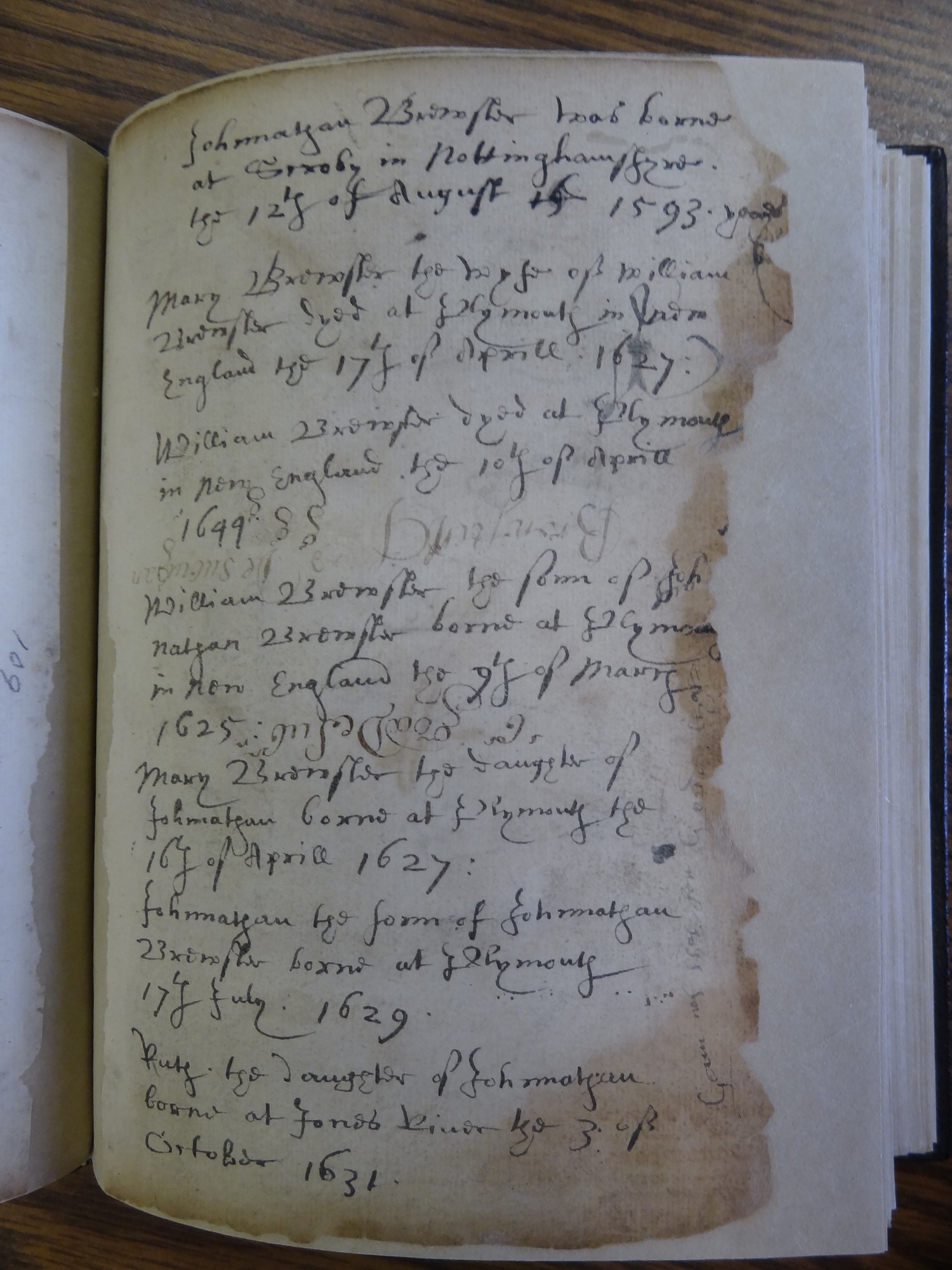
 A page from the "Brewster Book," containing some of the family birth and death records for William and Mary Brewster and their children.
A page from the Brewster family Bible. http://mayflowerhistory.com/brewster-william/


William and Mary Brewster were founding members of the separatist congregation at the heart of the Mayflower voyage. They were in Scrooby until 1608, when they fled with other members of the congregation to Leiden, where William became an elder, teacher, and printer. They were a leading family among those who undertook that first voyage to Plymouth.

William was born around 1566, probably in Scrooby, Nottinghamshire. His father's name was also William Brewster. Mary's maiden name is unknown. They were married by 1593.

William was well educated. He entered Peterhouse, Cambridge, in 1580, although he did not graduate. At the time of his death, an inventory of his estate found nearly 400 books, in English and in Latin, worth 42 pounds.

The Massachusetts colony did not have a formal minister, so William took on many of those duties, including preaching. He continued to do so after the family moved to Duxbury, after Mary's death on April 17, 1627. William died in Duxbury, April 10, 1644. They had six children, one of whom died in infancy. The surviving children were: Jonathan (born in 1593, clearly named before his parents converted), Patience, Fear, Love, and Wrestling. We are descended from his daughter Patience.

William Brewster -- Mary (unknown)
  - Patience Brewster -- Thomas Prence
                 - Mercy Prence -- John Freeman
                     - Edmund Freeman -- Sara Mayo
                         - Ruth Freeman -- Israel Doane
                             - Edmund Doane -- Elizabeth Osborn

                              - Israel Doane -- Desire Nickerson
                                    - Israel Doane -- Mehitable Kinney 
                                        - Olive Doane Kinney -- Simeon Kinney
                                            - Thomas Kinney -- Mary Houghton Kinney
                                                - Julia Kinney Hancock -- Ernest Hancock


References:

Anderson, Robert Charles 1995 The Great Migration Begins: Immigrants to New England 1620-1633. New England Historic Genealogical Society.

Saturday, June 16, 2018

William and Elizabeth Bassett

File:Reverend James Keith Parsonage, West Bridgewater MA.jpg
The Reverend James Keith Parsonage, built in Bridgewater, MA in 1662. It would have been a substantial part of the town where William (and possibly Elizabeth) Bassett lived. Photograph by John Phelan, wikicommons.


I'm continuing my series of ancestors who are documented in Robert Charles Anderson's The Great Migration Begins

There was more than one William Bassett in the Massachusetts colony during the Great Migration. This particular William Bassett was probably born around 1600, based on his marriage age. He and his first wife, Elizabeth, came to the colony in 1621 on the Fortune. While they originally lived in Plymouth, they moved to Duxbury by 1637 and Bridgewater by 1656. William was a blacksmith and a freeman before 1632/3. He must have been educator for his estate included more than twenty books, mostly about theology. 

William served in a number of committees and offices, including on juries and as a constable for Duxbury. He was listed as one of the men allowed to bear arms in 1643. He had an estate of at least 100 acres, and the final inventory of his estate valued more than 123 pounds without the land. More than 9 pounds of that was books, and a substantial amount more were his blacksmiths tools. 

Like, apparently, all inhabitants of the Massachusetts colony, William had occasional run-ins with the law. In his case, he was fined in 1648 for "not mending of guns in seasonable time" and in 1653 for "neglecting to publish and make known an order directed to him from the council of war, prohibiting provisions for being transported out of the colony."

It is unclear when Elizabeth died. She is not mentioned in any documentation after 1627, but William did not remarry until after 1651. Sometime between 1651 and December 12, 1664, he married Mary Tilden Lapham, daughter of Nathaniel Tilden and widow of Thomas Lapham. They did not have children.

William gave an oral will on April 3, 1667, and presumably died soon after.

We are descendants of William and Elizabeth's second son, Nathaniel, born around 1630. He married Dorcas Joyce, the daughter of John Joyce. 

            - William Bassett -- Elizabeth (unknown)
                 - Nathaniel Bassett -- Dorcas Joyce
                     - Hannah Bassett -- Joseph Covell
                         - Sarah Covell -- William Nickerson
                             - Mercy Nickerson -- Heman Kenney
                                  - Isaac Kenney -- Sarah Godfrey
                                      - Mehitable Kenney -- Israel Doane
                                          - Olive Doane -- Simeon Bartlett Kinney
                                             - Thomas Kinney -- Mary Houghton Kinney
                                                 - Julia Kinney Hancock -- Ernest Hancock


References:

Anderson, Robert Charles 1995 The Great Migration Begins: Immigrants to New England 1620-1633. New England Historic Genealogical Society.

Saturday, June 9, 2018

Robert Bartlett and Mary Warren Bartlett

Continuing my series on ancestors who can be found in Anderson's The Great Migration Begins (1995).

Robert Bartlett arrived in Plymouth, Massachusetts Colony, in 1623 on the Anne. He was a wine cooper, a freeman by 1632/3, and probably illiterate, since he signed all deeds with a mark. His origins are unknown, but it is estimated he was born in 1604, based on his date of marriage.

Highlights of his career in Plymouth include being summoned before the court on May 1, 1660, and convicted of "speaking contemptuously of singing of psalms". He also served on various committees, particularly those related to laying out or surveying highways and land. He was on the list of men in Plymouth who were permitted to bear arms in 1643. 

Before 1629, he married Mary Warren, the daughter of his neighbors Richard and Elizabeth Warren. Robert, Mrs. Elizabeth Warren (the mother-in-law) and his brother-in-law Thomas Little appear frequently in documentation pertaining to land and crops in and around Plymouth. He seems to have owned quite a bit of land. He received one acre upon arrival (as did all of Anne's passengers), but subsequent documents mention at least 100 acres of land.

Robert and Mary had eight known children: Benjamin, Rebecca, Mary, Sarah, Joseph, Elizabeth, Lydia, and Mercy. We are descendants of the second son, Joseph, who was born around 1639 and married Hannah Pope, daughter of Thomas Pope.

Robert gave a spoken will on September 19, 1676. In October, the inventory of his estate totaled 170 pounds, 16s, 6d, including 100 pounds in real estate, 2 houses and a barn.

Robert Bartlett -- Mary Warren
     - Joseph Bartlett -- Hannah Pope
          -Robert Bartlett -- Sarah Cooke
               - Lemuel Bartlett -- Mary Doty
                    - Lemuel Bartlett -- Hannah Tinkham
                         - Lydia Bartlett -- Thomas Kinney
                              - Simeon Bartlett Kinney -- Olive Doane
                                   - Thomas Kinney -- Mary Elizabeth Houghton
                                        - Julia Kinney -- Ernest Hancock


References:

Anderson, Robert Charles 1995 The Great Migration Begins: Immigrants to New England 1620-1633. New England Historic Genealogical Society.

Thursday, January 18, 2018

Edward and Rebecca Bangs, times two

I'm continuing my series of ancestors who are documented in Robert Charles Anderson's The Great Migration Begins. The history of Edward and Rebecca Bangs is much less salacious than that of Stephen Bachiler, but they are part of the reason that we are descended from basically everyone who lived on the outer arm of Cape Cod in the 17th and 18th centuries.

Edward Bangs was born in England sometime around 1591. He arrived in Massachusetts in 1623 on the Anne. He would have been about 32 years old. He initially lived in Plymouth where he was given four acres of land, which suggests his household consisted of four people. If the other three people were a wife and children, they must have died fairly early. By 1633, he married Lydia Hicks, who had also come to Massachusetts on the Anne. She was baptized at St. Mary Magdalen in Bermondsey, Surrey, September 6, 1612, so she would have been 21 or younger at the time of their marriage. The couple had one son, John, who was born sometime between 1631 and 1634. Lydia died soon after. By 1635, Edward re-married to Rebecca (her last name is uncertain) and they had nine children together. Rebecca may have been the daughter of Edmund Hobart, but there's no proof.

The Nauset Lighthouse in Eastham, Massachusetts, which is
only 300 years too young for Edward Bangs to have ever
seen it.
Edward and Rebecca Bangs moved to Eastham by 1645. Eastham is on the outer arm of Cape Cod. They owned land
around an area called "Warren's Wells". I have no idea where that would be. Edward was an innkeeper at least part of the time. At other times he is referred to as a "yeoman". In 1657 he was granted permission to sell wine and "strong waters" in Eastham, but only "for the refreshment of the English, and not to be sold to the Indians." In 1664, there is a record of him importing six gallons of liquor for his establishment.

Innkeeper Bangs was clearly an engaged citizens. He held a number of offices, including deputy to Plymouth Court for Eastham, serving on juries, and serving  many committees, including committees to divide land, assess taxes, and reunite Plymouth and Duxbury. He must have been known for his integrity or at least his willingness to serve.

It's not certain when Rebecca died, but she died before Edward because she is not mentioned in his will. Edward Bangs died between October 19, 1677, when he wrote his will, and March 5, 1677/8, the probate date. He was buried in the Eastham Cove Burial Ground, along with a large number of distant relatives.

We're related to Edward and Rebecca Bangs through two of their children. First, we're related through their eldest surviving son, Jonathan, not be be confused with John, who was the son of Edward's first wife, Lydia.

Edward Bangs -- Rebecca (unknown) Bangs
             - Jonathan Bangs -- Mary Mayo Bangs
                 - Mary Bangs Nickerson -- Thomas Nickerson
                     - Thomas Nickerson -- Lydia Covell Nickerson
                         - Desire Nickerson -- Elisha Nickerson
                             - Sarah Nickerson Kinney -- Nathan Kinney III
                                  - Thomas Kinney -- Lydia Bartlett
                                      - Simeon Kinney -- Olive Doane Kinney
                                          - Thomas Kinney -- Mary Houghton Kinney
                                              - Julia Kinney Hancock -- Ernest Hancock


We're also related through Edward and Rebecca's daughter, Hannah Bangs Doane.

Edward Bangs -- Rebecca (unknown) Bangs
             - Hannah Bangs Doane -- John Doane Jr.
                 - Hannah Doane Collins -- John Collins
                     - Martha Collins Godfrey -- Moses Godfrey
                         - Joseph Godfrey -- Mehitable Hamilton Godfrey
                             - Sarah Godfrey Kinney -- Isaac Kinney
                                  - Mehitable Kinney Doane -- Israel Doane
                                      - Olive Doane Kinney -- Simeon Kinney
                                          - Thomas Kinney -- Mary Houghton Kinney
                                              - Julia Kinney Hancock -- Ernest Hancock


References:

Anderson, Robert Charles 1995 The Great Migration Begins: Immigrants to New England 1620-1633. New England Historic Genealogical Society.

Thursday, January 11, 2018

Reverend Stephen Bachiler, a most notable crank

Bachiler coat of arms
Stephen Bachiler is my 13th great-grandfather. He led quite an interesting life.

He was born around 1560 in England and received a B.A. from St. John's college in Oxford in 1585/6. He was married four times, to progressively younger women, but Deborah was a daughter from his first wife, whose name might have been Anne, and who may have been the sister of Reverend John Bate. They were married by 1590 and she died before 1624.

Reverend Bachiler was frequently in trouble. Scandal and discord followed in his wake. He became the vicar of Wherwell, Hampshire, in 1587. He had puritanical leanings (in the theological sense) and was a notable nonconformist. In 1593 the Star Chamber cited him for making "lewd speeches tending seditiously" about Queen Elizabeth and her government. He was removed from his vicarage during a purge of Puritans in 1605, under James I. In 1614, he was once again before the Star Chamber when Reverend George Wighley accused him, his son Stephen, John Bate (who may have been his brother-in-law and/or cousin), of libeling and ridiculing him in verse. In the 1620s, the Bachilers moved to Newton Stacey a village in Hampshire. Somehow he incited his parishioners to act against the sheriff of the parish, who had to petition for aid to the King in Council.

Reverend Bachiler clearly knew other Puritans. Some of his children moved to the Netherlands, presumably to be part of the Puritan community there. In 1621, Adam Winthrop, father of Governor John Winthrop, made note in his journal of dining with Bachiler. Bachiler would have been well aware of the Puritan colony in Massachusetts.  In the 1630s he joined a group of London merchants to form the Plough Company, which sent two shiploads of settlers to New England.

Stephen Bachiler himself arrived in New England in 1632, aboard the William and Francis, the second of the Plough Company's ships. He was already at least 70 years old. His first wife, Anne, was already dead, and he had married twice more. It's not clear who came with him on this voyage, but his youngest daughter with Anne, Theodate Bachiler Hussey, was already in New England with her husband. Reverend Bachiler first settled at Lynn with her and tried to form a new church. However, there was constant unrest within the congregation. Furthermore, he didn't get along any better with the authorities in New England than he had in England. He is believed to have been the only dissenting vote among the ministers against the expulsion of Roger Williams, the founder of Providence. For these reasons, presumably, Bachiler was pushed out of his position as minister in Lynn by 1636.

He may have moved from Lynn to Ipswitch, but in 1637 he moved to Yarmouth. Rather, apparently, he walked there. In winter. Considering he was about 77 at the time, that's pretty impressive. He didn't stay in Yarmouth long. The next year he left for Newbury. Again, he did  not stay long and moved on to Hampton in 1639. Governor Winthrop noted that "Mr. Batchellor had been in three places before, and through his means, as was supposed, the churches fell to such divisions, as no peace could be till he was removed."

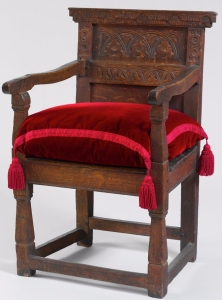
This is the Hussey-Bachiler chair. It is in the Met.
Reverend Bachiler once sat here.
In 1641, Bachiler was pushed out of Hampton when he "did solicit the chastity of his neighbor's
wife." The subsequent scandal kept him from finding employment in other parishes. He moved to Strawberry Bank, which is now Portsmouth. While living there, in 1648, he married Mary Magdalene Bailey, who was some 60 years his junior. Unsurprisingly, the marriage between the 26 year old widow and the 88 year old minister was...rocky. In 1650 they were brought to the Quarterly Court because, essentially, Mary was living with another man. In 1651, when Mary got pregnant despite being estranged from her husband, George Rogers was sentenced to 40 strokes for adultery. His partner, Mary,  "for her adultery shall receive 40 strokes save one at the first town meeting held at Kittery six weeks after the delivery and be branded with the letter A." Some scholars believe Mary Bachiler was the inspiration for Nathaniel Hawthorn's novel, The Scarlet Letter.

Reverend Bachiler returned to England, probably in 1651. He died and was buried in London on October 31, 1656. He was around 96 years of age.

Because some of his children stayed in New England, he counts a number of famous Americans among his descendants. These include Richard Nixon, Jennie Jerome (Winston Churchill's mother), Gerald Ford, H.H. Dow (founder of Dow Chemical), Meghan Markle (soon to marry into the British royal family), Daniel Webster, and John Whittier.

Our relationship to Reverend Bachiler (down to my great-great grandmother):
Stephen Bachiler -- Anne
     - Deborah Bachiler Wing -- John Wing
         - Daniel Wing -- Hannah Swift Wing
             - Lydia Wing Abbot Hamilton -- Thomas? Hamilton
                 - Daniel Hamilton -- Mary Smith
                     - Samuel Hamilton -- Bethia Stewart Hamilton
                         - Mehitable Hamilton Godfrey -- Joseph Godfrey
                             - Sarah Godfrey Kinney -- Isaac Kinney
                                  - Mehitable Kinney Doane -- Israel Doane
                                      - Olive Doane Kinney -- Simeon Kinney
                                          - Thomas Kinney -- Mary Houghton Kinney
                                              - Julia Kinney Hancock -- Ernest Hancock

References:

Anderson, Robert Charles 1995 The Great Migration Begins: Immigrants to New England 1620-1633. New England Historic Genealogical Society.

Stephen Bachiler on Wikipedia

Saturday, September 10, 2016

Harvard Grads

Harvard's oldest surviving building, Massachusetts's Hall
(built long after John Bowers graduated)

While looking for something else, I came across Sibley's Harvard Graduates an 18-volume work detailing the lives all all the early graduates of Harvard University, from its inception (as Harvard College) in 1642. I was fascinated that someone took the time to do such a time-consuming and, frankly, rather useless piece of research, but of course I wanted to know if we had any Harvard grads among our ancestors.

The earliest close relative (although not direct ancestor) I could find was John Bowers, a graduate of Harvard's sixth class, in 1649 (Sibley 1873). He was the son of George and Barbara Bowers of Plymouth (later Cambridge) Massachusetts. After graduation, he moved to Connecticut to take up a parish there. Through the Kinney line, we are descended from George and Barbara Bowers through their daughter -- John's sister -- Ruth Bowers Knowles.

There were several clergymen in our Kinney ancestry, some of whom were likely Harvard graduates, but Sibley's second and third volumes are not readily available on-line, and with classes beginning, I don't have the time to search the other sixteen volumes!
________
Sibley, John Langdon. 1873. Sibley's Harvard Graduates, I. Biographical Sketches of Those Who Attended Harvard College in the Classes 1642-1658. Cambridge University Press, Cambridge.

Thursday, July 21, 2016

Murder on the High Seas, and all that good stuff

In my previous post on the Cape Cod Calvinist Kerfuffle of 1717-1738, I mentioned Kinney ancestor Joseph Doane, famous for capturing nine pirates fleeing the wreck of the Whydah.  

While researching the Doane line, I came across the dramatic story of the schooner Abigail, which illustrates how dangerous shipping could be in the Cape Cod area in the 18th century (1). It's also a reminder that we're descendants from, essentially, the entire county of Barnstable, Massachusetts, which covers the outer hook of Cape Cod. Or, at least, it's 17th and 18th century inhabitants.

The Abigail was owned by Captain Thomas Nickerson of Chatham, in Barnstable county. [He was my first cousin, 8x removed. His father, Thomas, was the brother of Desire Nickerson, which is both her maiden and married name, my 7xgreat-grandmother.] By the late 1700s, the economy in Barnstable county was focused on fishing and shipping. Captain Nickerson used his schooner to transport cargo between Boston and the outer Cape Cod. 

On November 15, 1772, the Abigail was found by Captain Joseph Doane Jr., himself piloting a schooner from Boston to Chatham, with her distress signal flying. [Joseph Doane Jr. was the son of pirate-hunter Joseph Doane, and therefore my 3rd cousin, 7x removed.] When Captain Doane boarded the vessel, he found the deck awash in blood and the cargo smashed open. Three men were dead, clearly murdered: Captain Nickerson himself, his cousin Sparrow Nickerson [also a relative of ours], and his brother-in-law Elisha Newcomb. [As far as I know, Elisha Newcomb was not related to our family, but I can't find his genealogy.]

There was one survivor, Ansel Nickerson. [Presumably, Ansel was also a cousin of mine, since he was a cousin of the captain, but I haven't found his place in the genealogy (2).] Ansel claimed that at 2am that morning, the crew had seen a topsail schooner heading toward them. Fearing he would be impressed into the British Navy, Ansel tied a rope around himself and let himself hang off the stern of the ship. While hanging, he heard four boats of armed men attack the ship, murder his captain, mate, and a crew-member, and carry off the youngest crew member, a boy of 13 named William Kent Jr. The pirates stole what they could, smashed open a barrel of rum and drank it, then argued about whether to burn the Abigail or just leave her to wreck herself. Luckily for Ansel, they decided to leave her.

Captain Doane carried the distraught Ansel Nickerson back to Chatham, but that was not the end of the story. For reasons that are not clear, the local official, Edward Bacon, Esq., was suspicious of Ansel's story. [I don't know if we're related to Edward Bacon. I can't find information about his family, but I don't know of any connections to a Bacon.] It seems unlikely that Ansel could have murdered four men -- for no known motivation -- without sustaining any injuries himself, but he was sent to Boston where he was tried for murder on the high seas and found not guilty when the jury deadlocked. 

The public and the courts were not satisfied, so Ansel was tried again, this time by a special Court of the Vice-Admiralty which charged him with piracy and robbery. He was represented by two Boston lawyers, John Adams and Josiah Quincy Jr., who had, two years earlier, successfully defended the British soldiers accused in the Boston Massacre. (And one of whom, of course, later became the president of the United States.) The trial lasted two weeks. Although Ansel was acquitted, something about his story, character, or evidence must have been extremely suspicious, for John Adams himself wrote in his diary, years later, that he was uncertain of his client's guilt or innocence. Ansel eventually moved to the Caribbean. Many of his neighbors remained convinced of his guilt.

Joseph Doane Jr., who had found the Abigail, went on to serve in the Revolution under Captain (later Colonel) Benjamin Godfrey of the Massachusetts militia [my 1st cousin, 9x removed. His father's brother, Moses Godfrey, was my 8xgreat-grandfather].


References:

1. Nickerson, Joseph A., Jr., and Geraldine D. Nickerson. 2008. Chatham Sea Captains in the Age of Sail. The History Press, p. 25-26. Available on-line here: https://books.google.com/books?id=FXgVBAAAQBAJ&pg=PA91&dq=boston+ship+captains&hl=en&sa=X&ved=0ahUKEwi7orXDq8TMAhVkIcAKHXLKBuYQ6AEIRjAH#v=onepage&q=Nickerson&f=false

2. http://capecodhistory.us/genealogy/Nauset/i2819.htm


Monday, July 4, 2016

4th of July, Genealogy Style

The Declaration of Independence
See the bottom there? Some of our distant relatives signed that.

Fifty-six white men from the Continental Congress signed the Declaration of Independence. Did you ever wonder: who were they, and are we related to any of them? Well, wonder no more. We are not direct descendants of any of the signers, but we have a more distant relationships to at least two:*

Lyman Hall, representative of Georgia. Born in Connecticut, he moved south and lived in South Carolina and Georgia after studying medicine at Yale. His property was burned by the British during the war, and he was accused of high treason. He escaped back to Connecticut, returning to Georgia after the war to serve as governor. He is a third cousin (multiple times removed) from the Kinney line, through our mutual descent from John Walker, one of the early colonizers of Connecticut. Lyman was the great-grandson of John's daughter, Hannah Walker Hall. The Kinneys descended from her sister, Mary Walker Brown Clark.

Robert Treat Paine, representative of Massachusetts. Lawyer, prosecutor (among other jobs, he was assistant prosecutor in the trial of British soldiers for the Boston Massacre), founder of the Academy of Arts and Sciences, Massachusetts attorney general and supreme court judge. He is a third cousin (many times removed) through our common descent from Nicholas Snow and his wife Constance Hopkins, both Mayflower passengers. Robert was the great-grandson of Nicholas's daughter, Mary Snow Paine. Our Kinney line is descended from Nicholas's son, Stephen, named for his mother's father, Stephen Hopkins, another Mayflower passenger.

The 4th of July is also a good day to remind you of the many Revolutionary War soldiers in our family.

______
*Note, as with many people of English ancestry, we have certain "gateway ancestors" who connect us back to medieval times. I am not counting relationships through those gateway ancestors here, only closer connections. Also, I'm relying on wikitree.com relationship finder, which is only as good as the family trees that have been entered into its system. There may be relationships that it is not finding because the trees are not complete. I wouldn't be surprised, for example, if we are relatives of Josiah Bartlett, since we are descendants from one Bartlett family in Massachusetts, but wikitree finds no connection.

Saturday, July 2, 2016

We are not related to Benjamin Franklin

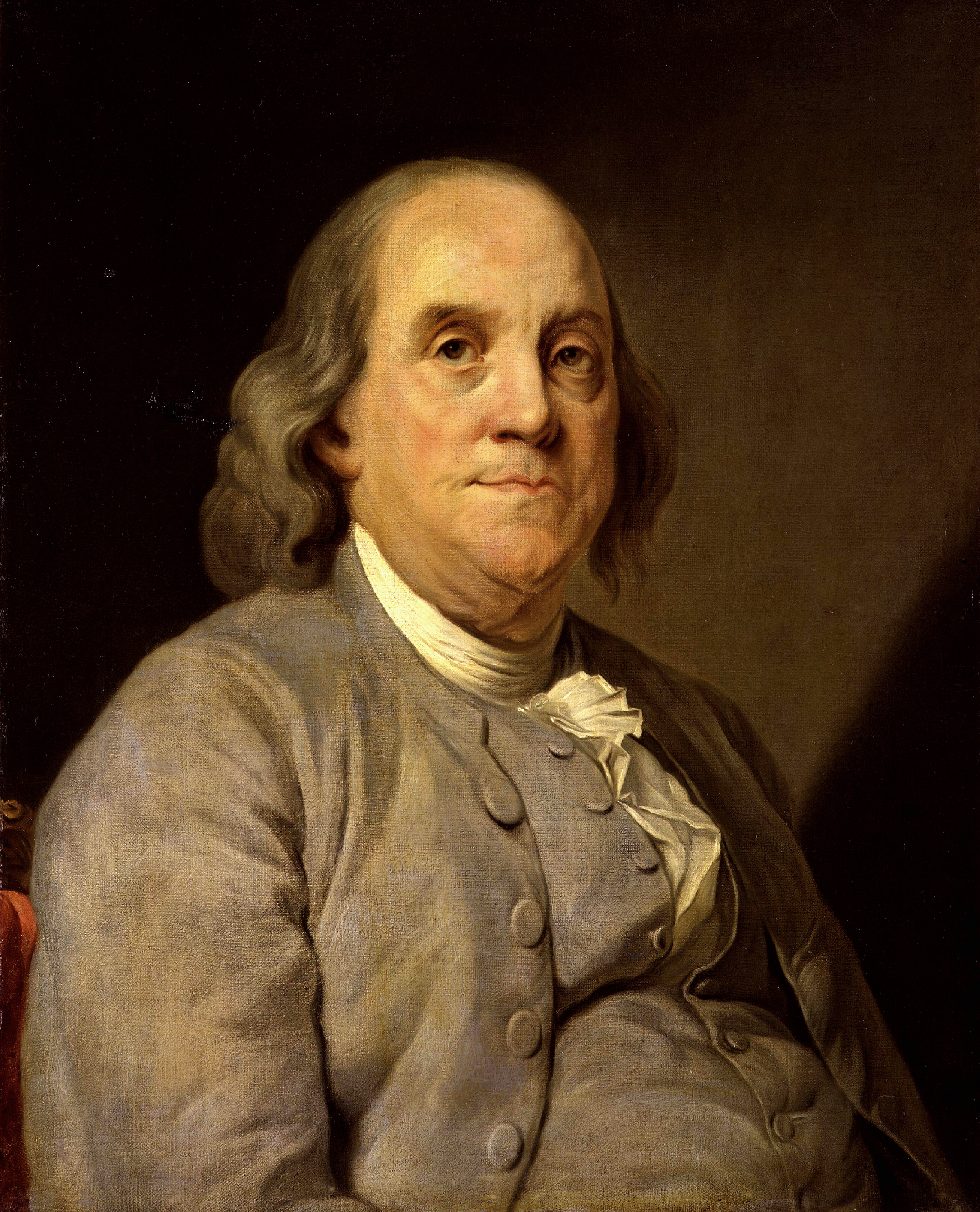
Benjamin Franklin. To whom we are not related.


As the 4th of July draws near, the Founding Fathers are on our minds. We are related, distantly, to some of them, but alas we are not related to my favorite: Benjamin Franklin. We do, however, have a non-family connection (of a sort).

In my post on the Cape Cod Calvinist Kerfuffle of 1717-1738, I mentioned my eight great-grandmother, Jedidah Smith Osborn. Her grandfather and great-grandfather were both named Thomas Mayhew. They were founders and leaders of the European colony on Martha's Vineyard, and they ran a mission school on the island. They were both fluent in the Wapanoag language and their strong relationships with the Wapanoag community (among other things, they required Europeans to pay an honest price for the land they colonized) kept the island from being pulled into King Phillip's War. By the (admittedly quite low) standards of the day, they were respectful and considerate of the indigenous people.

The two Thomases were assisted by Peter Folger (or Foulger). Peter had come to New England in 1635 with his parents, but he was a Baptist and therefore was harder to employ or to integrate into the Puritan society. The Mayhews were more tolerant in this respect, also, than their brethren on the mainland. When Thomas Jr. left for a return trip to England (from which he never returned) he left the mission and school in Peter's hands. Peter later surveyed and then led a European settlement on Nantucket. He married Mary Morrill, with whom he had a number of children, including their second-youngest daughter, Abiah, who married Josiah Franklin and was mother of Benjamin Franklin.

So, although we have no blood relationship with Benjamin Franklin, our families are intertwined, and young Ben no doubt grew up hearing stories about our Mayhew great-grandfathers from his own grandfather.

Thursday, May 5, 2016

Samuel Osborn, the Rebel Reverend, and the Cape Cod Calvinist Kerfuffle of 1717-1738

Gratuitously beautiful Cape Cod sunset

In my last post, I mentioned my interest in the Kinney line. Although my great-great-grandmother, Julia Kinney, was born in Nova Scotia, her family was originally from Massachusetts. While filling out some details of her ancestry, I came across the story of Samuel Osborn, the Rebel Reverend.

Let's be clear: by the strict standards of Puritan New England, it didn't take much to be a rebel. Still, my eighth great-grandfather was at the heart of a 20-year rumpus that I'll call the Cape Cod Calvinist Kerfuffle. The following description of his life comes most from the The Doane Family, written in 1902 by A.A. Doane, and based on the information given by Israel Doane, Samuel's grandson (and my sixth great-grandfather)(1). However, there are a number of other sources on his life, including a pamphlet he wrote stating his own side in the CCC Kerfuffle (2).

Samuel Osborn was born around 1685 in Scotland, although his parents were from Ireland. He was educated in Glasgow, then received an advanced degree from the University of Dublin. He arrived in Boston in 1707 with letters of recommendation from well-established church men in County Down. We don't know what he did to make a living those first few years, but we do know that he courted a young woman by the name of Mercy Norton on Martha's Vineyard because sometime in 1710 or 1711, she had a son she named Samuel Osborn Jr.

Despite modern usage of the word "puritanical", the Puritans were not opposed to sex, even premarital sex. In fact, premarital pregnancy was rather common (as many as 40% of women were pregnant or had children before marriage), and this may have been encouraged as a way of ensuring that a couple was both compatible and fertile. The assumption, though, was that the couple would marry before (or shortly after) the baby was born. Samuel Osborn did not marry Mercy Norton, however, claiming that she had been 'loose' in her behavior and that he had no reason to believe the child was his. It's worth pointing out, however, that a) most illegitimate children were not named after their fathers, if their fathers refused to admit paternity; b) Samuel Osborn was known to have spent time with the boy, because, he claimed, it was a normal, neighborly, totally not-awkward thing to do; and c) there is some evidence that Samuel Jr. came to live with Samuel Sr. and his family when his mother married.

So, yeah, totally not his son.

The Hoxie House, Sandwich, MA
home of Reverend John Smith
On January 1, 1710, presumably (possibly?) after he and Mercy had parted ways, Samuel Osborn married Jedidah Smith, my eighth great-grandmother. Samuel's choice of wife may have been an early sign of his 'radical' religious leanings. Her paternal grandfather, Reverend John Smith, was the minister of Sandwich, Massachusetts, one of the more liberal communities in the region. After attending Quaker meetings and listening to their community concerns, he lobbied for the repeal of colonial laws that prescribed the practice of their religion. The Hoxie House, one of the oldest surviving Cape Cod homes and now a museum, was his residence.

Jedidah's maternal great-grandfather, Reverend Thomas Mayhew, was the leader of the European settlement on Martha's Vineyard. He required all members of the settlement to buy their land properly from the Wampanoag who owned the land, he learned the Wampanoag language, and he set up a school teaching Native youth Greek and Latin. Because the relationship between the Wampanoag and the Martha's Vineyard European settlement was so good, it was one of the few peaceful places in New England during King Phillip's War. Relative to his contemporaries, Thomas Mayhew was practically a saint. In other words, he acted like a decent human being. (Granted, he tried to set himself up as a hereditary aristocrat but, hey, nobody's perfect. Perhaps in restitution, his great-great-grandson coined the phrase "No taxation without representation.")

Governor Thomas Mayhew of Martha's Vineyard
In marrying Jedidah Smith, then, Samuel Osborn was allying himself with a family that had a reputation for tolerance and mercy, admittedly only in comparison to the rather low standards of Puritan New England. The young couple began their life modestly. Samuel was a schoolmaster at Edgartown (near Sandwich) in 1712, in Harwich in 1713, and in Plymouth by 1715 or 1716. In 1717, he was called to serve as minister in the church at Eastham (Orleans), and so began the Cape Cod Calvinist Kerfuffle.

At heart of the Kerfuffle was the personal animosity of Reverend Nathaniel Stone, minister of Harwich (Brewster) since 1700 (3). Stone was not a well-liked man, described by contemporaries as arrogant, self-aggrandizing, and a toady. He was also not above attacking others for his own gain. Let's just say that Cotton Mather -- he of Salem witch trial fame -- described Stone as too quick to stir up trouble, and leave it at that.

Reverend Stone's congregation of Harwich was the nearest neighbor to that of Eastham, and although he had no authority there, he still objected to their new minister. The objections he gave were theological and moral, as well as national -- Irishmen were not well-respected in that time and place -- but one wonders what the personal relationship was between the men. Samuel Osborn had been schoolmaster in Harwich four years earlier, and his wife, Jedidah, was the first cousin once removed of Reverend Stone's wife, Reliance Hinkley.

Reverend Stone arranged for a letter protesting Samuel Osborn's ordination as minister, signed by three men and thirteen women (including Hannah Hobart Doane), and delivered by Hannah Doane's husband, John. (Note: John Doane was my first cousin, many times removed.). Osborn attacked the letter, particularly the implication that women should have any say in the running of the church. With his deacons, John Paine and Joseph Doane, he convinced all but one signer to withdraw their objection. The last, obstinate holdout was Hannah Doane, who having reached the age of fifty and loosing her son at sea, had no f-$!s left to give. She never did back down in her fight against Osborn and was eventually excommunicated for her "ungodly carriage" (i.e. unwillingness to shut up while possessing two X-chromosomes).

Quick genealogical/inbreeding note: Samuel Osborne's deacon, John Paine, was likely a relative of
Honest to goodness gold from an honest to goodness pirate
treasure chest, recovered from the excavations of the Whydah
some sort, since Paine was his mother-in-law's maiden name. His other deacon, Joseph Doane, the cousin of John Doane, was my 8th great-grand-uncle. The Cape Cod Calvinist Kerfuffle was no big deal to Joseph, who was known at the time for capturing nine pirates from the Whydah, the flagship of Captain "Black Sam" Bellamy. The Whydah was rediscovered and excavated in 1984. Both excavations and artifacts can be visited at the Whydah museum in Provincetown, Massachusetts, as can the original jail in Barnstable, where Joseph delivered the pirates.

By the end of 1718, it appeared that the Cape Cod Calvinist Kerfuffle was at an end. Reverend Osborn was permanently fixed in Eastham, and Reverend Stone was chewing his liver in nearby Harwich. But for people who raised their own food, built their own houses, created all their own household items, and bore about ten children each, they had a shocking amount of free time on their hands to snipe at each other. The two congregations spent 20 years competing for members and fighting over theological niceties, before Reverend Osborn was finally ousted by the local "squire" Nathaniel Freeman (yeah, I'm related to him, too, as first cousin ten times removed) and Deacon Joseph Doane, who had switched sides. Maybe he got bored by the lack of pirates in his life and wanted to stir the pot a little.

Samuel Osborn was removed on suspicion of Arminianism, which all Good Calvinists (like the Puritans) considered heretical. I'm not the best person to explain the theological difference here because a) I'm Catholic and I don't understand how any congregationalist religion can accuse someone of heresy when there's no structure to determine what is orthodoxy; and b) I don't care that much. But, basically, as I understand it: Good Calvinists believed in predetermination. In other words, people like Reverend Stone would go to heaven because that was God's will. Whomever God's will turned against was doomed to hell. (You'll be shocked to hear that God's will for individuals bore a strong resemblance to Reverend Stone's personal opinion of them.) Arminianists, on the other hand, allowed some measure of personal responsibility in a person's moral choices. A person could, for instance, reject God's mercy, thereby dooming themselves to hell when they were intended for heaven. That suggested there was no predetermination, which every Good Calvinist knew was a Lie of Satan deserving of Fire and Brimstone.

Samuel Osborn never again ministered to a congregation. He attempted to move to Maine, but Reverend Stone and his allies wrote letters to the congregations there warning of his heretical ideas, and they turned him away. Mercy and tolerance weren't just uncommon in Puritan New England, they were dangerous. Giving up on the ministry entirely, Reverend Osborn opened a school in Boston and taught there until he died in 1774. His reputation was redeemed by later generations, including Henry David Thoreau, who admired his practical, pastoral approach in teaching his parishioners how to dry and store peat for fuel (score one for the Irish!). The last laugh, of course, went to Reverend Osborn when, after Reverend Stone's death, his church became Universalist.


References:

(1) The book is available on-line through Google: https://books.google.com/books?id=qu5EAAAAYAAJ&pg=PA499&lpg=PA499&dq=reverend+samuel+osborn&source=bl&ots=tCxM3hS7TM&sig=3XpRXuMRQQTXmnBYhf3DPqyyd5M&hl=en&sa=X&ved=0ahUKEwjG1KrD4q3MAhWos4MKHcj3B2wQ6AEIKDAC#v=onepage&q=reverend%20samuel%20osborn&f=false

(2) A Church of Christ Vindicated, published in Boston in 1724

(3) Most details of this conflict come from: Paine, Gustavus Swift, 1952, Ungodly Carriages on Cape Cod. The New England Quarterly 25: 181-198 http://people.brandeis.edu/~dkew/David/Swift-Cape_carriages-1952.pdf