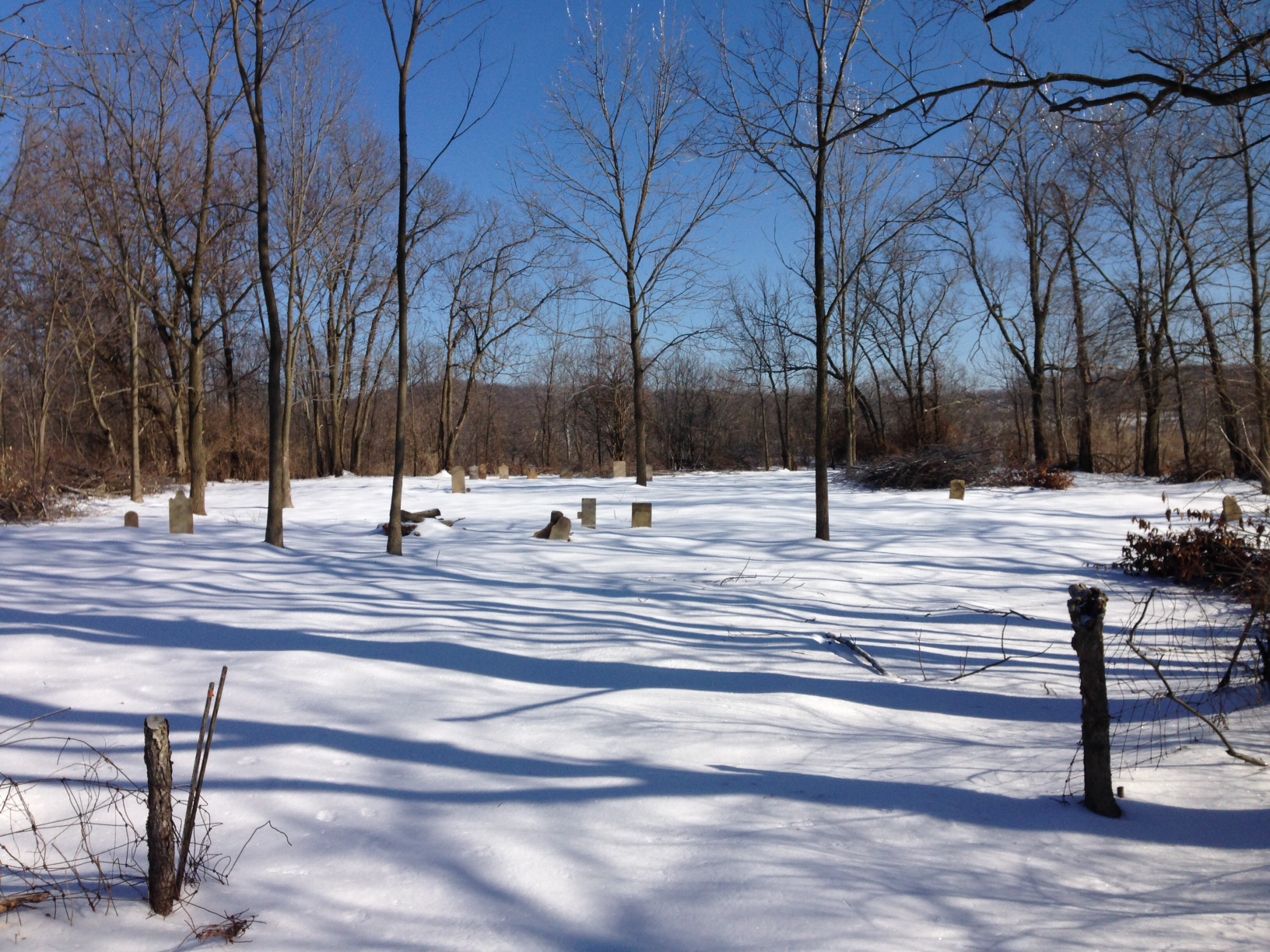
Showing posts with label Pennsylvania. Show all posts

Sunday, July 21, 2019

Deans and the Whiskey Rebellion

I was reading Ron Chernow's biography of Alexander Hamilton when I was struck by his description of the Whiskey Rebellion, specifically, of its epicenter as west-central Pennsylvania. The Whiskey Rebellion took place from 1791-1794, and guess who was living in west-central Pennsylvania at that time? The early Dean family! Specifically, my 6xgreat-grandfather, James Dean, who died around 1795 (his wife was probably already dead by this point), and his son and daughter-in-law, my 5xgreat-grandparents, Abraham and Sarah Stewart Dean.

The Whiskey Rebellion began in the Appalachian area, among the Scotch-Irish small farmers, who were enraged by a whiskey tax that was far more punitive and inconvenient to them than to the larger distilleries of the coast. Many small farmers made whiskey as a more efficient way of transporting their crops for sale across poor roads. The tax was detrimental to one of their primary money-making enterprises and the required inspections were problematic given their dispersed farmsteads and difficult traveling conditions.

The resistance to the tax had its most formal expression on July 27, 1791, when a group of community leaders gathered at Redstone Old Fort in Fayette County and signed a proclamation declaring their grievance. The most prominent politician present was Albert Gallatin, later Thomas Jefferson's secretary of treasury. Among those who signed the statement was one "John Canon", possibly from Washington County.

There is a John Canon (or Canan) who was the son-in-law of James Dean, husband of Abraham's sister, Margary.  Could he have been the signatory? We do know he was a civic leader, according to this biography of his son, also named John, who was a Pennsylvania representative:
John Canan, his father, was born in Ireland in 1746; his mother, Margery Dean, also born there, came to America before the Revolution, and they were married here. John Canan was second lieutenant in the 2d Pennsylvania Regiment in 1777. In 1786 and '87 he was a member of the general assembly from Bedford county. He was also a member of the supreme executive council from 1787 to 1790. Under the constitution of 1790 he was appointed an associate judge and he was again a member of the assembly from Huntingdon county from 1791 to '94, and senator from Huntingdon and Bedford from 1795 to 1799. He owned a large estate in land, and late in life entered the forge and furnace business, being unfortunate in his investment. He died in 1831, at the age of 85 years. Margery Dean Canan died in 1815, when she was 55 years old.
Neither this John Canan or his son were from Washington county, but they were definitely from the area.

I haven't had a lot of time to do genealogy this summer, but I hope to look into this more in the future. Regardless of which side of the Whiskey Rebellion our ancestors supported -- if we ever know -- they definitely lived through the heart of it.

Wednesday, November 29, 2017

Philips. Lots and lots of Philips.

A few weeks ago, I came in contact with a distant cousin, Philip Hodges. We share a great-great grandfather, David Philip Dean. I sent a short email laying out the history of the name "Philip" in our family. I realized I'd never written it up for this blog, so here it is:

The first known Philip in our direct ancestry was Johannes Philip Welsheimer. "Johannes" was his baptismal name. Normally, this name is not used except in legal and religious contexts. So, he would have been known as "Philip". Philip was born around 1730 in Berlin and immigrated to Pennsylvania in 1766. He was one of a surprisingly large number of "Pennsylvania Dutch" to enter that colony in the early to mid 1700's. This article discusses some of the legal and practical barriers that were put in place to ensure the new Germany-speaking settlers wouldn't change the essentially English character of the colony. Whatever his reasons for emigrating, he was dedicated to his new country and eventually served in the Revolutionary War as a gunsmith. 

His son, also named Philip, immigrated to the U.S. with his father. He was born in 1757 in Berlin, which made him 9 at the time of immigration. He may have been the only family member to come with Philip I, or he may have had a brother named Frederick. It's also possible that a wife or daughters were present but not considered important enough to record. Philip II was a stocking weaver. His original apprenticeship papers have been preserved. They were drawn up between his father and a stocking maker named Adam Edleman in Lancaster County, Pennsylvania, in 1770. The name Edleman suggests that the Welsheimers were part of the German-American community in Pennsylvania and may have preferred to make important deals, like apprenticeships, with fellow Germans. Philip II eventually married a woman named Catherine Hull whose ancestry I have not been able to trace but may have been a member of the Hull/Holl family, a Germany Dutch family involved in cloth manufacturing. Regardless of his feelings about his fellow Germany immigrants, he, too, served in the Revolutionary War, in the 3rd Battalion of the York County Militia. 

Philip II was quite successful and bought a good deal of land in Pennsylvania, Maryland, and West Virginia. In July of 1811, he left home in Cumberland township, Pennsylvania, to walk to the coast where he planned to find a ship headed back to Germany. He wished to buy high-quality looms there that he could not purchase in the United States. However, he died of (apparently) natural causes en route to the ship. His body was found weeks later on the road. 

Philip Welsheimer III was the son of the stocking weaver. He was born in 1791 in what is now West Virginia. He grew up there, was a successful farmer, and married Catharine Duley. Their family Bible was the subject of a previous post on this blog. He moved his family from West Virginia/West Pennsylvania to South Salem, Ohio in the 1830s. He died there in 1864. South Salem is where the Dean family was living, as well. Philip's daughter, Anna, married Abram Dean. In 1847, Abram and Anna Welsheimer Dean moved to Des Moines, Iowa. Their youngest son was born there. He was named David Philip Dean, in honor of his grandfather. 

David Philip was the last common ancestor I shared with Philip Hodges. However, the name lives on in both lines, clearly. I'm descended from David Philip's son, Carl Philip Dean, and then Carl's son Philip Carlyle Dean. Both my father and brother are Philips. Except for Anna, who passed the name into the Dean family, we have an unbroken line of Philips back to the 1730s!

Sunday, April 3, 2016

Other Deans of Pennsylvania

I wrote an earlier blog post about Abraham Dean, his (probable) father, James, and the many Deans of central Pennsylvania in the mid-1700s. I laid out in that blog post my evidence for a connection between James and Abraham Dean of the area near Alexandria, Pennsylvania, and Margery Dean Canan, wife of John Canan.

There are other Deans in the same area at that time, some of whom may be relatives and others who may have been wholly unconnected. Evidence for these relationships tend to be more tentative, but I lay it out below. As with the previous post, this one is aimed at the two or three people in the world who actually care about the details of this topic. And, as with the previous post, most of this information comes from the research by Larry Dean, with a few items of my own thrown in.

The Connection Between Abraham and Robert Dean

Abraham is listed in the U.S. Direct Tax Lists for Huntingdon and Somerset Counties, Pennsylvania, in 1798. Abraham is listed as Occupant #14, in Baree Township, "on head waters of Shavers and Stone Creek". Occupant #15 is Robert Dean, with the exact same location information. Occupant #16 is James Dean, also located in the same area. No other families are listed with that location. James, and I already discussed, was Abraham's father. However, this James seems likely to be his brother, since James Sr.'s death was recorded in the Canan family bible in 1795. Robert is another likely brother.

The Connection Between Abraham and William Dean

William Dean was the only other Dean whose name was directly connected to Abraham's in the primary literature. Abraham was appointed the administrator of William Dean's estate in Pitt Township, Allegheny County, on April 21, 1789, after William died without a will. Abraham's co-administrator was Jane Dean, William's wife (1). Allegheny County is significantly farther west than Huntingdon, where James and Abraham lived.

Larry Dean's post covers this case in detail, and includes an email from the local Genealogy Society which claims that the Abraham Dean who administrated William Dean's estate was the son of William and Jane Dean. However, there are no other Abraham Deans who appear in the 1790 census, other than the one in Huntingdon County (2) (well, there is the one in Maine, but that seems a stretch). If William Dean had a son named Abraham, then he was not the head of his household in 1790, yet the fact that he was administering William Dean's will suggests he was of age. So, assuming the Abraham who administered William Dean's will is the same Abraham who is our direct ancestor, what relationship did Abraham have with William and Jane Dean?

The previous blog post includes the evidence that Abraham was James's son, not William's. The genealogy that was cited in Larry's post included no sources to collaborate the suggested relationships or the dates, but it claimed that William was born in 1735 and had received land in Pitt Township for his service in the Revolutionary War. The war ended in 1783, so William could have been elsewhere in Pennsylvania before that time. 

In the mid-1770s, multiple Deans appear in Hopewell Township of what was then Bedford County. At that time, what is now Huntingdon County was part of Bedford County, and Hopewell Township was created in 1773 from Barree (about 10 miles north of Alexandria, PA) (3). James Dean paid taxes on 300 acres in Hopewell township in 1779. A William and a John Dean paid taxes there in 1775, 1776, and 1779 (4). In 1784, there was a William Dean listed as an inhabitant of Huntingdon, where James Dean was also living. (Abraham was not listed, but he may not have bought his land until later that year.)  William's household consisted of 7 white persons (4). In other words, IF this is the same William Dean, then James, William, and Abraham Dean lived in the same area in the 1770s and early 1780s, after which William and his wife Jane moved farther west when they were granted land in Pitt Township. William appears to be in the same generation as James, as far as we can tell from the land records. Certainly, he is at least ten years older than Abraham, as he begins buying land and paying taxes in 1775. 

It is possible, then, that William was the father of Abraham. We cannot disprove this on the basis of the primary documents. However, the secondary evidence more strongly suggests James is Abraham's father, and Abraham never named any of his children William or Jane (see my previous post for discussion of Scotch-Irish naming practices). My suspicion - which I am unable to prove - is that William was Abraham's uncle, a brother of James. Abraham, as a relatively young and fit man (compared to, say, his father, who was around 50 at a time when life expectancy was much lower), was sent to his Aunt Jane's side when his uncle died unexpectedly, and helped her set the estate in order.

However, just to make things more complicated, the William Dean who died in Allegheny County may not have been the same William Dean who lived in Huntingdon! Larry Dean makes a good case that that William Dean, in fact, moved to Kentucky. Which, if either, or these Williams were related to our line remains frustratingly uncertain.


The Connection between Abraham Dean and Matthew and John Dean

And finally, I descend far into the realms of speculation. 

Matthew Dean and his son John lived in in Frankstown Township in what was then Bedford County. This area was later divided into Bedford and Baree Townships (which we've heard of before) and is located in Blair County, just southwest of Alexandria, PA (3). Their lives are fairly well documented because much of their family was killed in a border raid by Native people who were angry at the incursion of white settlers onto their land (4, 5, 6, 7). Matthew, his oldest son John, and his three oldest daughters (Margaret, Rebecca, and Elizabeth) were in the fields and missed the attack on his farmstead/fort that killed Matthew's wife Rebecca and their five other children. 

There is only circumstantial evidence that Matthew and John Dean are related to James and Abraham Dean:

  1. Matthew and James Dean lived very close to the area where James and Abraham lived, and at the same times. Matthew is first listed on the tax roles for Frankstown Township in 1776, and lived there until he died in 1781 (8).
  2. In his will, Matthew Dean named John Canan as executor. John Canan was James Dean's son-in-law (he had married James Dean's daughter, Margery) (9).
  3. John Dean (son of Matthew), James Dean, and John Canan were all founding members of Hart's Log Presbyterian church (5).
  4. According to secondary sources, Matthew and James Dean came to the United States around the same time. Matthew Dean's great-grandson said that “Matthew Dean came to Pennsylvania about the year 1760 from Ireland.” (7). As discussed in my previous post, James Dean's great-grandson claimed he, too, had come from Ireland in 1760.
  5. A number of family names are shared in common, although unfortunately they are also very common names from the period, so the fact that both families have Margaret/Margery or Elizabeth, John, etc., is not very convincing.
My suspicion - again, not provable - is that Matthew and James Dean were brothers. William may have been another brother. 

If this is true, then one other intriguing piece of information may help clarify the Dean families of Pennsylvania: John Dean listed his birth city as York, PA, in his Revolutionary War pension file (10). If Matthew and James (and William?) Dean arrived in Pennsylvania in 1760, but they are first found on the tax rolls in the mid-1770s, what were they doing between those dates? Of course, they may have been working as laborers, and therefore not showing up in the records until they had saved enough to become men of property. But John's birthdate of 1763 in York suggests they spent some time there. York is south-southeast of Harrisburg, The Clerk of Courts Quarterly for York County record an Elizabeth and a Hans Dean living in the town in October of 1768, when they were brought in for a court case (I believe they were witnesses) (11). Elizabeth Dean was also tried for stealing in York in July of 1775. Obviously, Dean is a rather common name, but it's possible that these Deans were somehow related to the (three?) Dean brothers who arrived in Pennsylvania from Ireland in 1760.


References:

1)  American Revolutionary Soldiers of Franklin county, Pennsylvania compiled by Virginia Shannon Fendrick, published 1969 by the Historical Works Committee of the Franklin County Chapter of the Daughters of the American Revolution.
2) "United States Census, 1790," database with images, FamilySearch (https://familysearch.org/ark:/61903/1:1:XHKJ-8MR : accessed 17 July 2015), James Dean, Huntingdon, Pennsylvania, United States; citing p. , NARA microfilm publication , (Washington D.C.: National Archives and Records Administration, n.d.), roll ; FHL microfilm .
3)  http://www.pa-roots.com/bedford/history/originoftownships.html
4) History of the Early Settlement of the Juniata Valley by U. J. Jones, published by Floyd G. Hoenstine, Holidaysburg, Pennsylvania
5) History of Huntingdon County, Pennsylvania Volume I, by J. Simpson Africa, published by Louis H. Everts 1883 at Philadelphia, Pennsylvania
6) History of Blair County, Pennsylvania Volume II, by J. Simpson Africa, published by Louis H. Everts 1883 at Philadelphia, Pennsylvania
7) A History of Blair County by Tarring S. Davis, published 1931
8) The Pennsylvania Archives Third Series, Vol. 22, p. 121, 200, 267, 297
9) Ancestry.com. Pennsylvania, Wills and Probate Records, 1683-1993 [database on-line]. Provo, UT, USA: Ancestry.com Operations, Inc., 2015.
10)  Genealogical Abstracts of Revolutionary War Pension Files by Virgil D. White, pub 1990, National Historical Publishing Company
11) http://www.yorkcountyarchives.org/search.asp

Thursday, February 11, 2016

James Dean. No, not the cool one.

In Deans in a Nutshell, I summarized the straight patronymic line of Deans from central Pennsylvania in the mid-1700s down to my great-grandfather. The post was a bit misleading, though, in the tone of certainty with which I discussed James Dean, the founder of our line in the Americas.

The truth is, while we have lots of documentary evidence tracing the Dean line from the present day back to Abraham Dean (1763-1806), our knowledge of his father is sketchy. I was inspired by the impressive genealogical work of Larry Dean (probably not a relation, but who knows!) to combine his knowledge of 18th century Pennsylvania Deans - laid out in this on-line essay - with the few bits of information I have gleaned from other sources, to try and clarify our relationship to the various Deans who were running around the Appalachians at the time.


I started my search with one assumption: while the name James is frustratingly common, the name Abraham is more unique. Therefore, any Abraham Dean on record in central Pennsylvania in the late 18th century was - in all likelihood - "our" Abraham Dean. I then worked back from known records of Abraham to try and identify his father and other relatives.


First, some facts about Abraham Dean:


Abraham Dean's Tombstone
In the Dean Cemetery in South Salem, Ross County, Ohio
Abraham Dean was born around 1763; his tombstone says he was 43 in 1806. We know this tombstone belongs to "our" Abraham Dean because he was buried next to Hannah Baird Dean (his daughter-in-law) and James Harvey Dean (his grandson).

Abraham died in South Salem, Ross County, Ohio. However, there are multiple secondary sources that tell us Abraham originally came from Pennsylvania. For example, a book on the history of Polk County, Iowa, published in 1890, wrote of Abraham's son, "John Stuart Dean, deceased, was born in Lancaster County, Pa, August 9, 1797, and closed a busy and useful life, December 21, 1872." (1)


Today Lancaster County, PA, is southeast of Harrisburg. However, in 1797, it was a much larger area. Primary documents suggest Abraham settled near modern-day Alexandria, PA, which is in Huntingdon County. Huntingdon County was created from Bedford County in 1787. Bedford County was created from Cumberland County in 1771. And Cumberland County was created out of Lancaster County in 1750. Either John was born farther east than his father later settled, or the shifting county lines hadn't been remembered twenty years and two states after his death.


Primary documentation confirms the family lived in Pennsylvania before moving to Ohio around 1800. These documents include:

  1. Abraham's children's birthplaces, listed in their census records. In 1850, for example, James Stewart Dean, John's older brother, stated he was born in Pennsylvania(2).
  2. The name Abraham Dean is found only twice in the 1790 census. One of those Abraham Deans is in Huntingdon County, Pennsylvania. The other is in Maine. (3) 
  3. An Abraham Dean was issued a land warrant on September 2, 1784, for an area in Franklin Township, north of the Little Juniata River (near modern-day Alexandria, PA). This purchase would have been made when he was 21, just as he was coming of age (4)
  4. In 1788, Huntingdon County's tax records show Abraham Dean paid  £10 on 2 horses and 1 head of cattle (5)
  5. In June of 1789, Abraham Dean served as a juror at a Court of General Quarter Sessions of the Peace held at Huntingdon(6). 
  6.  In 1798, the United States Direct Tax in Huntingdon County listed Abraham Dean as the owner of 395 acres at the headwaters of Shavers and Standing Stone Creeks (about 10-15 miles NE of Alexandria, PA). Two other Deans are listed as living at those same headwaters, and there are no other families there. Those Deans are James and Robert.

Secondary sources back up the primary sources. In a history of central Pennsylvania, I found this quote: "Continuing down the creek [Spruce Creek, which is north of Alexandria] we find next Abraham Dean's tract at the Great Falls, called Mexico, the warrant for which was issued Sept. 2, 1784. From this tract to near the mouth of the creek, which was then called the East Branch of the Little Juniata, the best land had been taken up by speculators in 1766."(8)

So Abraham Dean was in central Pennsylvania, near modern-day Alexandria, in the late 1700s. But who was his father? Who were his other family members? There were a number of Deans living in that area, were they all kin?


Abraham's name is directly linked in the primary sources to only two individuals: James Dean and William Dean.


The Connection Between Abraham and James Dean


Abraham and James Dean were listed next to each other in the 1790 census (3), suggesting they were neighbors. Unfortunately, that first census only listed the name of the head of household and ages/sexes of other household members. So, all we know about James Dean is that his household consisted of 3 boys younger than 16, 1 man older than 16 (himself) and 4 women/girls. Abraham's household, at the same time, consisted of one boy younger than 16, two men older than 16, and two women/girls. Abraham's surviving children were all born after 1790 - he may not have been married yet in 1790 - so it is not clear who the other members of his household were.


James Dean appears on the tax records of what is now Huntingdon County much earlier than Abraham Dean. Abraham bought his land in 1784, but James is first listed as paying taxes in Barree Township in 1774, as well as in 1775, 1776, and 1779 (5). Barree Township in Huntingdon County is about 10 miles NE of Alexandria, PA. James, then, is older than Abraham. We can assume there is some family relationship, since they owned land close together, but is James Abraham's father? An older brother? We cannot tell for certain on the basis of the primary sources alone, but secondary sources and family naming patterns suggest that James was Abraham's father.


First, a note about naming conventions: Scotch-Irish families frequently followed a standard naming tradition, in which the first-born son was named for his paternal grandfather, the second-born for his maternal grandfather, and the third for his father. The next sons, if there were any, were often named for a paternal uncle, then a maternal uncle, etc., etc. Daughters followed a similar convention: the first-born daughter was named for her maternal grandmother, the next for her paternal grandmother, and the third for her mother. Maternal and paternal aunts' names could follow (9).


Not everyone followed these rules to the letter, but Abraham's first-born son was named James, and therefore that was likely Abraham's father's name, as well.


We also have significant evidence that James Dean was the father of Margery Dean Canan. Margery Dean Canan married Col. John Canan, who later became a prominent Pennsylvanian businessman and politician. Because Canan was well-known, his life was somewhat better documented than other citizens of that time and place. Therefore, we know that he was married in 1775, meaning Margery had to have been born at or before 1760, at the latest.  Since Abraham was born in 1763, this makes Margery the correct age to be his sister.


The James Dean who was Margery Dean Canan's father was clearly the same James Dean who lived in Huntingdon County in the last quarter of the 1700s. The primary evidence connecting John Canan and James Dean is as follows:


1. As I mentioned in a previous blog post, the 1784 journal of James Harris, surveyor, mentions drinking cider "with Mr. Canan at Mr. Mitchell's and Mr. Dean's his father-in-law." In the same journal entry, he mentions his assistant taking a horse to Warrior's Mark that evening. Warrior's Mark is less than ten miles NE of Alexandria, PA. A William Mitchell, possibly the Mr. Mitchell of the journal entry, is listed in the 1790 census on the page before James and Abraham Dean (3).
2. Larry Dean records a Canan family bible that listed a number of deaths, including those of John and Margery Canan. Only one Dean was mentioned in that bible: James Dean, who died in November of 1795. 

Secondary sources and naming conventions support the contention that James Dean was the father of Margery Dean Canan. A biography of their grandson, S. Dean Canan, published in 1907 stated that  "He [John Canan] married, in 1775, Margery Dean, born 1760, died 1815, daughter of James and Catherine Dean, both natives of Ireland, and married after their arrival in America." (10). John and Margery named their second son James (as would be expected for a second son who was named after his maternal grandfather), and their first daughter Catherine (again, as expected, if that was the name of Margery's mother.)

If James Dean is Margery Dean Canan's father, then the ages of James, Margery, and Abraham suggest that James was the father of Margery and Abraham. There is some support for this in the names Abraham gave his children. His two oldest children are James and Catherine, and his third daughter was named Margery.


I mentioned before that Abraham's name is linked in primary documents with a man named William Dean. There were a number of Dean men documented in Central Pennsylvania in the late 1700s, but there's so much material to cover, those relationships will have to wait for another post.

References:

(1) "Portrait and Biographical Album of Polk County, Iowa", 1890, p. 428, (https://archive.org/stream/portraitbiograph08chic#page/428/mode/2up)] 


(2). United States Census, 1850," index and images, FamilySearch (https://familysearch.org/ark:/61903/1:1:MX7S-R6B : accessed 1 June 2015), James Dean, Buckskin, Ross, Ohio, United States; citing family 2812, NARA microfilm publication M432 (Washington, D.C.: National Archives and Records Administration, n.d.).

(3) "United States Census, 1790," database with images, FamilySearch (https://familysearch.org/ark:/61903/1:1:XHKJ-8MR : accessed 17 July 2015), James Dean, Huntingdon, Pennsylvania, United States; citing p. , NARA microfilm publication , (Washington D.C.: National Archives and Records Administration, n.d.), roll ; FHL microfilm .

(4) History of the Early Settlement of the Juniata Valley by U. J. Jones, published by Floyd G. Hoenstine, Holidaysburg, Pennsylvania

(5) The Pennsylvania Archives Third Series, Vol. 22

(6) Source: Extracts from Court Quarter Sessions, 1789-1795, Huntingdon County, PA,http://files.usgwarchives.net/pa/huntingdon/othcourt/1789-1795-court.txt

(8) "History of Huntingdon and Blair Counties, Pennsylvania", by J. Simpson Africa, p. 329, 


(9) http://www.johnbrobb.com/Content/TheScottishOnomasticPattern.pdf


(10) "History of Cambria County Pennsylvania, volume 3", by Henry Wilson Storey, p.64

(11) Allegheny Co., PA will book #1, page 10, FHL #0858898

Wednesday, September 9, 2015

The Deans in a Nutshell

I've been going back through the WikiTree pages and filling in the siblings and their first-generation children for every one of my direct ancestors. I've finished the Deans (that is, the straight patronymic line, not including all of the wives who married in), so this seems a good time to summarize the Deans in America.*

The Deans were Scotch-Irish, an ethnic/religious group mostly from northern England and southern Scotland. They were Protestant dissenters, strong Calvinists, who were first settled in Ulster in the 1500s (because they were causing too much trouble as border raiders in England), and later encouraged or forced to migrate to the American colonies, particularly in the 1700s. Over 300,000 Scotch-Irish migrated from Ulster to the Americas between 1710 and 1810, mostly to Pennsylvania, which had the most welcoming religious laws, or south along the Appalachian mountains, particularly into the Carolinas.

James Dean (about 1740-?) and Catherine Gamble (about 1740-?): These were the first Deans in the Americas. They were both born in Ireland, almost certainly in Ulster, and settled in Pennsylvania. They were married after their arrival in the Americas, which suggests that Catherine's parents and siblings could also be somewhere in Pennsylvania, although I haven't found them. They arrived sometime before 1760, since that was the year their first child, Margary, was born. In History of Huntingdon and Blair Counties, Pennsylvania, by J. Simpson Africa (p. 329), James is listed under the pioneers of Oneida Township, with his son, Abraham. This is an area of central Pennsylvania that was badly hit during the Seven Years War (aka French and Indian War). In the generation before, it had been largely cleared of people, Native and European alike. When the war ended, the Scotch-Irish were particularly prevalent among the new settlers. The same source says James was a member of the first board of elders elected by the congregation of Hart's Log Church, Sept. 10, 1787. He and Catherine may very well have settled elsewhere in Pennsylvania earlier, but there is no record of them before their arrival in Oneida Township. His farm was located near what is today Alexandria, Pennsylvania.

Old Hartslog Church
We only have records of two children, Margary and Abraham (see below). Margary married Colonel John Canan, who was also Scotch-Irish, and stayed near her parents in Pennsylvania. I blogged about the Canan family previously. John Canan was a Revolutionary War soldier and served in the General Assembly and as state senator for Pennsylvania. He developed coal and iron deposits, building one of the first furnaces in the region. Small families were very rare at this time, although childhood mortality was high. It is possible/likely that there were other children born to James and Catherine, but we have no record of them.

Tombstone of Abraham Dean, Ross County, Ohio
photograph by Scott
http://www.findagrave.com/cgi-bin/fg.cgi?page=mr&MRid=47082416
Abraham Dean (1763-1806) and Sarah Stewart (1766-1837): Abraham and Sarah were both born in Pennsylvania to Scotch-Irish families. He served as a private 3rd class in the 7th company, 1st battalion, of the Cumberland County Militia during the Revolutionary War (1). In 1784 he bought land north of present-day Alexandria, Pennsylvania, and named the tract "Mexico" (2). He and Sarah were married sometime around 1790. By 1811, however, they had moved their family to South Salem, in Ross County, Ohio. Ohio had been Shawnee and Lenape land (along with other tribes), and under military occupation by the French until the Revolutionary War. Freed from restraint by the British government, the new United States started pushing westward soon after independence. The first major Euro-American colony in Ohio was at Marietta in 1788, with statehood following in 1803 (after decades of war to enforce Euro-American rule). The Deans entered an Ohio that was only recently conquered and sparsely inhabited by Euro-Americans.

At least one of Sarah Stewart's sisters, Margaret Stewart Brown, and her family, also moved to South Salem. More of her siblings may have joined them. As I mentioned in a previous post, this type of clan migration was common. Abraham and Sarah had eight children who scattered throughout the Midwest. Their fifth child (and second son) was John Stewart Dean.

John Stewart Dean (1792-1872) and Hannah Baird (1800-1828): John was born in Lancaster County, Pennsylvania. He was a child when his family moved to Ohio. Hannah was probably born in Lincoln County, North Carolina, near King's Mountain, where her father fought during the Revolutionary War (3). In fact, he was one of the original signers of the Tryon Resolves, an early declaration of resistance to British rule. The Bairds were another Scotch-Irish family that had originally been from Pennsylvania. The Bairds moved into Ohio in the early 1800s, partly because of their opposition to slavery, Many Bairds were participants in abolitionist activities.

Hannah and John were married in Brown County, Ohio, in 1819. Hannah's older brother, John Hill Baird, was a good friend of John Stewart Dean. They served together during the war of 1812 (3). After returning to their homes (they had to walk across Ohio after being discharged), John Hill Baird married the eldest Dean sister, Catharine, and John Stewart Dean married his friend's sister, Hannah. Hannah and John had three children, the oldest of whom was Abram Stewart Dean. Unfortunately, Hannah died quite young and was buried in the Dean cemetery in South Salem, Ohio. John went on to marry twice more.

In 1847, John led a group of five families (mostly his relatives) from South Salem to Polk County, Iowa(4). They were among the first families to settle in the area. The U.S. Army had built a fort on the Des Moines River in 1843. (Fun fact, the fort was originally going to be called Fort Raccoon, after the other river that joins the Des Moines at that point. Only by the grace of the War Department was Iowa saved from having Raccoon as its state capital.) The fort was there to control the Sauk and Meskwaki tribes, who had been forcibly resettled there from eastern Iowa. It wasn't long, however, before the army moved the tribes farther west, and in 1846 the fort was abandoned as Native people were denied land rights in Iowa. The city was opened to settlement as the seat of Polk County in May of 1846, and the Deans arrived in November of 1847.

Walnut Street Bridge, Des Moines, Iowa, 1866
On the far side of the bridge was the site of the original
Dean household in Iowa.
The John Stewart Dean became a leading man in Des Moines (4). He was known as "Uncle Johnny" throughout the area. He and his family settled on the east side of the river, and were founders of the Presbyterian church, which met for the first time in his home. He was instrumental in getting the state capital located in east Des Moines, donating some of his land to the project. To this day, the state capital sits at the end of Dean Street, just to the west of Dean Lake. The Dean's original homestead was in downtown Des Moines, along the river. In 1851 a massive flood destroyed much of the area. The Deans resettled a few miles east, closer to where John's son, Abram, had placed his farm.

Abram Stuart Dean (1820-1859) and Anne Retta Welsheimer (1819-1905): Abram was born in Ohio, where he met and married Anne Welsheimer. Anne was a first in the direct Dean line: a wife who was not primarily of Scotch-Irish stock. In fact, her mother was probably Scotch-Irish (there's very little known about her), but her father was German (5). The Welsheimers had settled in Pennsylvania in the 1760's. They came from Berlin, probably for religious reasons (they were Calvinists). Anne's grandfather and great-grandfather had fought in the Revolutionary War, then her father had moved westward into Ohio.

The Dean plot in Sims cemetery, Des Moines
Abram and Anne had five known children, three born while they still lived in Ohio. They were about 27 when they moved to Des Moines. They spent the first winter in an old barracks, then built a log cabin on the north shore of Dean Lake (6). Their last two children were born there. Like his father, Abram was a devout Presbyterian and founding member of the church in Des Moines. Unfortunately, he only lived about a decade after their move to Iowa. He was 39 when he died in 1859. He lived long enough to see the city incorporated in 1851, and the capital moved to part of the land he donated in 1857. Anne never remarried. They and many of their children are buried in Sims Cemetery in Des Moines.

David Philip Dean (1852-1941) and Sarah Jane "Jennie" Brattain (1855-1919): David was the youngest child of Abram and Anne, born after their move to Des Moines. His father died just before his 7th birthday. Luckily, he had an extensive network of cousins, aunts, uncles, and grandparents in Iowa. I wonder if that is what turned him into such an avid genealogist.

The Brattains deserve their own blog post, but, briefly, they were another Scotch-Irish family. The Brattains, like the Deans, had married into Protestant German families. Jennie Brattain was born and raised in Henry County, Indiana, then married David in Des Moines, Iowa in 1876. I don't know how she met David. Jennie's father, Hiram, had spent time in Iowa as a child. In the 1850 census, he was living with his family in Van Buren County. Perhaps the families had met then, but Van Buren is not very close to Des Moines. My guess is that David was working in Indiana and met Jennie there.

However they met, their marriage was very successful. They had fourteen children, nine of whom survived past early childhood. Sometime between 1910 and 1919, the family moved to Coupeville, Washington, where they stayed until the current generation. Honestly, I have no idea why they moved there. One of the things I've learned from genealogy is that, in some ways, I know more about my distant ancestors than my more recent ones. David, his children, and his grandchildren were so busy discovering the Deans of the distant past that they didn't always document the Deans of the 20th century. Either that, or the documentation was gathered by my great aunt, Lillian Dean Huffstetler (David's granddaughter) whose materials I have not yet had a chance to see.

References:

1. American Revolutionary Soldiers of Franklin County Pennsylvania, by Virginia Shannon Fendrick, p. 59

2. History of Huntingdon and Blair Counties, Pennsylvania, by J. Simpson Africa, p. 329

3.  "Wilson-Baird History" by Fran C. Shepherd, 1942 (exerpt on page2 here: http://baird-bard-beard.org/BB/downloads/Volume5-March1995.pdf):

4. From "Portrait and Biographical Album of Polk County, Iowa", 1890, p. 428, (https://archive.org/stream/portraitbiograph08chic#page/428/mode/2up)

5. "A History of the Welsheimer Family", by Edith Welsheimer, Bronson Printing, Las Cruces, New Mexico, 1969.https://dcms.lds.org/delivery/DeliveryManagerServlet?dps_pid=IE97573

6. Portrait and biographical album of Polk County, Iowa, Lake City Publishing Co., Chicago, 1890

_____
*I can't summarize the Deans before America because I have nothing in the way of records prior to their arrival here.

Thursday, June 11, 2015

Clan, Community, and Migration


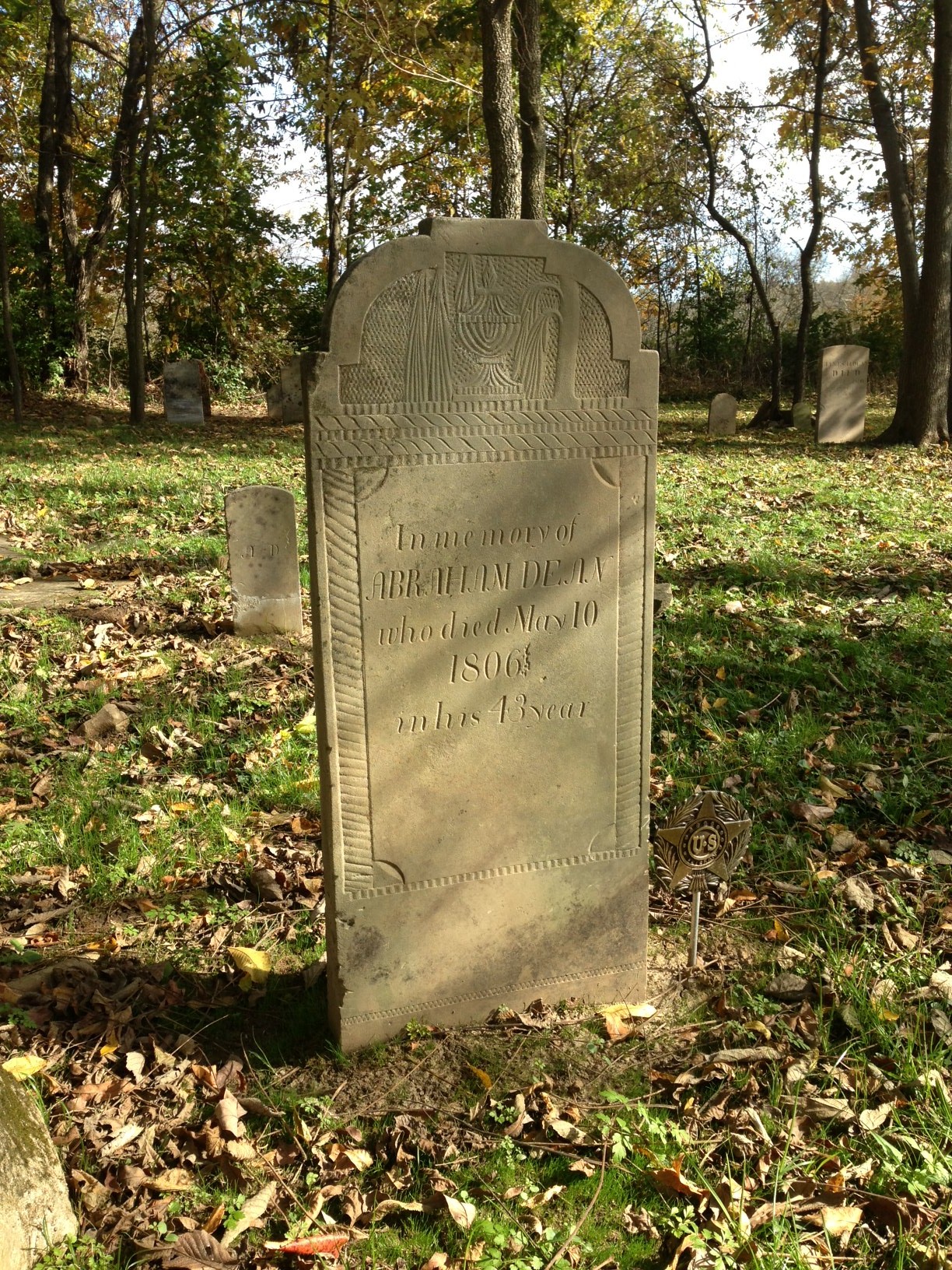
Dean Cemetery, South Salem, Ohio.
Photograph by http://image2.findagrave.com/photos/2014/46/CEM2317245_1392597580.jpg

Since I began working on genealogy, I've been struck by the family migration patterns of my ancestors. We're aware that European colonists moved frequently, spreading out across the continent. But unlike modern migration patterns (for example, my brother and I both moved away from Michigan for jobs), the earlier migrants moved with their large, extended families.

For example, Abraham Dean was born in western Pennsylvania in 1763. In the early 1800's, he moved with his family to South Salem, Ohio. But it wasn't just his immediate family who moved. He moved with his wife's family, including most of Sarah Stewart Dean's siblings. These were adults with their own households, spouses, and children, but they all moved to Ohio together. (Abraham only had one sibling, Margary Dean Canan, and she remained in Pennsylvania, along with her husband and children.) In the next generation, the children and grandchildren of Abraham moved to Des Moines, Iowa. Again, this was not just one nuclear family but the majority of his children, their own spouses, sisters- and brothers-in-law, and children. It was a clan migration.

Clan migrations weren't only typical of Scotch-Irish families in the early 19th century. On the other side of my family, Irish-Catholic Robert Cunningham, born in New York in 1850, spent his childhood in Columbus, Wisconsin. Robert married Elizabeth Rooney, and around 1890 they moved to Minneapolis, Minnesota. They moved with the entire Rooney family, including Elizabeth's parents, and most of her brothers and sisters, along with their families. This is how my great-great-great grandparents came to be buried less than an hour from where I now live.

Not all clan migrations were even based on kinship. One of my students told me that her surname is a town in Germany. Many of the towns' inhabitants emigrated together, and they took their town as their last name, so they could find each other in their new country. Something similar (without the name change) occurred in the Stoecklein branch of my mother's family. The Stoeckleins moved to Dayton, Ohio, from Faulbach, Bavaria. A number of families from that small town moved together, and remained close. Although my 3xgreat-grandfather, Joseph Stoecklein, married in Dayton, his wife, Carolina Zwisler, was the daughter of schoolmates of his parents back in Faulbach.

Surely these migration patterns were based on practicalities, as well as affection. Family members could help each other in a strange new place, whether they were negotiating a newly-conquered landscape or an alien city. It is an important reminder that, as a species, we were never meant to go it alone. We are social animals, and highly dependent on our family, however that is defined.

It's pretty common for academics to end up far from their families, and I personally can attest to the high cost of that separation. Just a couple weeks ago, my mother showed me a picture of her mother, surrounded by a plethora of female relatives - aunts, cousins, and sisters-in-law. Her remark was "Look how much help she had." Certainly, the large family sizes of previous generations were not possible if one woman did it all. As a society, we seem to have forgotten the importance of extended family.

Thursday, May 14, 2015

On the Importance of Lost Moments Found

Puritan men drinking (from https://seventreesfarm.wordpress.com, but I couldn't find
the artist). OK, so my ancestors (or at least these ancestors) weren't Puritans, but it's
surprisingly hard to find a picture of colonial men drinking.


While researching the family of Margary Dean Canan, the daughter of my 6xgreat-grandfather, James Dean, I came across a book, The History of Centre and Clinton Counties (Pennsylvania), by J.B. Linn (1975).  The book re-prints the journal of James Harris, who surveyed the area in 1784 (p.21-22). James Harris appears to have worked with, and possibly boarded with, John Canan, Margary Dean's husband. I was intrigued by the following journal entry:

"27th [of November], Mr. Brown goes for his horse to the Warrior Marks and returns to Mr. Canan's. I drink cyder with Mr. Canan at Mr. Mitchell's and Mr. Dean's his father-in-law."
A simple sentence, "I drink cyder with...Mr. Dean...", but so evocative. I imagine the men huddled close to the light and warmth of a hearth, the crude plank house dark around them. I can almost smell the wood smoke, tangy apples, and wet wool of homespun clothes. Perhaps they could hear Margary and her mother in the kitchen, or were the ladies sitting with them near the fire, working by it's light? The Revolutionary War had ended earlier that year. Did they talk about the new government, or old conflicts with their neighbors?

There is something visceral about this sentence. It captures the imagination and the senses in a way that no historical overview of colonial Pennsylvania ever could. It brings the dead to life in a way that no tombstone, no formal portrait could match.

Here, then, is the link between ethnohistory and archaeology. These records affect me much as I am affected by holding a the remains of an ancient pot, or tool, or meal. A person (not a number, not a label, but a person) once created or shaped the object, and now a person holds it again and wonders, remembers. A physical connection is made to the past. We are cultural creatures, and that cultural connection binds us to the people of the past just as strongly as the flimsy strands of DNA.


Thursday, May 7, 2015

Revolutionary War Soldiers


As I work through the genealogies, I'm keeping lists, so I can easily find information about people who, for example, were all Scotch-Irish, or lived in North Carolina. Most of these lists are not share-worthy, but I think this one is interesting: a list of family members who fought in the Revolutionary War.

(Note: I'll keep updating this as I get more information)

James Baird, Captain under Col. William Graham, Tryon County Regiment, 1776-1779. From 1779-1780 served in the Lincoln County Regiment (note: this is the same county, it just changed it's name). Fought in the battle of King's Mountain, South Carolina, and in the Cherokee Expedition.(1) See also my post on his life. James Baird is my 6xgreat-grandfather. His grand-daughter, Hannah Baird, married into the Dean line.

William Hill, Colonel in the militia (which one? I don't know!). Served in the battle at Rocky Mount and wounded at Hanging Rock, August 6, 1780. Also fought in King's Mountain and Cowpens.(2) Perhaps a more important contribution would be his Ironworks. William Hill is my 6xgreat-grandfather. His daughter, Jane, was the mother of Hannah Baird, who married into the Dean line. [Update, Feb 14, 2016: Oops! Turns out Jane Hill wasn't the daughter of William, she was the daughter of John and Jane Hill of Lincoln County, North Carolina. More on this as I figure it out]

Abraham Dean, Private 3rd Class, 7th Company, 1st Battalion, Cumberland County Militia, 1780-1781, under Captain John Woods.(3) Abraham Dean is my 5xgreat-grandfather, in the direct Dean line.

William Stewart. Private 4th Class?, Cumberland County Militia. It is unclear when he served, but he is listed as part of the militia in 1778 and 1780. There is an existing pass from Captain Philip Mathias, saying "Permit the Bearer William Stewart to pass unmolested to Cumberland County as he hath served 2 months honestly and faithfully in the 4 class of Cumberland Militia. Given under my hand this 4th Day of January 1778" (4) My great aunt Lillian Dean Huffstetler has records that list him as "Captain of a troop of Dragoon", or "second lieutenant in the Cumberland County, PA militia", but it is not clear if either of these are true.

James Addair. He is mentioned as a Revolutionary War soldier in several genealogies, but the source isn't clear. He did serve in the Virginia militia before the war, and he also took the oath of loyalty in 1777. (7) 

Philip Welsheimer, Sr. Rank and File in the 3rd Battalion of the York County Militia. Listed in the roster of April 15, 1778, under Captain Michael Kohn.(5)

Johannes Philip Welsheimerin Captain Andrew Graff's company from Pennsylvania, mustered in Philadelphia in July 16, 1776, with the remark "appointed gunsmith."(5)

"Colonel" Samuel Hancock. He served as a sergeant and private for more than two years during the Revolutionary War. The description of his service, which he gave as part of his pension application, can be found here. He seems to have spent much of the war marching around and being deathly ill. His brother Simon died in 1776 in Chester, PA, during military service. Samuel was not actually a Colonel, but like Colonel Sanders, he was a southern gentlemen of means and military background, so he was given the courtesy title. His brother, Edward, was similarly called "Captain" after serving three terms during the Revolution. Their eldest brother, William, also served. (10)

These were all the men from the Dean lineage who fought in the war. The other major branch off this side of the tree was the Brattains, who married into the Dean line when Sarah Jane Brattain married David P. Dean (my great-great-grandfather). The Brattains were Quakers, and did not fight in the war, although Sarah Brattain's great-grandfather, William Milliken, was burned out by Loyalists who objected to their support for independence.(6)

It appears that some of her non-Quaker ancestors did fight in the war, however:

Johann Georg Kissling. He served in Pennsylvania under Captain Kemp, in the Berk's County Militia, along with sons George Jr. and Conrad (8)

Jean (John) Chastain - he was too old to serve, but he is considered a "patriot" by the DAR for supplying the Bedford County, Virginia, militia with pounds of beef(9)

John Hewitt - there is a John Hewitt, of the right age and place, who was in the Revolutionary War, although it is not clear that this is the same John Hewitt as our ancestor.

The other line, that of the Kinneys, moved to Nova Scotia before the war, although it is possible some of them were loyalists and moved there afterward. I'm still looking into that possibility. 

References:
(1). Information from "The American Revolution in North Carolina" http://www.carolana.com/NC/Revolution/nc_patriot_military_captains.html, accessed April 18, 2015

(2). Roster of South Carolina Patriots in the American Revolution, Volume 1, A-J. By Bobby Gilmer Moss. 2009

(3). "AMERICAN REVOLUTIONARY SOLDIERS OF FRANKLIN COUNTY PENNSYLVANIA", compiled by Virginia Shannon Fendrick, p.59 (Available online:http://lcweb2.loc.gov/master/gdc/scdser01/200401/World_Almanacs_1903_1923/american%20rev%20sold%20frank

(4).  "History of that part of the Susquehanna and Juniata valleys, embraced in the counties of Mifflin, Juniata, Perry, Union and Snyder, in the Commonwealth of Pennsylvania..."Edited by F. Ellis and A. N. Hungerford. Published in Philadelphia by Everts, Peck & Richards, 1886, Pages 865-874.

(5) "A History of the Welsheimer Family", by Edith Welsheimer, Bronson Printing, Las Cruces, New Mexico, 1969.https://dcms.lds.org/delivery/DeliveryManagerServlet?dps_pid=IE97573

(6) "Notes on the Milliken Family", by Millard F. Hudson, California Genealogy Society, Issues 1-3, 1900, p.55 https://play.google.com/store/books/details?id=oW8wzD32obkC&rdid=book-oW8wzD32obkC&rdot=1

(7) Blog by Kenny Adair: http://www.genealogy.com/forum/surnames/topics/adair/2999

(8) http://mcclure.freeservers.com/geokeas.htm

(9) Pierre Chastain and Descendants, Vol. 1, p.24

(10) Dorman, John Frederick. 2004. Adventurers of Purse and Person: Virginia 1607-1624. Genealogical Publishing Company, p. 287.

Thursday, April 16, 2015

Who were the Bairds?

As I mentioned in my previous post, a little more information about Hannah Baird, my 4xgreat-grandmother, led to an extensive genealogy of the Bairds. I entered Hannah's family tree into wikitree on the basis of that information.

Unfortunately, as any genealogist knows, you can't trust family trees that don't include documentary sources. Lots of family myths were written down - even published - and now show up as "facts" in genealogies all over the world. So what is the genealogy I found, and what documentary evidence supports it?

The genealogy comes from the "The Baird Brigade: A Surname Booklet", by Barbara J. Peters, published in 1995. This is not a professionally published book, it's a pamphlet put together by a family member and scanned into a PDF. It's invaluable, however, because it includes a great deal of documentation, including bible records, cemetery records, tax lists, wills, letters, and marriage records. It is not limited to "our" Baird line, however. The genealogy that's relevant to John and Jane Hill Baird is "Branch #29" and "Branch #30", submitted by Theodore Claud "Ted" Baird. Unfortunately, in most cases his sources are not cited.

Below, I will lay out the genealogy (Baird line only), starting with Hannah Baird, and what evidence I currently have to support it.

Hannah Baird was the daughter of John Baird and Jane (Hill) Baird
     The evidence for this connection was discussed in my previous post.

John Baird (b. 1759 in Lincoln County, North Carolina, d. January 9, 1815, Georgetown Ohio) was the son of James Baird and Nancy Meney Baird
   The Ted Baird genealogy mentions James Baird's will dated to October 9, 1808, but doesn't give the actual wording. Presumably this will confirmed the genealogy Ted Baird laid out. This John Baird did have a son named John, who was mentioned in his will.

James Baird (b. c1740 in Chambersburg, Pennsylvania, d. October 11, 1808, Lincoln County, North Carolina) was the son of John Baird and Frances Scott Bradner
     Frances Scott Bradner left her son James 5 shillings sterling in her will. John Baird mentions his wife Frances and his son James in his will. Note, however, that James, John, William, and several other names were clearly very common within the broad Baird/Beard clan. There is no conclusive indication that the James Baird mentioned in this will is the one who married Nancy Meney and was father of the John Baird born in 1759. None the less, the will specifically names James as the heir to John's land on the Catawba Creek, which is where we know James 1759 was born. This seems a strong connection.

John Baird (b. c1720 in Hamilton, Pennsylvania, d. 1782 in Lincoln County, North Carolina) was the son of John Baird (or possibly William Baird) and Avis (Bowne) Baird.
     This is where things really get hairy. Was John Baird 1720 the son of John Baird 1707? There is a John Baird whose will leaves his estate to his wife Avis. But the only sons named are Andrew and Zebulon. Through a variety of triangulations, some researchers feel confident that they also had a son named John (as well as children named Mary, John, Alexander, and Elizabeth). (Source: Glenn Book). But this is still tentative, and others believe John 1720 was the son of William Baird and his wife, Agnes Clarihew. Similarly, the last name of John's wife is still debated. There is good circumstantial evidence that she was a Bowne, but it is not definitive. 
     Even more problematic (from my perspective) is the fact that John Baird 1720 was born in Pennsylvania, while John Baird 1707 lived in New Jersey his whole life. A lot of Scotch-Irish families moved from Scotland or Ireland into Pennsylvania in the early to mid 1700s. When the land in Pennsylvania started filling up, many followed the mountains down to North Carolina (skipping Virginia, whose religious laws were too restrictive for these staunch Presbyterians). But John Baird 1707 was a Quaker, and originally part of the Puritan Great Migration into New England. How did this Puritan/Quaker family from New England end up following the normal path of Scotch-Irish Presbyters? On the other hand, Zebulon Baird Vance is more clearly a descendant of John Baird 1707 (more on that in a later post), and his family followed this path. 

John Baird (b. January 28, 1707 in Monmouth, New Jersey, d. July 5, 1749 in Topenemus, Monmouth, New Jersey) was the son of John Baird and Mary (Osborne) Baird.
     Genealogical and Memorial History of the State of New Jersey, by Francis Bazley Lee (Lewis Historical Publishing Society, 1919) lists John Baird 1707 as the son of John Baird 1665. That book, however, gives his mother as Mary Hall, rather than Mary Osborne. 

John Baird (b. c1665 in Aberdeen, Scotland, d. April 6, 1755, in Topenemus, Monmouth, New Jersey) was the son of John Baird and Janet (Fatheringham) Baird
     The life of John Baird 1665 is, in general, fairly well documented. Who his parents were, and his relationship to other Bairds who lived in and around New Jersey at the time, is not nearly as clear. I have no known documentation of this relationship.

This post was not meant to be informative, so much as to give me some space to lay out what evidence we really do - and do not! - have about the Bairds. This lets me organize my thoughts, and hopefully will lead to more clarity in the future.