Showing posts with label Hancock. Show all posts

Friday, August 16, 2024

Martha Hancock Wheat

 In a previous post about my great-great-great-grandfather, Ammon Goode Hancock, I mentioned his sister Martha. Martha's journal about her religious experiences was the focus of an article by historian Cynthia Kierner (Kierner 1992). Dr. Kierner kindly pointed me toward the archive where her transcriptions of the journal could be found and I was able to obtain them from the UNC Charlotte. She had originally obtained them from a descendant of the Wheat family.

Martha Hancock Wheat's journal is not gripping material, unless you are particularly interested in conversion stories, although it is fascinating how much her testimonies mirror modern evangelical testimonies. I'm not a scholar of religion, however, so my interest was entirely in the references to her family. 

For copyright reasons, I can't post the entire transcript here, but I will send it to you if you are interested Just email me! I'm going to quote parts of it and add in commentary that places her journal in the familial context.

She began writing her journal in 1850:

I was born in Bedford County, Virginia February 12 1823 -- and for several years thereafter neither of my parents made any pretention to religion, so I did not have the advantages of early religious training.

Martha's parents (the ones she throws under the bus here in her first line) were Justus Hancock and Harriet (Walden) Hancock. 

Family documents -- and public documentation in Virginia -- give Justus's birth as May 19, 1791 in Bedford, Virginia. Bedford is just outside of Lynchburg, where the Hancock family lived until at least the mid-20th century, and presumably still do, although our line moved to the west coast in the late 1800s. His family had been in Virginia since before the Virginia Muster of 1624/25 and he was also the descendant of early Huguenot settlers who arrived in the early 1700s. One of those settlers gave his mother her maiden name of Ammon, which was where his son's name came from.

Harriet Walden Hancock was the daughter of John Walden and Martha Hopkins, which is where Martha's name came from. She was born in 1795, also in Bedford, and her family also had been in Virginia since before the Muster. 

In 1820, around the time Martha was born, Justus Hancock's household was listed in the census with five enslaved people, suggesting they were moderately prosperous landowners (and, well, morally complicit). Martha had four siblings: her older brothers Ammon and Jonathan, and her younger brother and sister, Daniel and Lucy. 

Martha's statement about her parents' lack of religion seems to reflect her very specific definition of religion, since the very next sentence in her journal is as follows:

But when quite a child, I was sent to a school, taught in an old church called Antioch. Here the circuit riders preached every two weeks, and I had frequent opportunities of hearing them.

I honestly don't know where, exactly, is/was the "old church called Antioch." I'm pretty sure the Hancocks were Methodist, however. My guess is that Martha didn't consider them sufficiently evangelical. Antioch must have been in -- or close to -- Bedford County, since Martha is clearly living at home and mentions that her family was not encouraging her to attend the church. I have searched for some of the names of preachers and congregants that Martha mentions, including "Brother Peyton", "Brother John R. Bennits" and "Sister Jane Tate". There was supposedly a "Mary Jane Tate", daughter of Zachariah Tate, born around 1809 in Bedford County, VA. She never married. I have no information about which church she attended, but she may be related to Henry Tate, who was buried in the Patmos Methodist Church in Huddleston, VA, which is in Bedford County. Patmos's webpage claims the church was founded in 1834, but there's no mention of the "Antioch" name.

She was baptized by a "Brother Nathaniel Thomas" who was preaching on the Bedford circuit. He also asked her to lead a prayer, which I thought was an interesting commentary on the role of women in the church. She also mentioned attending a women's prayer meeting at "Sister Thurman's". There were a number of Thurmans in Bedford County in the late 1700s and early 1800s, but no idea where they went to church. 

Skipping over a bunch of religious commentary, the next interesting paragraph from a family history perspective is this:

Years past by and I had not obtained that which I sought [religious enlightenment, I think]. When twenty three years old I was united in holy wedlock, to him whom I had chosen, in preference to many others, as one who loved and served God.

Martha's chosen groom was Zachariah Wheat. They were married July 7, 1845, in Bedford County. Martha would have been twenty-two if she married in 1845 and was born in 1823. However, I'm pretty sure she's lying about her age, both here and in the very first sentence of her journal, where she gave her birth year. 

In the 1850 U.S. Census for Bedford County, Martha is listed as 30 and her husband Zachariah is listed as 38. (U.S. Census 1850). This would be a birth year of 1820. In the 1860 U.S. Census, her age is given as 36 -- a birth year of 1824 -- while her husband is 48, since he, unlike his wife, actually aged ten years over the previous decade (U.S. Census 1860). In 1870, her age is given as 46 -- consistent with a birth year of 1824 -- while her husband is only 52 (U.S. Census 1870). At her death, on August 21, 1874, her age was given as 53, which would make her birth year 1821. Our family records suggest 1821 is the correct date. 

Zachariah Wheat was born Dec 17, 1811, so he was around ten years older than Martha. He had been previously married to Clementine (Early) Wheat, who died April 21, 1844, about a year before Zachariah married Martha. Zachariah had three children from that previous marriage: Jonathan Wesley, Ann R, and Mary Louise. At the time of the marriage, Jonathan would have been around seven and Mary Louise about three. Martha seems to have had some concerns about stepping into the role of wife and mother, as she noted: 

When my Husband addressed me soon after we became acquainted, I thought there was an  insuperable barrier to our Union. He was a Widower, and I had often thought I would never be a step mother, as I had seen many who seemed to be very unhappy. But as I believed him to be a good man, I again went to my Heavenly Advisor, and the more I prayed for guidance the more I became satisfied that I should not reject him on account of his children. With streaming eyes I told my objections, how could I take so much responsibility upon myself, as to undertake to raise those motherless children. But then as clearly as the words had been spoken the answer would come. You wished to be useful and you wished to be a Missionary, and now that a door of usefulness has been opened to you, you refuse to enter in. My love for Him increased and I felt that at last I had my makers approbation and could marry the Man I loved.

Martha says that Zachariah "addressed" her soon after they "became acquainted". I don't know if this phrase refers to the beginning of courtship or if they truly hadn't known each other before. Zachariah's family had lived in Bedford County for generations, as had Martha's. Zachariah's mother, Edith Chastain Wheat, was a descendant of a prominent Huguenot family that had arrived in Virginia in 1699. Edith's niece, -- Zachariah's first cousin -- Charlotte Hewitt, married Ammon Hancock, Martha's oldest brother, in 1851. 

Martha and Zachariah had four children together:

Harriet J. Wheat - born 1846

Sarah L. Wheat - born 1848

William R.B. Wheat - born 1856

Otis P. Wheat - born 1860

I found this online as a picture of Martha Hancock Wheat and Zachariah Wheat, so I can't guarantee it's truly them. I don't have any pictures handed down through the family. If this is their oldest child, then this picture should be from 1846 or 1847. Gotta say, she's out of his league.

This blog post is getting long, so I will stop here and discuss Martha's children and later mentions of her family in the next post.


Bibliography

Kierner, Cynthia A. 1992. Woman's Piety within Patriarchy: The Religious Life of Martha Hancock Wheat of Bedford County. The Virginia Magazine of History and Biography 100:79-98.) 

"United States Census, 1850," database with images, FamilySearch (https://familysearch.org/ark:/61903/1:1:M88P-YLD : accessed 28 December 2015), Martha A Wheat in household of Zachariah J Wheat, Bedford county, Bedford, Virginia, United States; citing family 496, NARA microfilm publication M432 (Washington, D.C.: National Archives and Records Administration, n.d.)

"United States Census, 1860", database, FamilySearch (https://familysearch.org/ark:/61903/1:1:M41M-JJY : accessed 28 December 2015), Martha A Wheat in entry for Z J Wheat, 1860.

"United States Census, 1870", , FamilySearch (https://www.familysearch.org/ark:/61903/1:1:MFLJ-8YZ : Tue Mar 05 12:43:43 UTC 2024), Entry for Z J Wheat and Martha A Wheat, 1870.


What, Exactly, is a Farm?

A colleague with whom I share both anthropological and genealogical interests pointed me toward this webpage of Washington history. I didn't find much specifically about our ancestors, but this post about the origins of Oak Harbor in January, 1851 was interesting. It hits both my family history interests and my anthropological research on land use and historical ecology. Note this section:

Norwegian shoemaker Zakarias Martin Taftezon (also spelled Toftezen and Taftsen, among other variants) (1821-1901), Swiss Ulrich Freund, and New Englander Clement W. "Charlie" Sumner met each other at New Orleans while en route to the 1849 California gold rush. They did not strike it rich in the gold fields and headed north to the Oregon Country. In late 1850, they landed in Olympia and with the help of Samuel Hancock, took an Indian canoe north down Puget Sound to find available land....

According to pioneer Jerome Ely, Taftezon cut steps into the steep bluff at the mouth of the inlet the Skagits called Kla-tole-tsche to climb up and view the area to the north. He spied the Oak Harbor prairie free of the dense stands of trees that covered so much of the region....Much of Puget Sound was covered by dense stands of timber, but the grass-covered prairies where the Indians dug their camas roots offered good prospects for farming.

I love "the grass-covered prairies where the Indians dug their camas roots offered good prospects for farming." Yes, they did. Because they were farms! You will generally see these roots classified as "wild" foods but the boundary between "wild" and "domesticate" or between "prairie" and "farm" is a lot fuzzier than most people realize. Indigenous people of the Pacific Northwest created fields of camas and manipulated soil and roots to make camas more productive. These prairies were created and managed ecosystems for growing camas. Sounds kinda like a farm, doesn't it?

Other crops grown by the Indigenous people of the Pacific Northwest include various fruit-bearing trees, berries, and (my personal favorite) shellfish in aquaculture beds.

So why didn't the Euro-American settlers arriving on Whidbey Island mention that it was covered in farms? Partly because they did not recognize them. These Indigenous fields didn't look like European farms, with fences and plow furrows and red-pained barns. The settlers' ethnocentrism only allowed them to see Europe-style farms as "true" farms. 

But also, settlers often refused to recognize the farms right in front of their faces because that would mean recognizing that they had stolen someone's land. Land grabs in this time period were based on the idea that Euro-Americans were hard-working people who improved and built upon land while Indigenous people were not. As "proof" of this, Euro-Americans pointed to the fact that much of North America was made up of unsettled or unimproved land. And where that wasn't true (which it mostly wasn't) they pretended it was true.

Now for the genealogical connection: note the reference to Samuel Hancock and the implication that he's working with Indigenous people to transport settlers to Whidbey island. Some thirty years later Mr. Hancock helped his great-nephew, E.J. Hancock, to move to Whidbey island, where E.J. married Julia Kinney, the daughter of a local ship captain. They became my great-great-grandparents.

Sunday, December 11, 2022

Killers of the King

I just finished an interesting book called Killers of the King by Charles Spencer. It follows the history of the men who were directly involved in the execution of Charles I and what happened to them afterward. (Spoiler alert: they were mostly killed in horrible ways. To quote the immortal Omar Little, "You come at the king, you best not miss.") 

The book is interesting in its own right but I kept thinking about the relationship this history had to our own genealogy. A large chunk of our ancestors -- the Kinney line but also some on the Manary side -- came to New England through the Great Puritan Migration. That migration took place in the context of the English Civil War, the Protectorate, and the Restoration. After the Restoration, some of the regicides fled to the Massachusetts colonies where they were protected by the authorities and population alike. The colonists were mostly not big fans of the Stuarts. 

Wikipedia has a list of all the regicides here. They were all major supporters of Parliament in the Civil War and many of them were Puritans, so I ran the names through Wikitree to see if we're related to any of them. Not surprisingly, we are, although mostly not in the ways I had expected. Many of our colonial ancestors were 2nd-5th cousins of these men, but in most cases it was our ancestors in colonial Virginia, not Massachusetts. My guess is that is because our colonial Virginian ancestors (the Hancock line, essentially) was more "aristocratic" and the leaders of the Parliamentarians were still fairly aristocratic/wealthy, despite their opposition to the king. By marriage, however, we're more likely to be related to these men through our Kinney or Manary connections, since their family members often ended up moving to the Massachusetts Puritan colonies.

We're distantly related to many of the regicides, but here are a few who have closer ties:

General Edmund Ludlow was my 12th great-uncle and one of Cromwell's great supporters. Cromwell named him military commander in Ireland until he objected when Cromwell declared himself Lord Protector. Ludlow was a member of the jury that convicted Charles I and he signed the death warrant. His brother Gabriel's grandchildren moved to Virginia and became our ancestors. Ludlow fled England after the restoration and lived the rest of his life in Switzerland. He was the only regicide who is known to have survived long enough to see the downfall of the Stuarts. He kept chronicles and letters and so his work is one of the main sources cited in the Killers of the King. He's the only regicide with anything like a direct relationship to us. Sara Ludlow Carter, my 10th great-grandmother, who moved with her brothers to the Virginia colony sometime around 1660, was the great niece of Edmund Ludlow. Her descendants married into the Hancock family.


Edmund Ludlow

Colonel Adrian Scrope is a 2nd cousin many times removed, again through our relationship to Edmund Ludlow, who was his uncle (or maybe great uncle?). Cromwell appointed Scrope head of security during the trial of Charles I, and he signed the death warrant. He was hanged, drawn, and quartered at Charing Cross in 1660. Parliament had originally just fined him for his role in the trial, but was executed after Richard Browne, Mayor of London, testified that he had confessed that he was unrepentant. Browne, incidentally, was a distant relative of ours by marriage. We're related to his uncle's wife. 

Adrian Scrope


Adrian Scrope in more difficult times (he's being disembowled in the lower picture)

Edward Wallop, another signatory, was found guilty but sentenced to life in prison and to a trip by sledge to the gallows at Tyburn. The sledge ride was the foreplay to execution at that time period, but Wallop was merely dragged through the city on the sledge and shown the gallows before being returned to prison. He was also some kind of 2nd or 3rd cousin of Edmund Ludlow, and therefore of ours, but it doesn't seem worth figuring out the details since he's even farther from us than Adrian Scrope. Spencer quotes a Dutch visitor's letter about January 27, 1662, "We walked with thousands of people to Tyburn and saw there Lord Monson, Sir Henry Mildmay and Mr. Wallop lying in their tabards on a little straw on a hurdle being dragged through under the gallows, where some articles were read to them and then torn up. After that they were again dragged through the streets back to the Tower." (p. 245)

My husband and children are first cousins (many times removed) of the wife of Colonel John Dixwell. Dixwell escaped by claiming to be unwell and asking Parliament for an extension before he handed himself into the court. He was granted the extension but he used it to liquidate some assets and flee to Europe. He was mistakenly reported as dead to the Royalists so he moved again to the Americas and managed to live a long and happy life in Connecticut under the assumed named of James Davids. Joe and the kids to are related to Dixwell through his third wife Bathsheba Howe.

They are also direct descendants of Augustine Garland's brother in law, William Newbold. Augustine Garland was a lawyer and the first committee chairman for Charles I's trial. Surprisingly, he was granted life in prison, perhaps because he pleaded he had no real choice. In his own trial he told the judge, "My Lord, I did not know which way to be safe in any thing, without doors was misery, within doors was mischief" (Spencer p.244). He forfeited his estate and was transported to a prison in Tangiers where he died.

We're not really related to the Big Cheese, Oliver Cromwell, but we do have connections through marriage. The Manary line is descended from Sarah Bucknam Dexter, who lived in the Massachusetts colony in the mid-1700's. Her brother Samuel was married to one of Cromwell's sister's descendants, Deborah Sprague. Through that same connection to Cromwell's sister, Frances, we are related by marriage to two other signatories of the death warrant: her husband Colonel Edward Whalley and their son-in-law, Lieutenant William Goffee. Both had been powerful members of Cromwell's inner circle. Whalley and Goffee fled to Connecticut after the Restoration and lived in hiding for the rest of their lives.


Death warrant of Charles I

Sunday, July 21, 2019

Julia Kinney Hancock, painter


When she visits, my mother often brings a treasure-trove of genealogical materials from my grandmother's stored belongings. This week, she brought this oil painting. On the back it says "Painted by Julia Kinney as a girl". Julia, who was my great-great-grandmother, was born in 1859. I'd guess her "girlhood" to be anytime before 1880. Before she reached the age of 20, Julia had lived in Nova Scotia, Boston, San Francisco, and Whidbey Island, Washington. This landscape doesn't particularly remind me of any of those areas, but it's more "east coast-y" than west. On the other hand, she very well may have copied some other painting and not seen this landscape in real life.

If you look closely, you'll see that the human figures are a bit stiff but the animals and landscape are quite good. Joe wanted to know if she kept painting, and if the family has any of her other work. Honestly, I don't know. Maybe some of my cousins do?

Saturday, May 19, 2018

Julia Etta Kinney

Julia Etta Kinney Hancock, 1910

The latest post in my series about my great-great grandparents focuses on Julia Etta Kinney, wife of Ernest Justus Hancock, who was the focus of my last post. She is one of my four great-great grandparents born outside the United States (all four in Canada), but her family's history is in Massachusetts, going back to the Mayflower. The Kinneys were a sea-faring family; most of the men were ships captains, owned ship-building companies, or served as port authorities. Over their history, they tended to move from Massachusetts to Nova Scotia and back again as if the border didn't exist. Julia's grandfather and father, though, eventually re-located to the west coast, which is how she came to living in Coupeville, Washington, and meet her husband.

Julia was born in 1859 in Hall's Harbour, Nova Scotia, the daughter of Captain Thomas Kinney and Mary Elizabeth (Houghton) Kinney. Thomas Kinney was working on the west coast by 1851 (1), while Julia and her mother stayed on the east coast, which may be why Julia was an only child. According to a biography published in the Island County Times in 1947, her family moved to Yarmouth when she was four and then Boston the next year (2). Her parents had been married in Boston, so it is possible that they moved to be near her mother's family. In 1868, when she was 11, she and her mother moved to San Francisco to join her father. In 1871, they moved up the coast to Coupeville.

Julia was unusually well-educated, compared to the other children in Coupeville. She had, after all, gotten her elementary education in Boston and San Francisco, while many of the other Coupeville families had come from less developed areas. Perhaps it was inevitable, then, that she would become a teacher.
______
References:

1) Lewis and Dryden
2) Island County Times

Wednesday, February 21, 2018

President's Day

Happy President's Day! In honor of his birthday, here's our connection to our first president:


Yup, for those of us on the Hancock line, George Washington is my 4x great-grandfather's sister-in-law's great-grandmother's maternal cousin's brother-in-law.

I literally laughed for about ten minutes while writing that.

Also interesting, though, is that the Ammon family (who married into the Hancocks and gave us the Ammon first name) attended the church where George and Mary Washington were married, at the same time that they were parishioners.


(props to Joe for the Gif)

Thursday, January 18, 2018

Edward and Rebecca Bangs, times two

I'm continuing my series of ancestors who are documented in Robert Charles Anderson's The Great Migration Begins. The history of Edward and Rebecca Bangs is much less salacious than that of Stephen Bachiler, but they are part of the reason that we are descended from basically everyone who lived on the outer arm of Cape Cod in the 17th and 18th centuries.

Edward Bangs was born in England sometime around 1591. He arrived in Massachusetts in 1623 on the Anne. He would have been about 32 years old. He initially lived in Plymouth where he was given four acres of land, which suggests his household consisted of four people. If the other three people were a wife and children, they must have died fairly early. By 1633, he married Lydia Hicks, who had also come to Massachusetts on the Anne. She was baptized at St. Mary Magdalen in Bermondsey, Surrey, September 6, 1612, so she would have been 21 or younger at the time of their marriage. The couple had one son, John, who was born sometime between 1631 and 1634. Lydia died soon after. By 1635, Edward re-married to Rebecca (her last name is uncertain) and they had nine children together. Rebecca may have been the daughter of Edmund Hobart, but there's no proof.

The Nauset Lighthouse in Eastham, Massachusetts, which is
only 300 years too young for Edward Bangs to have ever
seen it.
Edward and Rebecca Bangs moved to Eastham by 1645. Eastham is on the outer arm of Cape Cod. They owned land
around an area called "Warren's Wells". I have no idea where that would be. Edward was an innkeeper at least part of the time. At other times he is referred to as a "yeoman". In 1657 he was granted permission to sell wine and "strong waters" in Eastham, but only "for the refreshment of the English, and not to be sold to the Indians." In 1664, there is a record of him importing six gallons of liquor for his establishment.

Innkeeper Bangs was clearly an engaged citizens. He held a number of offices, including deputy to Plymouth Court for Eastham, serving on juries, and serving  many committees, including committees to divide land, assess taxes, and reunite Plymouth and Duxbury. He must have been known for his integrity or at least his willingness to serve.

It's not certain when Rebecca died, but she died before Edward because she is not mentioned in his will. Edward Bangs died between October 19, 1677, when he wrote his will, and March 5, 1677/8, the probate date. He was buried in the Eastham Cove Burial Ground, along with a large number of distant relatives.

We're related to Edward and Rebecca Bangs through two of their children. First, we're related through their eldest surviving son, Jonathan, not be be confused with John, who was the son of Edward's first wife, Lydia.

Edward Bangs -- Rebecca (unknown) Bangs
             - Jonathan Bangs -- Mary Mayo Bangs
                 - Mary Bangs Nickerson -- Thomas Nickerson
                     - Thomas Nickerson -- Lydia Covell Nickerson
                         - Desire Nickerson -- Elisha Nickerson
                             - Sarah Nickerson Kinney -- Nathan Kinney III
                                  - Thomas Kinney -- Lydia Bartlett
                                      - Simeon Kinney -- Olive Doane Kinney
                                          - Thomas Kinney -- Mary Houghton Kinney
                                              - Julia Kinney Hancock -- Ernest Hancock


We're also related through Edward and Rebecca's daughter, Hannah Bangs Doane.

Edward Bangs -- Rebecca (unknown) Bangs
             - Hannah Bangs Doane -- John Doane Jr.
                 - Hannah Doane Collins -- John Collins
                     - Martha Collins Godfrey -- Moses Godfrey
                         - Joseph Godfrey -- Mehitable Hamilton Godfrey
                             - Sarah Godfrey Kinney -- Isaac Kinney
                                  - Mehitable Kinney Doane -- Israel Doane
                                      - Olive Doane Kinney -- Simeon Kinney
                                          - Thomas Kinney -- Mary Houghton Kinney
                                              - Julia Kinney Hancock -- Ernest Hancock


References:

Anderson, Robert Charles 1995 The Great Migration Begins: Immigrants to New England 1620-1633. New England Historic Genealogical Society.

Thursday, January 11, 2018

Reverend Stephen Bachiler, a most notable crank

Bachiler coat of arms
Stephen Bachiler is my 13th great-grandfather. He led quite an interesting life.

He was born around 1560 in England and received a B.A. from St. John's college in Oxford in 1585/6. He was married four times, to progressively younger women, but Deborah was a daughter from his first wife, whose name might have been Anne, and who may have been the sister of Reverend John Bate. They were married by 1590 and she died before 1624.

Reverend Bachiler was frequently in trouble. Scandal and discord followed in his wake. He became the vicar of Wherwell, Hampshire, in 1587. He had puritanical leanings (in the theological sense) and was a notable nonconformist. In 1593 the Star Chamber cited him for making "lewd speeches tending seditiously" about Queen Elizabeth and her government. He was removed from his vicarage during a purge of Puritans in 1605, under James I. In 1614, he was once again before the Star Chamber when Reverend George Wighley accused him, his son Stephen, John Bate (who may have been his brother-in-law and/or cousin), of libeling and ridiculing him in verse. In the 1620s, the Bachilers moved to Newton Stacey a village in Hampshire. Somehow he incited his parishioners to act against the sheriff of the parish, who had to petition for aid to the King in Council.

Reverend Bachiler clearly knew other Puritans. Some of his children moved to the Netherlands, presumably to be part of the Puritan community there. In 1621, Adam Winthrop, father of Governor John Winthrop, made note in his journal of dining with Bachiler. Bachiler would have been well aware of the Puritan colony in Massachusetts.  In the 1630s he joined a group of London merchants to form the Plough Company, which sent two shiploads of settlers to New England.

Stephen Bachiler himself arrived in New England in 1632, aboard the William and Francis, the second of the Plough Company's ships. He was already at least 70 years old. His first wife, Anne, was already dead, and he had married twice more. It's not clear who came with him on this voyage, but his youngest daughter with Anne, Theodate Bachiler Hussey, was already in New England with her husband. Reverend Bachiler first settled at Lynn with her and tried to form a new church. However, there was constant unrest within the congregation. Furthermore, he didn't get along any better with the authorities in New England than he had in England. He is believed to have been the only dissenting vote among the ministers against the expulsion of Roger Williams, the founder of Providence. For these reasons, presumably, Bachiler was pushed out of his position as minister in Lynn by 1636.

He may have moved from Lynn to Ipswitch, but in 1637 he moved to Yarmouth. Rather, apparently, he walked there. In winter. Considering he was about 77 at the time, that's pretty impressive. He didn't stay in Yarmouth long. The next year he left for Newbury. Again, he did  not stay long and moved on to Hampton in 1639. Governor Winthrop noted that "Mr. Batchellor had been in three places before, and through his means, as was supposed, the churches fell to such divisions, as no peace could be till he was removed."

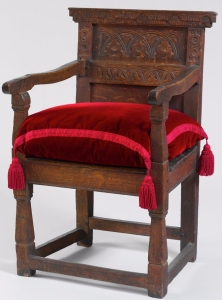
This is the Hussey-Bachiler chair. It is in the Met.
Reverend Bachiler once sat here.
In 1641, Bachiler was pushed out of Hampton when he "did solicit the chastity of his neighbor's
wife." The subsequent scandal kept him from finding employment in other parishes. He moved to Strawberry Bank, which is now Portsmouth. While living there, in 1648, he married Mary Magdalene Bailey, who was some 60 years his junior. Unsurprisingly, the marriage between the 26 year old widow and the 88 year old minister was...rocky. In 1650 they were brought to the Quarterly Court because, essentially, Mary was living with another man. In 1651, when Mary got pregnant despite being estranged from her husband, George Rogers was sentenced to 40 strokes for adultery. His partner, Mary,  "for her adultery shall receive 40 strokes save one at the first town meeting held at Kittery six weeks after the delivery and be branded with the letter A." Some scholars believe Mary Bachiler was the inspiration for Nathaniel Hawthorn's novel, The Scarlet Letter.

Reverend Bachiler returned to England, probably in 1651. He died and was buried in London on October 31, 1656. He was around 96 years of age.

Because some of his children stayed in New England, he counts a number of famous Americans among his descendants. These include Richard Nixon, Jennie Jerome (Winston Churchill's mother), Gerald Ford, H.H. Dow (founder of Dow Chemical), Meghan Markle (soon to marry into the British royal family), Daniel Webster, and John Whittier.

Our relationship to Reverend Bachiler (down to my great-great grandmother):
Stephen Bachiler -- Anne
     - Deborah Bachiler Wing -- John Wing
         - Daniel Wing -- Hannah Swift Wing
             - Lydia Wing Abbot Hamilton -- Thomas? Hamilton
                 - Daniel Hamilton -- Mary Smith
                     - Samuel Hamilton -- Bethia Stewart Hamilton
                         - Mehitable Hamilton Godfrey -- Joseph Godfrey
                             - Sarah Godfrey Kinney -- Isaac Kinney
                                  - Mehitable Kinney Doane -- Israel Doane
                                      - Olive Doane Kinney -- Simeon Kinney
                                          - Thomas Kinney -- Mary Houghton Kinney
                                              - Julia Kinney Hancock -- Ernest Hancock

References:

Anderson, Robert Charles 1995 The Great Migration Begins: Immigrants to New England 1620-1633. New England Historic Genealogical Society.

Stephen Bachiler on Wikipedia

Saturday, December 30, 2017

David and Jennie Dean Family Bible


I blogged previously about the serendipitous events that brought the Philip and Catherine Welsheimer Family Bible into my life. For Christmas, I received another priceless gift: the family Bible of David Philip Dean and his wife Sara "Jennie" Brattain Dean. They would be my great-great grandparents. David was the grandson of Philip and Catherine Welsheimer. Their Bible was found among my grandmother's things. I assume it was sent to her by my great-aunt, Lillian Huffstetler.

I wanted to share some pictures and items from the Bible so other family members can see it.

Outside cover


Inside cover. The text reads:
Family Bible of David P. Dean and Sarah Jane Brattain-Dean who were married August 22, 1876
DesMoines, Iowa The above names were written by Eva D. Trowbridge July 14, 1961 at the home of
Manie Dean Edmundson 3227 Wright Ave Bremerton, Wash
[Eva and Manie were daughters of David and Sarah]
Frontpiece of the Bible. It dates to 1863. I don't know
if the Bible belonged to one of them prior to marriage
or if it was purchased for their family from an older printing.
Note the pages pinned on the side. I removed the
pins to prevent rusting and damage to the pages


This is what was written on the back of the tract pinned to the opposite page of the Bible's frontpiece. On the top is the name "Ann Dean" in very faint letters. Ann was David's mother, Anna Welsheimer Dean, who died in 1905, which means she is not the person who wrote the rest of the page. I suspect it was David Dean who did so:

This tract was given to D.P. Dean , about the year 1860 or 61. He was walking along the road on his way to his Uncle Jim Finch's [David's paternal aunt, Sara, had married James Finch], when two men on passing by in a one-horse buggy handed him this tract and one other. This circumstance is very vivid in my mind at this time, Feb 16, 1920, 69-70 years ago. This piece of road was what is now Court Avenue between 20th and 30th sts, DesMoines, Iowa.

The second tract has the same story written on the back, but it was written in March 1916


A number of newspaper clippings were stored in the Bible, including this one from January 30, 1907, describing the wedding of David and Sarah's daughter, Madge, to Herbert Swenson, in Altoona, Iowa. (Clicking on the picture should give you a larger version to read)

Here is a sadder clipping. This is an obituary for David and Sarah's son, Ralph, who died at 18 in June of 1918. From the newspaper account it sounds like he had suffered from illness for much of his life. A number of clippings related to Ralph were in the Bible. He was obviously much missed.

An interesting clipping that showed how David and Sarah kept in touch with their extended family. The article is from a Middletown, Indiana, newspaper and about the wedding of L.K. Wisehart in 1908 or 1909. I don't know who L.K. was, but the article mentions he was the son of Richmond Wisehart. Richmond was Sarah Brattain Dean's maternal uncle, the brother of her mother, Louisa Wisehart.
Here's a fun clip! Apparently in 1936 David Dean grew a 2lb tomato and a 7lb potato! 
This advertisement answered a question I had long had: when, exactly, did the Dean family move to Washington? The answer, apparently, is sometime soon after Dec 7, 1910, when they sold their farm and equipment in Altoona, Iowa
Lillian Dean's wedding to Raymond Stiles in November 1911, Whidbey Island, Washington

The church bulletin announcing Sarah Brattain Dean's death. April 6, 1919

The pages before the New Testament have family records. This is the marriages page. It appears there are two different hands that wrote here. Below, I put the notes by that second hand in {}. That second hand seems to take over entirely after 1907, but perhaps earlier. Although the first hand could be Sarah and the later David, I have an alternative theory: the first hand is Anne Welsheimer Dean's. After her death in 1905 (or perhaps when she was incapacitated earlier), either Sarah or David took over adding to the Bible. That theory is based on a) the fact that the hand seems to disappear before 1905 (I think, some entries are hard to tell); b) the writing has an archaic look to me; and c) the handwriting reminds me somewhat of the Welsheimer family Bible, which was written by one of Anne's parents.

The writing is as follows:
Aug 22nd 1876 Mr. David Philip Dean to Miss Sarah Jane Brattain
{Ceremony took place at residence of J. Wisehart SE Corner 12th and Court Ave. DesMoines, Iowa}

Miss Mary Louanna Dean to Mr. Will Edmundson Dec 29 1897 {At home near Altoona NW4 NW4 12.79.23}

Ethel Gertrude Dean to William Casebeer Dec. 25, 1900 last Christmas of the 19th century {at same house as above described}

[note: not clear if this entry is in the first or second hand]: Madge Estella Dean to Mr. Herbert L. Swenson Jan. 30th, 1907 {at same house as above described}

{Aura Dean to Karl E. Hodges at the house of her uncle Ro E. Fulton 915 Queen Anne Ave. Seattle Washington, Sept. 7, 1910.

Lillian Dean to Raymond C. Stiles. Wesley M.C. NE Corner East 11? Des Moines St. DesMoines Iowa Nov 8, 1911

Eva Dean to Robert W. Trowbridge at M.E.C. in Coupeville Washington Nov. 15th 1911.

Carl Dean to Vera Hancock Sept 1916

Merl to Irene Cotte in Chicago June 1919


Another mystery solved! I have often wondered how David and Sarah met, since she was from Indiana and he was from Iowa. I wondered if he'd visited some of his mother's kin who lived not far from Sarah's family. However, based on this entry, it appears that Sarah was actually in Iowa visiting her mother's Wisehart kin, although I'm not sure who.

The second page of Family Records includes the births. Most of this page is written in the original handwritting from the first page, perhaps Sarah's. There are some notes of deaths, but I think those come from Eva and Marnie, as noted on the inside cover of the Bible. I've put their notes in {} below.

Mary Louanna Dean July 26, 1877
Madge Estella Dean, Sept 14, 1878 {D- April 12 '66}
Ethel Gertrude Dean, Oct. 29, 1879
Daisy Dean, May 8, 1881.
Harvey Edwin Dean, April 18, 1883
Aura Dean, Sept. 10, 1884 {D - Aug 5 '64}
Eva Dean, Aug. 31, 1886
Edna Dean, Oct. 10, 1887
Jimmie [Jimmie is crossed out and James written in} Dean, Feb. 16, 1889
Infant Son, Aug. 10, 1890.
Lillian Dean, July 21, 1891 {D - May 9 '62}
David Merlin Dean, Feb. 24, 1894.
Carl Phillip Dean, Dec. 14, 1895.
Ralph Hiram Dean, June 18, 1899.

I suppose it's good they stopped having kids, as they'd completely run out of room on the page! I will note that this is 14 children in a span of 22 years

The final page of the Family Records is the saddest, the list of deaths. The first five names are in the same hand. The next two may be in the same hand that wrote the comments and later entries on the marriage page. The final deaths, those of Sarah and David themselves, appear to have been written by Eva and Marnie in the 1960s.

First hand:
Harvey Edwin Dean, Feb. 7, 1885.
Daisy Dean, Feb. 8, 1885.
Edna Dean, Feb. 5, 1890.
Jimmie Dean, Feb. 9, 1890.
Infant Son, Aug. 10, 1890.

Second Hand:
Ethel Gertrude Dean, Feb. 11, 1901.
Ralph Hiram Dean, June 12, 1918

Eva and Marnie:
Sarah Jane (Brattain) Dean, B. Nov 7, 1854, D. 1919
David Philip Dean, B. Feb 16 1852, D. Apr 16 1941
The deaths page is particularly heartbreaking. Six of their fourteen children died young. Harvey and Daisy died on subsequent days in 1885. Perhaps there was some disease that went through the family? Harvey would have been six and Daisy three. Something similar happened five years later, in February of 1890, when two children died within days of each other. Edna would have been two and Jimmie just shy of his first birthday. Later that year, the unnamed son was likely a stillbirth. And, as discussed above, their youngest child died at eighteen. We forget, sometimes, how lucky we are to live in this age of medical miracles. 

Friday, January 20, 2017

Ernest Justus Hancock


Edward, Earnest, and James Hancock
No date on the photo, but must be in the early to mid 1860s

This is part 3 of my series on my great-great grandparents. Ernest Justus "E.J." Hancock, and his wife, Julia Etta Kinney, could not have been more different from the subjects of my first two posts, David and Jennie (Brattain) Dean, although their children married. The Deans and Brattains were descendants of Midwestern farmers, from families that been earlier colonizers of the areas that had been conquered from Native peoples in Ohio, Indiana, and Iowa. In some cases, earlier generations of Deans/Brattains had left the South because of their opposition to slavery. The Brattains, for example, were original Quaker. Some members of both families were active members of the abolitionist movement. Although their lineages included Revolutionary War soldiers and other brave and resourceful men and women, they didn't come from a background of particular wealth or fame.

The Hancocks and Kinneys, on the other hand, came from older and more patrician stock. They were descendants of the Jamestown and Plymouth colonists, respectively, with all of the positives and negatives such descent implies. Ernest and Julia met and married in the state of Washington, as some of the first members of their family to leave Virginia or New England.

Ned, Ammon, Ernest, Charlotte, and Lilly Hancock
Around 1865 (Lilly was born May 1864)
Ernest Justus "E.J." Hancock was born November 24, 1854, in Lynchburg, Virginia, the son of Ammon Goode and Elizabeth Charlotte (Hewitt) Hancock. I won't write much about his childhood because I discussed his father in great detail in an earlier post. Suffice to say, he was born seven years before the start of the Civil War into a family with a tobacco factory, large tobacco plantations and, therefore, they had enslaved a large number of people. The Hancocks were wealthy. E.J.'s father had to petition President Johnson for a pardon in 1865 because he owned more than $20,000 in property. I don't know exactly how much his father was worth, but $20,000 in 1865 is worth nearly $300,000 today. In other words, the Hancocks were one of the families whose wealth was based on forced labor, who had the most to gain by keeping their workers enslaved, and who were in a position to finance the fight to maintain the slave economy. Although E.J. and his siblings were too young, and his father was apparently too old, several of their cousins were officers in the Confederate army.

Despite Gone-With-the-Wind-inspired fantasies of poor white folks devastated by war (a war, remember, that they had started because labor extracted through terror was cheaper than paying people), the Hancocks were clearly well off after the war. Undoubtedly, some of their wealth was lost, (wealth, again, extracted through violence from the bodies of enslaved people), but in 1870, they were still living in the same house, still owned the same tobacco factory, still owned at least some tobacco plantations (I'm not sure about all of them), and still employed Black servants (1). Ernest. and his brothers could afford to go to college; both Ernest and his younger brother, Ned, attended the Virginia Military Institute, matriculating in 1875. Ned graduated in 1879, but E.J. left the university without graduating and moved west to Coupeville, Washington (2).

Why did he go there? His uncle, Samuel Hancock was on Whidbey Island by 1860, and in the Pacific Northwest significantly earlier (3). Another uncle, Francis "Frank" Hancock, who was married to Hester Hewett, likely a cousin of E.J.'s mother,  lived there from 1862-1870, before moving to Stillaguamish flats (4). Presumably, the good reports from his family, and having a support network already in the region, inspired Ernest's choice of location.

Aloha Farm in 1899. The people are E.J., Julia, and Vera Hancock.
The woman in the center was a local teacher.
According to his profile in An Illustrated History of the State of Washington by Harvey Kimball Hines, (published 1893, p. 568), Ernest moved to Washington in 1879, then returned to Virginia in 1881. He apparently spent the next couple of years making arrangements for a permanent move back to Washington, which took place in 1883. He bought 45 acres on Whidbey Island and built Aloha Farm. My great-aunt Lillian, his granddaughter, wrote that the family no longer remembers why the farm was named "Aloha". E.J.'s wife, however, had some connections to Hawai'i, so it's possible that the farm got its name after their marriage.

There were plenty of racial tensions in Washington, just as there had been in Virginia. Most centered around the status of Chinese immigrants. Like many immigrant groups, the Chinese community on the west coast met with social and political barriers put up by white Americans. The Chinese Exclusion Act of 1882 was the most significant anti-Chinese legislation of American history. Interestingly, Ernest denounced the Act, writing, "The Chinese, by industry, pay strict attention to their own business, and studying their employers' interest, have created a demand for their labor, and it is only justice that they be allowed to fill the demand." (6).


Justus, Virgil, and Vera Hancock, who all miraculously
survived to adulthood
Ernest married Julia Etta Kinney on March 3, 1886. Julia has a fascinating history of her own, which I'll discuss in another blog post. Genealogically speaking, though, their marriage combined the Hancock's First Families of Virginia line (going back to Jamestown) with the Kinney's Great Puritan Migration lineage (going back to the Mayflower). Ernest and Julia had four children. Their three sons were Eugene Ammon, Justus "Jut" Lee [that Lee middle name just kills me], and Virgil Kinney. Their only daughter, Vera Houghton, was my great-grandmother. 

Ernest. was clearly successful in Whidbey Island, no doubt helped along by his family's ill-gotten money. He was one of the founders of the Island County Bank of Coupeville in 1892, and elected its first vice-president. Unfortunately, the bank closed in 1893, when "the cashier absconded with the funds, spending them in the 'most disreputable dives in Seattle'" (7). The bank building itself still stands, however. Ernest also owned "an immense amount of city property, and [had] many other profitable investments" (5) in addition to Aloha Farm. 

Ernest died on August 1, 1924, in Coupeville. He was 69 years old.
_______
References:

1) "United States Census, 1870," database with images, FamilySearch (https://familysearch.org/ark:/61903/1:1:MFLK-NVT : accessed 25 September 2015), S G Hancock, Virginia, United States; citing p. 62, family 468, NARA microfilm publication M593 (Washington D.C.: National Archives and Records Administration, n.d.); FHL microfilm 553,137.

2) VMI Roster Archives, available here: http://archivesweb.vmi.edu/rosters/index.php?LastName=Hancock&FirstName=&VMIClass=&keyword=

3) https://qmackie.com/2010/02/20/samuel-hancock-witnesses-smallpox-among-the-makah-1853/

4)  http://www.findagrave.com/cgi-bin/fg.cgi?page=gr&GRid=98503324

5) An Illustrated History of the State of Washington by Harvey Kimball Hines, 1893, p. 568

6) quoted in Coupeville, by Judy Lynn, Kay Foss, and the Island County Historical Society.. . Arcadia Publishing, 2012.

7) Self-Guided Walking Tour of Historic Coupeville - National Park Service

Friday, February 26, 2016

A Memorial to the Enslaved

[Note: White readers please read my post on guilt before reacting to or replying on this post.]

This post is dedicated to the tragedy of slavery, and in particular slavery as perpetuated by my ancestors.  It lists every person enslaved by one of my direct ancestors and the information we have about them. I will update it as I find new information. I've organized it by the last name of the enslaver, on the theory that that name may have been adopted by the enslaved person as well. Otherwise, I have no last names for any of the people listed here. Hopefully, this may be useful to someone searching for their ancestry among those who frequently went unnamed. 

Many myths about slavery are found in our history classes, and especially among white Americans. It is a myth, for example, that slaves - particularly house slaves - were generally well-treated by their masters; that slaves were better off under the "protection" of their enslavers than on their own; or that Black American slaves were no worse off than Irish potato farmers, or Jewish ghetto dwellers, or 19th century tenement laborers. Certainly, people of African-American descent have no monopoly on oppression, but the U.S. institution of slavery was so brutal, so horrific, so evil, that it belongs in a class of its own. Many slaves and former slaves told their own stories, and these are easily accessible on-line (although painful to read). Some places to begin: the WPA former slave narratives, Frederick Douglass's autobiography, Incidents in the Life of a Slave Girl by Harriet Ann Jacobs, or Twelve Years a Slave by Solomon Northup (the book, not the movie, although I hear that is good, too. I'm not a movie person). For a more analytical/historical perspective, an excellent resource is the History of American Slavery podcast by Slate Academy.


Slavery was the foundation on which this republic was built, so it is no surprise that its ripple effects continue to be felt today. One blog post cannot do justice to this topic, but some accessible authors include Ta-Nehisi Coates (personally I think his Pulitzer-winning work on reparations isn't even his best writing even on this topic. For a short intro, I highly recommend his appearance on Bill Moyers's show.); Isabel Wilkerson's book The Warmth of Other Suns, which focuses on the Great Migration but roots it clearly in the post-slavery period; for more technical work, try the publications of sociologist Rodney D. Coates (who is not, to my knowledge, a relative of Ta-Nehisi Coates) or political scientist William A. Darity. 

Please note that it is extremely disturbing to read about families torn apart and people referred to as property. Also, primary documents use words that we would not today, but this post maintains the original language, to bear witness.


Eternal rest grant unto them, O Lord,
and let perpetual light shine upon them.
May they rest in peace.
Amen
Possible last name of Baird:

Name: Jane, Date of birth: Before 1764 (based on the fact that she had multiple children by 1784), location: North Carolina in 1784. Enslaver: John Baird and then Frances Scott Bradner Baird, and then Frances Baird Gilliland (their daughter), Details: In John Baird's will, dated February 20, 1784, "I give and bequeath unto Frances Baird my dearly and well-beloved wife, a negro wench named Jane and her youngest child named Tom". Because it says "her youngest child", I wonder if some of the other people who were willed away were other children of hers. Frances Baird made her own will on January 6, 1786, and in it she mentioned Jane. "I bequeath unto my daughter Frances, mar­ried to Alexander Gilleland a negro wench named Jane to her and to her heirs and assigns forever". No mention is made of Jane's son, Tom, suggesting he had died or been sold before this time.


Name: Tom (son of Jane), Date of birth: before 1784, location: North Carolina in 1784. Enslaver:  John Baird and then Frances Scott Bradner Baird, Details: In John Baird's will, dated February 20, 1784, "I give and bequeath unto Frances Baird my dearly and well-beloved wife, a negro wench named Jane and her youngest child named Tom". Because the will says "her youngest child", I wonder if some of the other people who were willed away were siblings of Tom.


Name: Nell, Date of birth: by 1764 (adult by 1784), location: North Carolina in 1784. Enslaver: John Baird, and then Eleanor Baird Witherspoon (his daughter). Details: In John Baird's will, dated February 20, 1784, "I will and bequeath to my well beloved daughter, Eleanor Witherspoon, all that tract or parcel of land on both sides of Little Catawba Creek including part of the meadow below the old mill containing two hundred and thirty-three acres, also a certain negro woman Nell To her and the heirs of her body or their heirs or assigns forever."


Name: Gilly, Date of birth: by 1764 (adult by 1784), location: North Carolina in 1784. Enslaver: John Baird and then Adam Baird (his son). Details: In John Baird's will, dated February 20, 1784, "I give and bequeath to my well beloved son, Adam Baird, the tract of land on the two small branches of Little Catawaba containing one hundred acres and one negro named Gilly, to him and his heirs and assigns forever."


Name: Harry, Date of birth: before 1784, location: North Carolina in 1784. Enslaver: John Baird and then Sarah Baird Martin (his daughter). Details: In John Baird's will, dated February 20, 1784, "I give and bequeath to my well beloved daughter, Sarah Martin, one negro boy named Harry, to her and the heirs of her body and their assigns forever." It is possible that Harry was the son of Jane, since she is described has having more than one child. It is also possible that Harry is the son of the man named Harry (see below), just based on the shared name.


Name: Harry, Date of birth: by 1764 (an adult by 1784), location: North Carolina in 1784. Enslaver: John Baird and then Frances Baird Gilliland (his daughter). Details: In John Baird's will, dated February 20, 1784, "I give and bequeath to my well beloved daughter Frances Gilliland, one negro man named Harry to her and the heirs of her body or their assigns forever." It is possible that Harry was the father of the boy named Harry (see above), just based on the shared name.


Name: Jack, Date of birth: by 1784, location: North Carolina in 1784. Enslaver: John Baird and then Anne Baird Brown (his daughter). Details: In John Baird's will, dated February 20, 1784, "I will and bequeath to my well beloved daughter Anne Brown, as above mentioned, one negro boy named Jack, to her and the heirs of her body or their assigns forever." Jack may have been the son of Jane, since she is mentioned as having other children. 


Name: Jean, Date of birth: by 1788 (described as a woman in 1808), location: Lincoln County, North Carolina in 1808. Enslaver: James Baird and then, possibly, Nancy Meney Baird (his wife). Details: In James Baird's will of October 9, 1808, he leaves to his wife "one Negro Woman Jean or Ann and to have her Choice of them." It may be possible that Jean was the same woman as Jane, mentioned above (the two names were often used interchangeably in the 18th century), who was enslaved under James' father John Baird and was willed with her youngest child to John's wife (James's mother) Francis Baird. Francis Baird willed Jane to her daughter, Frances Gilliland, though, not to her son.


Name: Ann, Date of birth: by 1788 (described as a woman in 1808), location: Lincoln County, North Carolina in 1808. Enslaver: James Baird and then, possibly, Nancy Meney Baird (his wife). Details: In James Baird's will of October 9, 1808, he leaves to his wife "one Negro Woman Jean or Ann and to have her Choice of them." 


At least two more people, names: unknown, Dates of birth: by 1808, Location: Lincoln County, North Carolina in 1808. Enslaver: James Baird. Details: In James Baird's will of October 9, 1808, he states, "is my will that all my negroes will be sold not above [withheld?] and that the family may go together if it can be done." He named two women (Jean and Ann) in his will, so this sentence suggests he had at least two more people held in slavery, and at least one family.


Possible last name of Ammon:


Name: Katherine, Date of birth: before September 19, 1757, Location: St. Peter's Parish, New Kent County, Virginia. Enslaver: Christopher Ammon. Details: The vestry book for St. Peter's Parish in New Kent County, Virginia, has a listing of baptisms, including "September 19, 1757: Katherine (Negro Girl belonging to Christopher Ammon)." There is no record of her mother or father. St. Peter's is an Episcopal church and many prominent Virginians were members there, including George Washington, who was married there in 1759. Christopher Ammon's own children were baptized there as well, between 1735 and 1755.  


Name: Ben, Date of birth: before February 5, 1757, Location: St. Peter's Parish, New Kent County, Virginia. Enslaver: Christopher Ammon. Details: The vestry book for St. Peter's Parish in New Kent County, Virginia, has a listing of baptisms, including "February 5, 1757: Ben (Negro Boy belonging to Christopher Ammon)." There is no record of his mother or father. St. Peter's is an Episcopal church and many prominent Virginians were members there, including George Washington, who was married there in 1759. Christopher Ammon's own children were baptized there as well, between 1735 and 1755.  

Name: Jude, Date of birth: before February 5, 1757, Location: St. Peter's Parish, New Kent County, Virginia. Enslaver: Christopher Ammon. Details: The vestry book for St. Peter's Parish in New Kent County, Virginia, has a listing of baptisms, including "February 5, 1757: Jude (Negro Girl belonging to Christopher Ammon)." There is no record of her mother or father. St. Peter's is an Episcopal church and many prominent Virginians were members there, including George Washington, who was married there in 1759. Christopher Ammon's own children were baptized there as well, between 1735 and 1755.  

Name: Unknown, Date of birth: around January 21, 1773, Location: St. Peter's Parish, New Kent County, Virginia. Enslaver: Christopher Ammon (although it is possible this is actually a son of of the Christopher Ammon from whom I'm descended) Details: The vestry book for St. Peter's Parish in New Kent County, Virginia, has a listing of baptisms, including "1773. Negro child belonging to Christopher Amons. Bapti Jan'ry 21." There is no record of the child's mother or father. Other children in the vestry book were all named, so I wonder if the fact that this child was not named suggests that he or she did not survive? St. Peter's is an Episcopal church and many prominent Virginians were members there, including George Washington, who was married there in 1759. Christopher Ammon's own children were baptized there as well, between 1735 and 1755.  


Possible last name of Welsheimer:

Name: unknown, Sex: female, date of birth: by 1800, location: Virginia in 1820. Enslaver: Philip Welsheimer, Details: There are documents from 1820 when the Welsheimer family moved from Virginia to Ohio, showing that Philip Welsheimer sold two slaves. Who these enslaved people are is not at all clear, but according to Welsheimer 1969, David Dean, who was the son of Philip's daughter, Anne (and my great-great-grandfather) remembered his mother's story of "seeing the negress who had cared for the children standing on a hillside, waving good-bye as they left Virginia." I assume she was one of the people sold, but it is possible that she was a third slave who was left with other members of the Welsheimer family.


Name: unknown, date of birth: unknown, location: Virginia in 1820. Enslaver: Philip Welsheimer, Details: There are documents from 1820 when the Welsheimer family moved from Virginia to Ohio, showing that Philip Welsheimer sold two slaves, one for about a thousand dollars, and the other "much less" (Welsheimer 1969). One of these slaves was probably the woman mentioned above. We do not know anything about the other person.


Possible last name of Cox:

Name: Robin, date of birth: unknown (adult by 1692?), location: Henrico County, Virginia. Enslaver: John Cox, and then Richard Cox. Details: In John Cox's will of February 19, 1692, he gave "To son Richard Cox, a negro named Robin".  Two other enslaved people are mentioned in the will, an adult woman named Betty and a child named Molley. It is possible that Robin was the husband/father of Betty and Molley.


Name: Molley, date of birth: child in 1692, location: Henrico County, Virginia. Enslaver: John Cox, and then Henry Cox. Details: In John Cox's will of February 19, 1692, he gave "To son Henry Cox, the bed I lie on and negro child Molley".  Two other enslaved people are mentioned in the will, an adult woman named Betty and an adult? man named Robin. It is possible that Molley was the daughter of Betty and Robin.

Name: Betty, date of birth: by 1672 (adult by 1692) location: Henrico County, Virginia. Enslaver: John Cox, and then George Cox. Details: In John Cox's will of February 19, 1692, he gave "To son George Cox, the plantation I live on and all the Neck of Land at Jarretts Spring to mouth of Capt. Gardner's Creek, a bed, a negro woman Betty, and items".  Two other enslaved people are mentioned in the will, a man named Robin and a child named Molley. It is possible that Betty was the wife/mother of Robin and Molley.

Name: Doll, date of birth: around 1692, location: Henrico County, Virginia. Enslaver: John Cox and then his grandson George Cox. Details: Book 6 of the Henrico Co. Records records a deed dated October 2, 1693, as follows; "Know all men by these presents that I, John Cox, Sen. of the County and parish of Henrico, planter, doe out of the love and affection for which I bear unto my son, Bartholomew Cox, and Rebecka his wife, and for yee advancement and promotion of their son George, have given, granted, aliened, assigned, and sett over and by these presents doe freely, clearly , and absolutely give, grant, alien, assign and set over unto my sd. Grandson, George Cox, ye son of Bartholomew Cox and Rebecka his wife, one Negro girl called Doll, being about a year old, to have and to hold the sd. girl and the issue of her body forever. As witness my hand this eleventh July, 1693" (pg. 439).

Name: Jack, date of birth: called "boy" in May 1754, location: Cumberland County, Virginia. Enslaver: Frederick Cox, and then John Cox his son Details: In the will of Frederick Cox, he wrote "I give my Negro Boy Jack [to?] my Son John when he is at full age or after his Mothers Decease."

Name: Philis, date of birth: adult? by May 1754, location: Cumberland County, Virginia. Enslaver: Frederick Cox, and then Elizabeth Cox. Details: In the will of Frederick Cox, he wrote "Philis and Sarah I lend to my loving Wife during her Natural Life she and their increase to be equally divided between my five Daughters."

Name: Sarah, date of birth: adult? by May 1754, location: Cumberland County, Virginia. Enslaver: Frederick Cox, and then Elizabeth Cox Details: In the will of Frederick Cox, he wrote "Philis and Sarah I lend to my loving Wife during her Natural Life she and their increase to be equally divided between my five Daughters."


Possible last name of Hopkins:

Name: Annaky, date of birth: before Feb 21, 1803, location: Bedford County, Virginia. Enslaver: Francis Hopkins and then Jane Cox Hopkins (his wife). Details: In his will dated February 21, 1803, Francis Hopkins wrote "I lend to my wife, Jane Hopkins, during her natural life my plantation whereon I now live, except the parts in possession of my sons, John and Price Hopkins. I also lend her all my household and kitchen furniture, plantation utensils, etc.; also, four negroes, to- wit: Annaky, Nancy, Sooky and Peter"

Name: Nancy, date of birth: before Feb 21, 1803, location: Bedford County, Virginia. Enslaver: Francis Hopkins and then Jane Cox Hopkins (his wife). Details: In his will dated February 21, 1803, Francis Hopkins wrote "I lend to my wife, Jane Hopkins, during her natural life my plantation whereon I now live, except the parts in possession of my sons, John and Price Hopkins. I also lend her all my household and kitchen furniture, plantation utensils, etc.; also, four negroes, to- wit: Annaky, Nancy, Sooky and Peter"

Name: Sooky, date of birth: before Feb 21, 1803, location: Bedford County, Virginia. Enslaver: Francis Hopkins and then Jane Cox Hopkins (his wife). Details: In his will dated February 21, 1803, Francis Hopkins wrote "I lend to my wife, Jane Hopkins, during her natural life my plantation whereon I now live, except the parts in possession of my sons, John and Price Hopkins. I also lend her all my household and kitchen furniture, plantation utensils, etc.; also, four negroes, to- wit: Annaky, Nancy, Sooky and Peter"

Name: Peter, date of birth: before Feb 21, 1803, location: Bedford County, Virginia. Enslaver: Francis Hopkins and then Jane Cox Hopkins (his wife). Details: In his will dated February 21, 1803, Francis Hopkins wrote "I lend to my wife, Jane Hopkins, during her natural life my plantation whereon I now live, except the parts in possession of my sons, John and Price Hopkins. I also lend her all my household and kitchen furniture, plantation utensils, etc.; also, four negroes, to- wit: Annaky, Nancy, Sooky and Peter". It is possible that Peter is the same man as the child who was born December 13, 1726, in New Kent County (see below), but that would put him in his late 70s by 1803, which would be an unusually long lifespan for the time. I'm listing the two records of Peter separately, because it's possible that this Peter was the son or grandson of the other Peter (if related at all.) 

Name: Peter, Date of birth: December 13, 1726, Location: New Kent County, Virginia. Enslaver: William Hopkins. Details:  The Parish Register for St. Peter's Parish in New Kent County, Virginia, has a listing of baptisms, including "Peter a negro of Wm. Hopkins born Decembr 13th 1726." There is no record of his mother or father. St. Peter's is an Episcopal church and many prominent Virginians were members there, including George Washington, who was married there in 1759. William Hopkins' own children were baptized there as well, between 1728 and 1737. Peter may have been the same Peter mentioned in the will of William's son, Francis (see above), but I listed the two records separately, since the Peter born in 1726 would have been in his late 70s by the time of Francis's death. Although it is possible he lived that long, that is a very long lifespan for colonial Virginia, so I think it more likely that the Peter mentioned in 1803 was a younger man named for this Peter, perhaps his son or grandson. 

Name: Joe, Date of birth: September 10, 1729, Location: New Kent County, Virginia. Enslaver:  William Hopkins. Details:  The Parish Register for St. Peter's Parish in New Kent County, Virginia, has a listing of baptisms, including "Joe a negro boy belonging to Wm. Hopkins born Septr 10th, 1729." There is no record of his mother or father. St. Peter's is an Episcopal church and many prominent Virginians were members there, including George Washington, who was married there in 1759. William Hopkins' own children were baptized there as well, between 1728 and 1737.

Name: Phil, Date of birth: April 24 1736, Location: New Kent County, Virginia. Enslaver:  William Hopkins. Details:  The Parish Register for St. Peter's Parish in New Kent County, Virginia, has a listing of baptisms, including "Phil Negro boy belonging to William Hopkins born April 24." There is no record of his mother or father. St. Peter's is an Episcopal church and many prominent Virginians were members there, including George Washington, who was married there in 1759. William Hopkins' own children were baptized there as well, between 1728 and 1737.


Possible last name of Chastain:

Name: Robert. Date of birth: before 1714. Location: Manakintown, Virginia. Enslaver: Pierre Chastain. In the Vestry Book of King William Parish, "Robert, negro" is listed as one of the tithable people (along with Pierre) in Pierre Chastain's household. Please note that this may mean Robert was not enslaved but rather a servant. 

Name: Billander. Date of birth: adult in 1760. Location: King William Parish, Cumberland County, Virginia. Enslaver: John (or Jean) Chastain, later his wife Charlotte Judith Chastain. In John's will, made December 22, 1760 but proved January 25, 1762, he left his wife, Charlotte Judith, "a Negro woman Billander and Negro man Mingo". Since Billander and Mingo were kept together, perhaps they were a couple? If so, they were potentially the parents of one or more of the children who were also divided by the will. Their names were Hannah, Myrtillo, Phyllis, Will, and Docus.

Name: Mingo. Date of birth: adult in 1760. Location: King William Parish, Cumberland County, Virginia. Enslaver: John (or Jean) Chastain, later his wife Charlotte Judith Chastain, later his son, John Jr., later John Jr.'s daughter, Fanny.. In John's will, made December 22, 1760 but proved January 25, 1762, he left his wife, Charlotte Judith, "a Negro woman Billander and Negro man Mingo". Since Billander and Mingo were kept together, perhaps they were a couple? If so, they were potentially the parents of one or more of the children who were also divided by the will. Their names were Hannah, Myrtillo, Phyllis, Will, and Docus. It is likely that Mingo is the same man who is later mentioned in the will of John Jr, written January 25, 1804, and proven September 28, 1807 in Bedford County. In that will, "Negro Mingo" was given to John Jr.'s daughter Fanny. No mention is made of Billander in this later will. She may have already died or been sold away from her family. Of the children, Hannah and Phyllis were mentioned (and separated) in the later will.

Name: Hannah. Date of birth: described as "girl" in 1760. Location: King William Parish, Cumberland County, Virginia. Enslaver: John (or Jean) Chastain, later his son John Chastain Jr, later to John Jr's son, Stephen. In John Sr's will, made December 22, 1760 but proved January 25, 1762, he left his son, "one Negro girl called Hannah". Hannah was potentially the daughter of Billander and Mingo, and the sister of Myrtillo, Phyllis, Will, and/or Docus.  It is likely that Hannah is the same woman who is later mentioned in the will of John Jr, written January 25, 1804, and proven September 28, 1807 in Bedford County. In that will, "2 Negroes Hannah and Tom" were given to John Jr.'s son Stephen. Mingo was also mentioned in the will, as was Phyllis (both were separated from their family, if indeed they were related to Hannah). No mention is made of Billander in this later will. She may have already died or been sold away from her family.

Name: Prince. Date of birth: adult in 1760. Location: King William Parish, Cumberland County, Virginia. Enslaver: John (or Jean) Chastain, later his daughter Mary Chastain Witt and her husband, Benjamin. In John Sr's will, made December 22, 1760 but proved January 25, 1762, he left his daughter, "one Negro man called Prince".

Name: Bett. Date of birth: adult in 1760. Location: King William Parish, Cumberland County, Virginia. Enslaver: John (or Jean) Chastain, later his daughter Judith, later his son John Jr., later John Jr's son John. In John Sr's will, made December 22, 1760 but proved January 25, 1762, he left his daughter, "one Negro woman called Bett and one Negro girl called Myrtillo". Since Bett and Myrtillo were kept together, perhaps they were mother and daughter?  It is likely that Bett is the same woman who is later mentioned in the will of John Jr, written January 25, 1804, and proven September 28, 1807 in Bedford County. In that will, "Negro Bett" was given to John Jr.'s son John. No mention is made of Myrtillo in this later will. She may have already died or been sold away from her family.

Name: Myrtillo. Date of birth: described as a "girl" in 1760. Location: King William Parish, Cumberland County, Virginia. Enslaver: John (or Jean) Chastain, later his daughter Judith. In John Sr's will, made December 22, 1760 but proved January 25, 1762, he left his daughter, "one Negro woman called Bett and one Negro girl called Myrtillo". Since Bett and Myrtillo were kept together, perhaps they were mother and daughter?

Name: Phyllis. Date of birth: described as a "girl" in 1760. Location: King William Parish, Cumberland County, Virginia. Enslaver: John (or Jean) Chastain, later his daughter Jane, later his son John Jr., later John Jr's daughter, Mary "Molly" Chastain. In John Sr's will, made December 22, 1760 but proved January 25, 1762, he left his daughter, "one Negro girl called Phyllis and one Negro boy called Will, one Negro girl called Docus". These children potentially were the children of Billander and Mingo, or of Bett. It is likely that this Phyllis is the same woman who is later mentioned in the will of John Jr, written January 25, 1804, and proven September 28, 1807 in Bedford County. In that will, "Phillis and a boy" were given to John Jr.'s eldest daughter, Molly. The boy may have been Phyllis's son.

Name: Unknown. Date of birth: described as a "boy" in 1804. Location: Bedford County, Virginia. Enslaver: John Chastain, Jr., later his daughter Molly. In the will of John Chastain Jr, written January 25, 1804, and proven September 28, 1807, a "Phillis and a boy" were willed to John's daughter, Molly. The boy may have been Phyllis's son.

Name: Will. Date of birth: described as a "boy" in 1760. Location: King William Parish, Cumberland County, Virginia. Enslaver: John (or Jean) Chastain, later his daughter Jane. In John Sr's will, made December 22, 1760 but proved January 25, 1762, he left his daughter, "one Negro girl called Phyllis and one Negro boy called Will, one Negro girl called Docus". These children potentially were the children of Billander and Mingo, or of Bett.

Name: Docus. Date of birth: described as a "girl" in 1760. Location: King William Parish, Cumberland County, Virginia. Enslaver: John (or Jean) Chastain, later his daughter Jane. In John Sr's will, made December 22, 1760 but proved January 25, 1762 in Bedford County, he left his daughter, "one Negro girl called Phyllis and one Negro boy called Will, one Negro girl called Docus". These children potentially were the children of Billander and Mingo, or of Bett.

Name: Jude. Date of birth: before 1804. Location: Bedford County, Virginia. Enslaver: John Chastain, Jr., later his daughter Elizabeth. In the will of John Chastain Jr, written January 25, 1804, and proven September 28, 1807, "2 Negroes Jude and Patt" were willed to John's daughter, Elizabeth.

Name: Patt. Date of birth: before 1804. Location: Bedford County, Virginia. Enslaver: John Chastain, Jr., later his daughter Elizabeth. In the will of John Chastain Jr, written January 25, 1804, and proven September 28, 1807, "2 Negroes Jude and Patt" were willed to John's daughter, Elizabeth.

Name: Sam. Date of birth: before 1804. Location: Bedford County, Virginia. Enslaver: John Chastain, Jr., later his son William. In the will of John Chastain Jr, written January 25, 1804, and proven September 28, 1807, "Negro Sam" was willed to John's son, William.

Name: Tom. Date of birth: before 1804. Location: Bedford County, Virginia. Enslaver: John Chastain, Jr., later his son Stephen. In the will of John Chastain Jr, written January 25, 1804, and proven September 28, 1807, "2 Negroes Hannah and Tom" were willed to John's son Stephen. It is possible Tom was Hannah's husband or son.

Name: Nell. Date of birth: before 1804. Location: Bedford County, Virginia. Enslaver: John Chastain, Jr., later his daughter Edith. In the will of John Chastain Jr, written January 25, 1804, and proven September 28, 1807, "Negro Nell" was willed to John's daughter, Edith.

Name: Jane. Date of birth: before 1804. Location: Bedford County, Virginia. Enslaver: John Chastain, Jr., later his daughter Jane (yes, same name as the enslaved woman). In the will of John Chastain Jr, written January 25, 1804, and proven September 28, 1807, "2 Negroes Jane and Selah" were willed to John's daughter, Jane.

Name: Selah. Date of birth: before 1804. Location: Bedford County, Virginia. Enslaver: John Chastain, Jr., later his daughter Jane (yes, same name as the enslaved woman). In the will of John Chastain Jr, written January 25, 1804, and proven September 28, 1807, "2 Negroes Jane and Selah" were willed to John's daughter, Jane.

Name: Unknown. Date of birth: described as a "wench" in 1804. Location: Bedford County, Virginia. Enslaver: John Chastain, Jr., later his wife Elizabeth. In the will of John Chastain Jr, written January 25, 1804, and proven September 28, 1807, a "Negro wench" was willed to John's wife, Elizabeth.


Possible last name of Hancock: (based on 1860 Slave Schedule and 1870 U.S. Census, see below for methods) All of the following people were enslaved by Ammon Goode Hancock.

Age: 50, Sex: male, Color: Black. Possible matches from the 1870 Census (Black or Mulatto men born around 1810, with the most likely matches listed first): Dandy Hancock, 60, Black, living in Brookville (or Brookneal), Campbell County, Virginia, which is the same location as the Ammon Good Hancock family. He works on a farm with his wife Sally, 50, and son Weaton, 12. Daniel Hancock, 60, Liberty Township, Bedford County, Virginia (this is the location of Ammon Hancock's father's plantation). Corbin F. Hancock, 59, East District, Loudon County, Virginia

Age: 48, Sex: male, Color: Black.  Possible matches from the 1870 Census (Black or Mulatto men born around 1812, with the most likely matches listed first): Jerry Hancock, 48, Southside, Appomattox County, Virginia. Harry Hancock, 48, Bacon, Charlotte County, Virginia. David Hancock, 47, First Revenue Division, Chesterfield County, Virginia

Age:35, Sex: male, Color: Black. Possible matches from the 1870 Census (Black or Mulatto men born around 1825, with the most likely matches listed first): Peter Hancock, 46, working on a farm in Eastern District Campbell County, Virginia (same county as Ammon Hancock), with wife Hannah, 32, and eight children ages 16-2, including a daughter named Lucy (same as Ammon Hancock's sister and youngest child). It seems unlikely that an enslaved person would name their child after a member of the family that enslaved them, but there are a number of reasons that one could have chosen to do so, including kinship ties or hoping to forge an economically helpful relationship with a potential employer. John Hancock and Jeff Hancock, both 45, both living in Stauton Township, Bedford County, Virginia (same county as Ammon Hancock's father's plantation), in separate households with their wives and children. George Hancock, 45, Gills Creek, Franklin County, Virginia. Jacob Hancock, 44, Union Hall, Franklin County, Virginia. Jacob Hancock, 45, Manchester, Chesterfield County, Virginia.

Age: 30, Sex: Male, Color: Black. Possible matches from the 1870 Census (Black or Mulatto men born around 1830, with the most likely matches listed first): Jacob (or possibly Joe S.) Hancock, 40, works on a farm in Eastern Division, Campbell County, Virginia (same county as Ammon Hancock), with his wife Amanda, 35. Samuel Hancock, 40, blacksmith, in Union Hall, Franklin County, Virginia. He is listed as "Mulatto", but a person's color description was not always the same from year to year.

Age: 28, Sex: Male, Color: Black. Possible matches from the 1870 Census (Black or Mulatto men born around 1832, with the most likely matches listed first): Spanell Hancock, 38, working on a farm in Franklin County, Virginia. Sam Hancock, 37, working on a farm in Franklin County, Virginia.

Age: 25, Sex: male, Color: Black. Jordan Hancock, 35, Union Hall, Franklin County, Virginia. Frank Hancock, 35, Elon, Amherst County, Virginia. (Since color designations weren't always consistent, all of the men listed here could also have been possible matches for the men listed in the entry below.)

Age: 25, Sex: male, Color: Mulatto. Possible matches from the 1870 Census: Morgan Hancock, 35, color: Mulatto, Birch Creek, Halifax County, Virginia. (Since color designations weren't always consistent, Morgan could also have been a possible match for the men listed in the entry above).

Age: 23, Sex: male, Color: Black. Possible matches from the 1870 Census: Madison Hancock, 34, Staunton, Bedford County, Virginia (same county as Ammon Hancock's father's plantation). Anderson Hancock, 34, Madison, Charlotte County, Virginia.

Age 23, Sex: male, Color: Mulatto. Possible matches from the 1870 Census: Daniel Hancock, 34, color: Mulatto, living in Brookville, Campbell County Virginia (same county as Ammon Goode Hancock). (Since color designations weren't always consistent, Daniel could also have been a possible match for the men listed in the entry above).

Age 22, Sex: Male, Color: Black. Possible matches from the 1870 Census: Alex Hancock, 32, Madison, Charlotte County, Virginia. 

Age 22, Sex: Male, Color: Mulatto. Possible matches from the 1870 Census: I couldn't find any exact matches, but color designations weren't always consistent, so Alex, above, could have been a possible match for this enslaved person. Also, the age/date of birth isn't always 100% correct, so someone listed as age 23 or 21 may actually be this person. Alternatively, of course, he could have died, moved away, or fallen between the census cracks.

Age: 21, Sex: Male, Color: Black. Possible matches from the 1870 Census: Sam Hancock, 31, Gills Creek, Franklin County, Virginia. James Henrick (may say Hancock), 31, Southside, Appomatox County, Virginia. Anthony Hancock, 30, Southside, Appomattox County, Virginia. John Hancock, 30, Madison, Charlotte County, Virginia. Silas Hancock, 30, Southside, Appomattox County, Virginia. William Hancock, 30, Madison, Charlotte County, Virginia. W. Hancock, 30, Jefferson, Alexandria County, Virginia. (W. Hancock's color is listed as "Mulatto", but color designations weren't always consistent, so he could have been the person listed in the 1860 slave schedule).

Age: 19, Sex: Female, Color: Mulatto. Possible matches from the 1870 Census (please note women are particularly hard to track in this way, since their names changed with marriage): Susan Hancock, 29, Brookville, Campbell, Virginia (same county as Ammon Hancock and his family). Harriet Hancock, 30, Union Hall, Franklin County, Virginia. Maria Hancock, 30, Madison, Charlotte County, Virginia. Mary Hancock, 30, Jefferson, Alexandria, Virginia. 

Age: 18, Sex: Male, Color: Black. Possible matches from the 1870 census, with most likely first: Richard Hancock, 28, Eastern Division, Campbell County, Virginia (same county as Ammon Hancock and family). Clem Hancock, 28, Madison, Charlotte County, Virginia. Henry Hancock, 28, Gills Creek, Franklin County, Virginia. 

Age: 17, Sex: Male, Color: Mulatto. Possible matches from the 1870 census, with most likely first (note all the men on this list were listed as "Black" on the 1870 census): Henry Hancock, 27, Union Hall, Franklin County, Virginia. Nathan Hancock, 27, Southside, Appomattox County, Virginia. Thomas Hancock, 26, Union Hall, Franklin County, Virginia.

Age: 17, Sex: Female, Color: Mulatto. Possible matches from the 1870 Census (please note women are particularly hard to track in this way, since their names changed with marriage): Cela Hancock, 27, Madison, Charlotte County, Virginia. Catharine Hancock, 26, Madison, Charlotte, Virginia.

Four children, all Age: 14, Sex: Male, Color: Black. Possible matches from the 1870 census: Henry Hancock, 23, Staunton, Bedford County, Virginia (same county as Ammon Hancock's father's plantation). Robert Hancock, 25, Stonewall, Appomattox County, Virginia. Robert Hancock, 25, Bonbrook, Franklin County, Virginia. Samuel Hancock, 25, Amherst, Amherst County, Virginia. William Hancock, 25, First Revenue Division, Chesterfield County, Virginia. Wilson Hancock, 25, Southside, Appomattox County, Virginia. Doctor Hancock, 23, Southside, Appomatox County, Virginia. 

Five children, all Age: 12, Sex: Male, 3 were listed as Color: Mulatto; 2 were listed as Color: Black. All of the possible matches from the 1870 census are Black, but color was not consistently recorded. Moses Hancock, 22, Eastern Division, Campbell County, Virginia (same county as Ammon Hancock and his family). Beverly Hancock, 22, First Revenue Division, Chesterfield County, Virginia. Isaac B. Hancock, 22, Southside, Appomattox County, Virginia. Jonathan Hancock, 22, Norfolk Ward 3, Norfolk County, Virginia.

Age: 11, Sex: Male, Color: Black. Possible matches from the 1870 census (most likely matches listed first): Robert Hancock, 21, Chamblissburg, Bedford County, Virginia (same county as Ammon Hancock's father's plantation). Henry Hancock, 21, Union Hall, Franklin County, Virginia. Peter Hancock, 21, Gills Creek, Franklin County, Virginia.

Seven children, all Age: 10, Sex: Male, 2 listed as Color: Mulatto, 5 listed as Color: Black. Possible matches from the 1870 census (most likely matches listed first): Joseph Hancock, 20, Staunton, Bedford County, Virginia (same county as Ammon Hancock's father's plantation). Levi Hancock, 20, Lynchburg, Lynch Ward, Campbell County, Virginia (same town as Ammon Hancock and his family). Alexander Hancock, 19, Staunton, Bedford County, Virginia (same county as Ammon Hancock's father's plantation). Filbert Hancock, 20, Madison, Charlotte County, Virginia. Anthony Hancock, 20, Elon, Amherst County, Virginia. Lewis Hancock, 19, Union Hall, Franklin County, Virginia.

Age: 8, Sex: Male, Color: Black. Possible matches from the 1870 census (most likely matches listed first): Lewis Hancock, 18, Union Hall, Franklin County, Virginia. James Hancock, 17, Gills Creek, Franklin County, Virginia. Madison Hancock, 17, Stonewall, Appomattox County, Virginia.

A note on Hancock methods: The names of enslaved people are often only recorded in wills or other property documents left by white slave-owners. Wills were the primary sources for the names of people enslaved by most of the families from which I've descended. Unfortunately, the Hancock line, in addition to being the part of my family most thoroughly complicit in the system of slavery, did not leave any wills from prior to the Civil War. Therefore, the only information we have about the names of the people enslaved by Ammon Goode Hancock come from the 1860 U.S. Slave Schedule. Ammon Goode Hancock bought a plantation and began a tobacco business around 1850. In the 1860 Slave Schedule, he is listed as enslaving 34 people. Based on their ages and sexes (almost all young men and boys), my guess is that they were purchased for Ammon's business, rather than slaves owned by his family over multiple generations. 

Unfortunately, Slave Schedules only list the age, sex, and color of individuals. In an attempt to put some names to these bare records, I compared the information from the 1860 Slave Schedule for Ammon Hancock with the U.S. Census of 1870 for the state of Virginia. 1870 was the first time that all people, regardless of the color of their skin, were counted as full citizens of the United States, and their fundamental humanity affirmed by listing their names, occupations, and relationships to each other in the census. I assumed that formerly enslaved people had taken the last name of Hancock, and that they were likely still in Virginia, merely because the alternatives would make them impossible to identify.

It would be great if the 1870 U.S. census produced many obvious correspondences between Black men and women listed in the 1860 Slave Schedule under the Hancock name. The reality is more complicated. To begin with, the 1860 Slave Schedule for the state of Virginia listed over 2,000 people enslaved by someone with the last name Hancock. Most had no connection to Ammon Hancock. Further more, many slaves, of course, chose any name other than their former enslaver's as their last name. Many took the name of the owner of the plantation where they were born, rather than where they were enslaved at the time of the Emancipation Proclamation. So, if Ammon Hancock had indeed purchased a number of people in the 1850s, it's possible that they took different last names. Finally, a number of the people listed in the 1860 Slave Schedule may have died, joined the Union Army during the Civil War and stayed up North, or, after the war, taken advantage of their freedom to move away. As a result, this list of individuals is really just a list of possibilities.