Showing posts with label Founding Fathers. Show all posts

Wednesday, February 21, 2018

President's Day

Happy President's Day! In honor of his birthday, here's our connection to our first president:


Yup, for those of us on the Hancock line, George Washington is my 4x great-grandfather's sister-in-law's great-grandmother's maternal cousin's brother-in-law.

I literally laughed for about ten minutes while writing that.

Also interesting, though, is that the Ammon family (who married into the Hancocks and gave us the Ammon first name) attended the church where George and Mary Washington were married, at the same time that they were parishioners.


(props to Joe for the Gif)

Tuesday, July 5, 2016

(Historical) Representation Matters

While looking through information about the Founding Fathers for the 4th of July, I came across this story of a descendant of Aaron Burr's cousin who reenacted his ancestor's famous duel with Alexander Hamilton for a PBS special. Antonio Burr had previously reenacted the duel with a descendant of Alexander Hamilton. 

Alexander Hamilton had eight children, most of whom survived and had children of their own, so it's no surprise that his direct descendants are numerous. But why is Burr's family represented by a more distant relative? If you look at most documents about his life, they will say he and his wife had one daughter who died as a young adult, and that her only child died before having children of his own. 

But there is substantial evidence that Burr had more than one illegitimate child. He adopted a French boy named Aaron Burr Colombe who is believed to have been his natural child. There is also reasonable documentation that he was the father of John Pierre Burr and Louisa Charlotte Burr Webb, the children of his Indian (as in from India) maid. It is an interesting reflection of the development of racial categories in Colonial America that Burr's (presumed) children considered themselves African-American, although their mother is believed to have been born in Calcutta. They became active in abolitionist causes, and Louisa's son was one of the first African-American novelists. 

As far as I can find, there has been no DNA testing to confirm Burr's patrimony of these three children. Regardless, if there are likely direct descendants of Aaron Burr, it's interesting that none of them were chosen for this reenactment. There are undoubtedly a number of reasons (Antonio Burr is an experienced reenactor, there were no descendants of John or Louisa willing to participate, etc.), but race may have played a part as well. Would PBS have faced a backlash if Aaron Burr was played by a Black man, even if that man was a direct descendant? Historical representations are often fraught with questions that reflect our own social ills more than those of the past. Personally, I think there was a missed opportunity to highlight the messy reality of race and history in the U.S.

Monday, July 4, 2016

4th of July, Genealogy Style

The Declaration of Independence
See the bottom there? Some of our distant relatives signed that.

Fifty-six white men from the Continental Congress signed the Declaration of Independence. Did you ever wonder: who were they, and are we related to any of them? Well, wonder no more. We are not direct descendants of any of the signers, but we have a more distant relationships to at least two:*

Lyman Hall, representative of Georgia. Born in Connecticut, he moved south and lived in South Carolina and Georgia after studying medicine at Yale. His property was burned by the British during the war, and he was accused of high treason. He escaped back to Connecticut, returning to Georgia after the war to serve as governor. He is a third cousin (multiple times removed) from the Kinney line, through our mutual descent from John Walker, one of the early colonizers of Connecticut. Lyman was the great-grandson of John's daughter, Hannah Walker Hall. The Kinneys descended from her sister, Mary Walker Brown Clark.

Robert Treat Paine, representative of Massachusetts. Lawyer, prosecutor (among other jobs, he was assistant prosecutor in the trial of British soldiers for the Boston Massacre), founder of the Academy of Arts and Sciences, Massachusetts attorney general and supreme court judge. He is a third cousin (many times removed) through our common descent from Nicholas Snow and his wife Constance Hopkins, both Mayflower passengers. Robert was the great-grandson of Nicholas's daughter, Mary Snow Paine. Our Kinney line is descended from Nicholas's son, Stephen, named for his mother's father, Stephen Hopkins, another Mayflower passenger.

The 4th of July is also a good day to remind you of the many Revolutionary War soldiers in our family.

______
*Note, as with many people of English ancestry, we have certain "gateway ancestors" who connect us back to medieval times. I am not counting relationships through those gateway ancestors here, only closer connections. Also, I'm relying on wikitree.com relationship finder, which is only as good as the family trees that have been entered into its system. There may be relationships that it is not finding because the trees are not complete. I wouldn't be surprised, for example, if we are relatives of Josiah Bartlett, since we are descendants from one Bartlett family in Massachusetts, but wikitree finds no connection.

Saturday, July 2, 2016

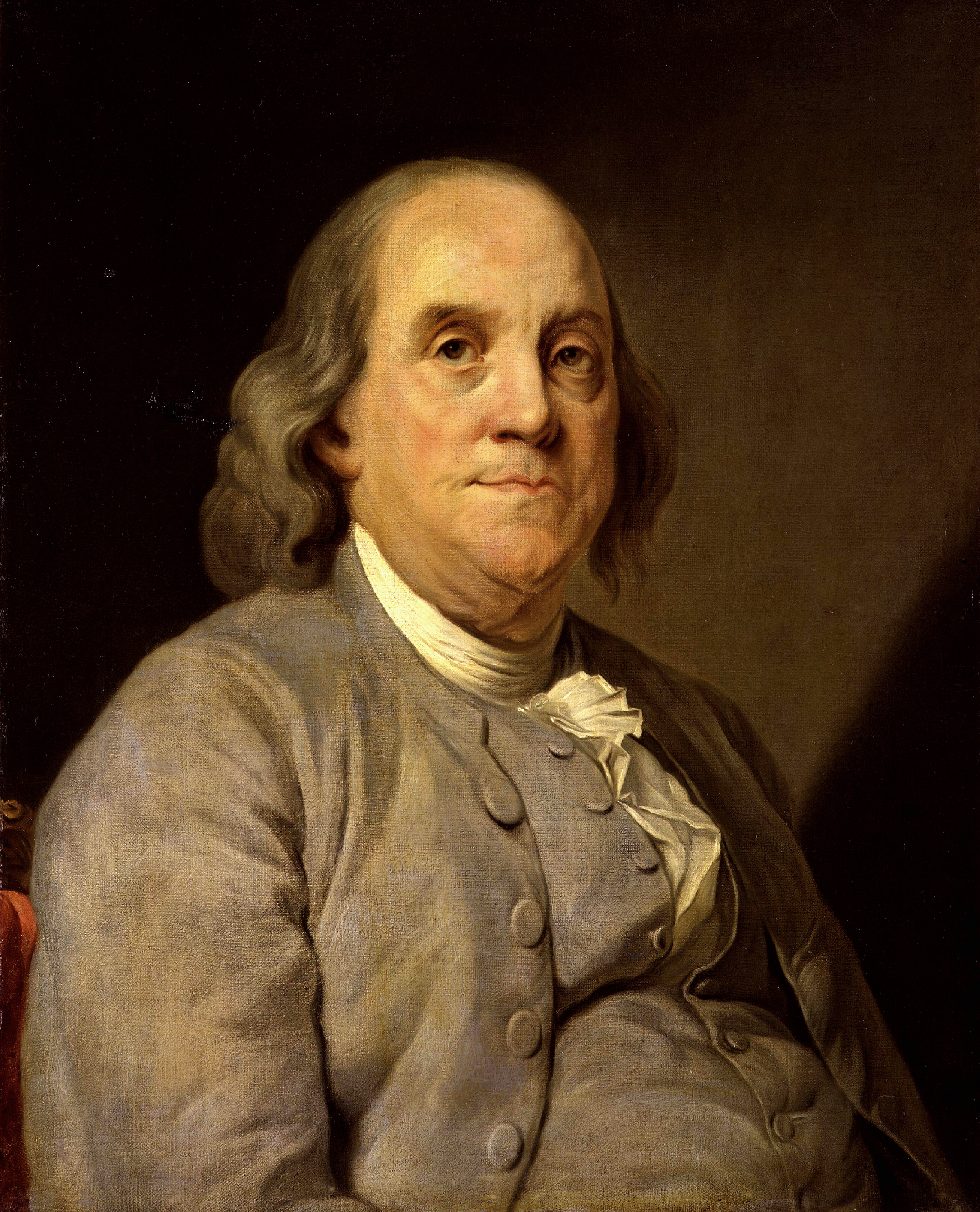
We are not related to Benjamin Franklin

Benjamin Franklin. To whom we are not related.


As the 4th of July draws near, the Founding Fathers are on our minds. We are related, distantly, to some of them, but alas we are not related to my favorite: Benjamin Franklin. We do, however, have a non-family connection (of a sort).

In my post on the Cape Cod Calvinist Kerfuffle of 1717-1738, I mentioned my eight great-grandmother, Jedidah Smith Osborn. Her grandfather and great-grandfather were both named Thomas Mayhew. They were founders and leaders of the European colony on Martha's Vineyard, and they ran a mission school on the island. They were both fluent in the Wapanoag language and their strong relationships with the Wapanoag community (among other things, they required Europeans to pay an honest price for the land they colonized) kept the island from being pulled into King Phillip's War. By the (admittedly quite low) standards of the day, they were respectful and considerate of the indigenous people.

The two Thomases were assisted by Peter Folger (or Foulger). Peter had come to New England in 1635 with his parents, but he was a Baptist and therefore was harder to employ or to integrate into the Puritan society. The Mayhews were more tolerant in this respect, also, than their brethren on the mainland. When Thomas Jr. left for a return trip to England (from which he never returned) he left the mission and school in Peter's hands. Peter later surveyed and then led a European settlement on Nantucket. He married Mary Morrill, with whom he had a number of children, including their second-youngest daughter, Abiah, who married Josiah Franklin and was mother of Benjamin Franklin.

So, although we have no blood relationship with Benjamin Franklin, our families are intertwined, and young Ben no doubt grew up hearing stories about our Mayhew great-grandfathers from his own grandfather.