Showing posts with label Kinney. Show all posts

Friday, August 16, 2024

What, Exactly, is a Farm?

A colleague with whom I share both anthropological and genealogical interests pointed me toward this webpage of Washington history. I didn't find much specifically about our ancestors, but this post about the origins of Oak Harbor in January, 1851 was interesting. It hits both my family history interests and my anthropological research on land use and historical ecology. Note this section:

Norwegian shoemaker Zakarias Martin Taftezon (also spelled Toftezen and Taftsen, among other variants) (1821-1901), Swiss Ulrich Freund, and New Englander Clement W. "Charlie" Sumner met each other at New Orleans while en route to the 1849 California gold rush. They did not strike it rich in the gold fields and headed north to the Oregon Country. In late 1850, they landed in Olympia and with the help of Samuel Hancock, took an Indian canoe north down Puget Sound to find available land....

According to pioneer Jerome Ely, Taftezon cut steps into the steep bluff at the mouth of the inlet the Skagits called Kla-tole-tsche to climb up and view the area to the north. He spied the Oak Harbor prairie free of the dense stands of trees that covered so much of the region....Much of Puget Sound was covered by dense stands of timber, but the grass-covered prairies where the Indians dug their camas roots offered good prospects for farming.

I love "the grass-covered prairies where the Indians dug their camas roots offered good prospects for farming." Yes, they did. Because they were farms! You will generally see these roots classified as "wild" foods but the boundary between "wild" and "domesticate" or between "prairie" and "farm" is a lot fuzzier than most people realize. Indigenous people of the Pacific Northwest created fields of camas and manipulated soil and roots to make camas more productive. These prairies were created and managed ecosystems for growing camas. Sounds kinda like a farm, doesn't it?

Other crops grown by the Indigenous people of the Pacific Northwest include various fruit-bearing trees, berries, and (my personal favorite) shellfish in aquaculture beds.

So why didn't the Euro-American settlers arriving on Whidbey Island mention that it was covered in farms? Partly because they did not recognize them. These Indigenous fields didn't look like European farms, with fences and plow furrows and red-pained barns. The settlers' ethnocentrism only allowed them to see Europe-style farms as "true" farms. 

But also, settlers often refused to recognize the farms right in front of their faces because that would mean recognizing that they had stolen someone's land. Land grabs in this time period were based on the idea that Euro-Americans were hard-working people who improved and built upon land while Indigenous people were not. As "proof" of this, Euro-Americans pointed to the fact that much of North America was made up of unsettled or unimproved land. And where that wasn't true (which it mostly wasn't) they pretended it was true.

Now for the genealogical connection: note the reference to Samuel Hancock and the implication that he's working with Indigenous people to transport settlers to Whidbey island. Some thirty years later Mr. Hancock helped his great-nephew, E.J. Hancock, to move to Whidbey island, where E.J. married Julia Kinney, the daughter of a local ship captain. They became my great-great-grandparents.

Sunday, December 25, 2022

Mary Jane Robinson Houghton. Maybe

 My great-great-grandmother is Julia Kinney Hancock. We have a lot of documentation about her mother, Mary Elizabeth Houghton Hancock. Mary Elizabeth's parents have always been difficult to securely document. There are a number of family trees out there on the intertubes that make various claims for her parents, but actual proof is sparse. 

Here's what we know for certain:

  • There is a marriage recorded for Mary Elizabeth Houghton, age 26, and Thomas F Kenney (we spell it Kinney), age 28, in Boston, MA, for March 20, 1858. This records her parents' names as William and Mary J. Houghton. Hopefully, this is true. I only express doubt because some of the information on the record is clearly false. Both Thomas and Mary Elizabeth claimed to be born in Boston and to be the children of parents born in Boston. In fact, both were born in Nova Scotia and all of their later census records list English Canada as the birthplace of their parents. [Massachusetts Marriages, 1695-1910," database, FamilySearch (https://familysearch.org/ark:/61903/1:1:FC6Q-MCX : accessed 15 February 2016), Thomas F. Kenney and Mary E. Houghton, 20 Mar 1858; citing reference ; FHL microfilm 818,099.]
These are the transcribed marriage records for the city of Boston in 1858. Thomas Kenney/Kinney and Mary Elizabeth Houghton are second from the bottom. I really wish she had included her mother's maiden name and/or that we had the original documents

  • The obituary of Julia Kinney Hancock, daughter of Thomas Kinney and Mary Elizabeth Houghton, states that she was born in Hall's Harbor, Nova Scotia, in 1859. Since Thomas Kinney was a mariner, he was away from home frequently. He had grown up in Yarmouth, 150 miles away from Hall's Harbor. If Mary Elizabeth was in Hall's Harbor when her daughter was born, it suggests that her family may have been from the area. Also, Hall's Harbor is small. It's not likely she was there because it was a major hub. The 1861 Canada Census has Thomas and Mary Elizabeth Kinney in Kings County (where Hall's Harbor is located). ["Nova Scotia Census, 1861," database, FamilySearch (https://familysearch.org/ark:/61903/1:1:MQQD-MY2 : 8 November 2014), Thos F Kenny, Kings, Nova Scotia, Canada; citing line 17; Library and Archives Canada film number M-881, Public Archives, Halifax; FHL microfilm 865,126.]
My Great-Aunt Lilian, who is always proven right in the end, has Mary Elizabeth Houghton's mother's maiden name as Robinson. I don't know if that information was handed down in the family or if she found documentation. 

Finding a William and Mary J Houghton living in Kings County, Nova Scotia around the time of Mary Elizabeth's birth in 1831 has been a challenge. The names are quite common. I may have finally come up with a breakthrough, though, and it leads to an unexpected reason why we may know less about Mary Elizabeth's family than we do about the Kinney side, as well as why she and Thomas lied about their birthplaces: it looks like Mary Elizabeth was Catholic. Perhaps the couple eloped in order to avoid familial or religious barriers?

I base this on the most likely records I can find of her parents, a William and Mary Houghton living in Hall's Harbor around the time that Mary Elizabeth would have been living there with her newborn daughter:
  • There is a William Howton in the Canadian census in Kings County, Nova Scotia, in 1861. ["Nova Scotia Census, 1861," database, FamilySearch (https://familysearch.org/ark:/61903/1:1:MQQD-9K4 : accessed 18 November 2015), William Howton, Kings, Nova Scotia, Canada; citing line 10; Library and Archives Canada film number M-881, Public Archives, Halifax; FHL microfilm 865,126.]
  • William Howton and his wife Mary J. are recorded in Kings County, Nova Scotia in the 1871 census, along with two daughters, Teressa and Louisa, ages 19 and 17. [http://data2.collectionscanada.ca/1871/pdf/4396663_00061.pdf]. William is listed as 63, Roman Catholic, a farmer, and born in Ireland. Mary J is 60, Roman Catholic, and also listed as born in Ireland. However, when her daughter, Louisa Frances Murphy, died in 1934, her death certificate states that her mother was born in Canada. 
  • In the 1891 census, William is recorded in Woodville, Kings, Nova Scotia, as an 87 year old widower. Woodville is about 10 miles from Halls Harbor. ["Canada Census, 1891," database, FamilySearch [https://familysearch.org/ark:/61903/1:1:MW23-4FX : accessed 18 November 2015), Wm Houghton, Woodville, Kings, Nova Scotia, Canada; Public Archives, Ottawa, Ontario; Library and Archives Canada film number 30953_148119.] 
Unfortunately, it's hard to tie this William Houghton and Mary J. to Mary Elizabeth Houghton Kinney. There are indications, however, that Mary J.'s maiden name was Robinson, which is the name in Aunt Lil's records. 

In the records of the Catholic church, St. John the Evangelist, in Windsor, Nova Scotia, I found the baptism of Patrick Houghton, son of William Houghton and Jane Houghton nee Robinson. It would not be at all surprising if Mary J went by her middle name. That's incredibly common in Catholic communities where every other woman is named Mary. Patrick's baptism was sponsored by Michael Donahue and Bridget Houghton. Patrick was baptized September 29, 1835. This would make him a perfect age to be the brother of Mary Elizabeth. Windsor, however, is about 30 miles from Hall's Harbor. ["Canada, Nova Scotia Church Records, 1720-2001", database with images, FamilySearch (https://www.familysearch.org/ark:/61903/1:1:DQJQ-D4MM : 27 May 2021), Patrick Houghton, 1835.]

The baptismal record of Patrick Houghton from the 1835 records of St. John the Evangelist Catholic Church in Windsor, Nova Scotia. The relevant record is in the upper right corner


The same church records have evidence for a likely sibling of Patrick's, Jane. Again, the parents names are listed as William Houghton and Jane Robinson. She was baptized August 27, 1837. Her sponsors were Patrick Lyons and Elizabeth Doye (or Dolyle?) ["Canada, Nova Scotia Church Records, 1720-2001", database with images, FamilySearch (https://www.familysearch.org/ark:/61903/1:1:DXMX-4SMM : 27 May 2021), William Hauton in entry for Jane or Janne Hauton, 1837.]

The record of Jane Houghton's baptism at St. John the Evangelist in Windsor, Nova Scotia, in 1837. Her record is on the bottom right of the page.

OK, but if these are siblings of Mary Elizabeth's, this begs two questions: 1) why isn't Mary Elizabeth's baptism in the records?; and 2) why are these records from a church so far from Hall's Harbor?

The answer to the first question is just depressing: the records don't go back far enough to catch Mary Elizabeth's birth. The answer to the second question, though, may be that Kings County didn't have a church of its own and relied on an itinerant priest. Another possible sibling of Mary Elizabeth's is listed in the baptismal records of the same church, St. John the Evangelist in Windsor, in 1840. This record book, however, actually lists the locations in which the weddings, funerals, and baptisms took place. They are from a variety of areas around Windsor, such as Kentville and Horton. The record for the baptism of Lavinia Houton [sic], daughter of William Houghton and Jane Robinson, specifically states it took place in Cornwallis. Cornwallis was one of the original townships of Kings County. She was sponsored by James Houghton and Mary Porter ["Canada, Nova Scotia Church Records, 1720-2001", database with images, FamilySearch (https://www.familysearch.org/ark:/61903/1:1:DWHV-8JMM : 27 May 2021), William Houton in entry for Lavinia Houton, 1840.]

Baptismal record of Lavinia Houghton, March 24, 1840, in Kings County, Nova Scotia. Her record is on the right near the center.

Other children baptized at the same church to William Houghton and Jane Robinson include:
  • Henry, on July 1, 1849, at 10(?) months old, sponsored by James Lyons and Mary Sullivan ["Canada, Nova Scotia Church Records, 1720-2001", database with images, FamilySearch (https://www.familysearch.org/ark:/61903/1:1:DWHG-V6N2 : 27 May 2021), Wm Houghton in entry for Henry Houghton, 1849.] 
  • Agnes (baptized at 5 months old on May 30, 1850), sponsored by Joseph Henderson and Bridget Thompson ["Canada, Nova Scotia Church Records, 1720-2001", database with images, FamilySearch (https://www.familysearch.org/ark:/61903/1:1:D7BM-YY2M : 27 May 2021), William Haughton in entry for Agnes Haughton, 30 May.]
  • Theresa, on October 17, 1851, sponsored by . In this record, the mother's name is listed as Mary Jane Robinson and the location is Cornwallis. Her sponsors names are hard to read, but I think it says Patt Sarsfield and Johanna Sulivan. ["Canada, Nova Scotia Church Records, 1720-2001", database with images, FamilySearch (https://www.familysearch.org/ark:/61903/1:1:DW2P-9DMM : 27 May 2021), William Haughton in entry for Teresa Haughton, 1850.] 

Are Henry, Agnes, and Theresa from the same family? Are they all (or any of them) siblings of Mary Elizabeth? It's hard to tell. I suspect not, though, since they do not show up in the census with our "target" William and Mary J. Houghton in 1861. With such common last names, though, it's hard to tell. 

One last record that might be relevant:

The baptism of Anne Houghton, lawful daughter of William Houghton and Janet Robinson, on Oct 22, 1833. She was sponsored by Neil Kelly and Bridget Lyons. Note that Patrick had been sponsored by a Bridget Houghton and Jane Houghton was sponsored by a Patrick Lyons. Could these be relatives? Or just frustratingly common Irish names? Anne was not baptized in the same church as the others. She was baptized in St. Gregory, Liverpool, Nova Scotia, which is on the opposite side of the peninsula from Kings County. ["Canada, Nova Scotia Church Records, 1720-2001", database with images, FamilySearch (https://www.familysearch.org/ark:/61903/1:1:DH6S-SPMM : 27 May 2021), Wiliam Houton in entry for Anne Houton, 1833.]

Here's what I'd really like for Christmas: a baptismal record for Mary Elizabeth Houghton herself. Short of that, I'd at least like the baptismal records for the daughters listed in the 1861 census (Theresa and Louisa) so I can directly connect them to the same family. 


Sunday, July 21, 2019

Julia Kinney Hancock, painter


When she visits, my mother often brings a treasure-trove of genealogical materials from my grandmother's stored belongings. This week, she brought this oil painting. On the back it says "Painted by Julia Kinney as a girl". Julia, who was my great-great-grandmother, was born in 1859. I'd guess her "girlhood" to be anytime before 1880. Before she reached the age of 20, Julia had lived in Nova Scotia, Boston, San Francisco, and Whidbey Island, Washington. This landscape doesn't particularly remind me of any of those areas, but it's more "east coast-y" than west. On the other hand, she very well may have copied some other painting and not seen this landscape in real life.

If you look closely, you'll see that the human figures are a bit stiff but the animals and landscape are quite good. Joe wanted to know if she kept painting, and if the family has any of her other work. Honestly, I don't know. Maybe some of my cousins do?

Saturday, August 11, 2018

Stephen Deane and Elizabeth Ring (again)

Stephen Deane (sometimes Dean) was born around 1605, based on his date of marriage. He arrived in Plymouth in 1621 on the Fortune and was admitted as a freeman before 1633. 

By 1630, he married Elizabeth Ring. We've heard about her before because she married Josias Cooke after she Stephen's death. We're descendants of their son Josiah, too. Stephen and Elizabeth had three children, Elizabeth (born around 1630), Miriam (1632), and Susanna (1634). Elizabeth married William Twining of Eastham. Miriam married John Wing, and Susanna, our ancestor, married Joseph Rogers and, after his death, Stephen Snow.

Stephen Deane was well enough educated to sign his deeds and to own a bible and other books. As noted in the previous post, Elizabeth may also have been literate. Stephen owned a corn mill near Plymouth and bought Godbert Godbertson's house in 1633. He only served on one committee, the one to assess taxes in 1634. 

Stephen died before October 1634. 

Stephen Deane -- Elizabeth Ring
             - Susanna Deane -- Stephen Snow
                 - Bethia Snow -- John Smith
                     - Mercy Smith -- Nathan Kinney
                         - Nathan Kinney -- Sarah Nickerson
                             - Thomas Kinney -- Lydia Bartlett
                                  - Simeon Kinney -- Olive Doane
                                      - Thomas Kinney -- Mary Houghton Kinney
                                          - Julia Kinney Hancock -- Ernest Hancock

References:

Anderson, Robert Charles 1995 The Great Migration Begins: Immigrants to New England 1620-1633. New England Historic Genealogical Society.

Saturday, August 4, 2018

Josias Cooke and Elizabeth Ring Dean

Josias Cooke was born around 1610, based on the age stated in his will. He arrived in Plymouth in 1633. He was admitted as a freeman in January 1636/7. He is not related to Francis Cooke, at least not closely.

In September of 1635, Josias married Elizabeth Dean, widow of Stephen Dean (who is also one of our ancestors) and daughter of widow Mary Ring. Her parents may have been William and Mary Ring of Ufford, Suffolk. Elizabeth already had three children with her first husband (we're descended from their youngest child, Susanna). She and Josias had three more: Anna, who married Mark Snow; Bethia, who married Joseph Harding; and Josiah, our other ancestor, who married Deborah Hopkins.

Both Josias and Elizabeth may have been educated. Josias had enough education to serve as town clerk. Both he and his wife had books mentioned in their estates at their times of death.

Josiah was a tavern keeper. He served on a number of juries, surveying and land purchase committees, and as constable of Plymouth in 1640. He moved to Eastham by 1647, when he served as the Eastham deputy to the Plymouth general court, and given a license to sell wine at Nauset (Eastham) in June 1648. He was on the 1643 list of men allowed to bear arms. He must have been well respected, given the number of times he served as deputy, selectman, or notary. He was not above spats, however. In March 1633, he was fined for fighting with Edward Doty (another of our ancestors). Doty, apparently, drew blood. He also involved in a number of petty lawsuits.

He died in Eastham in October 1673. Elizabeth outlived him. She died in Eastham in May 1687. At his death, his estate was worth 104 pounds, 17s, not including the real estate.

Josias Cooke -- Elizabeth Ring
- Josiah Cooke -- Deborah Hopkins
  - Deborah Cooke -- Moses Godfrey
     - Moses Godfrey -- Martha Collins
        - Joseph Godfrey -- Mehitable Hamilton
           - Sarah Godfrey -- Isaac Kenney
              - Mehitable Kenney -- Israel Doane
                 - Olive Doane -- Simeon Kinney
                    - Thomas Kinney -- Mary Elizabeth Houghton
                       - Julia Kinney -- Ernest Hancock

References:

Anderson, Robert Charles 1995 The Great Migration Begins: Immigrants to New England 1620-1633. New England Historic Genealogical Society.

Saturday, July 28, 2018

Francis Cooke and Hester Mahieu

Francis Cooke was born around 1583. He moved to Leiden before 1603, where he met and married Hester Mahieu. They had seven known children, six of whom survived to adulthood.

Francis and Hester were members of the Puritan congregation in Leiden, although they were not part of the original congregation that left England together. Hester was a French Walloon, and upon marriage Francis joined the Walloon church in Norwich and then Leiden. Either Francis or Hester probably had some level of education because upon Francis's death his estate included one Bible and four older books.

Francis came to Plymouth aboard the Mayflower with his eldest son John, who would have been around 13 at the time.  (I will note that Anderson gives John Cooke his own chapter, even though he was still a child in his father's household at the time of his arrival. No such courtesy was afforded to the Carpenter sisters or Mary Chilton, of course). Hester and their three other children, including our ancestor Jacob Cooke, arrived on the Anne in 1623. Jacob was the second son, born around 1618. He would have been a toddler at the time of the voyage. Later, he married Damaris Hopkins, the daughter of Stephen Hopkins, another Mayflower passenger.

Francis was listed as a freemen before 1633. Like most respectable men of the Massachusetts colony, Francis fulfilled a variety of offices, including committees for laying out land and highways. He was listed among the men able to bear arms in 1643. He died in Plymouth in April 1663, and his estate was valued at over 86 pounds. After his death, there were a number of court cases relating to the distribution of his land between his children.

Francis Cooke -- Hester Mahieu
  - Jacob Cooke -- Elizabeth Lettice
     - Sarah Cooke -- Robert Bartlett
        - Lemuel Bartlett -- Mary Doty
           - Lemuel Bartlett -- Hannah Tinkham
              - Lydia Bartlett -- Thomas Kinney
                 - Simeon Kinney -- Olive Doane
                    - Thomas Kinney -- Mary Elizabeth Houghton
                       - Julia Kinney -- Ernest Hancock


References:

Anderson, Robert Charles 1995 The Great Migration Begins: Immigrants to New England 1620-1633. New England Historic Genealogical Society.

Saturday, July 21, 2018

Henry Cobb and Patience Hurst

Henry Cobb and his first wife, Patience Hurst, daughter of James Hurst, arrived in Plymouth in 1632. Perhaps it's better to say that both Henry and Patience were in Plymouth and married by that date. It's not clear from the documentation whether they married in Massachusetts colony or before arrival. Patience's father was also an early immigrant to the region (but I haven't reached the H book, yet, so I don't know how early).

Henry was born around 1607, based on his year of marriage. His background is unknown. He and Patricia had seven known children. We're the descendants of their eldest son, John.

Henry was a tavernkeeper. Although the family started in Plymouth, they had moved to Scituate by 1634 and to Barnstable by 1639. Most of our Kinney ancestry comes from the Barnstable area, which is out on the arm of Cape Cod. Interestingly, when the Cobbs left Scituate, they sold their lot and house to Manasseh Kempton, another of our ancestors, the husband of Juliann Carpenter.

Both Henry and Patience were members of the church. Henry was ordained a ruling elder in Barnstable in April 1670. He was a freeman before 1633. Henry had at least some education. He was able to sign his own name, as seen on some surviving documentation. His estate included 24s of books. Henry served a number of offices, including deputy and excise collector for Barnstable, and on a number of juries. While a Barnstable deputy, he was fined for "defect in appearance". He was also one of the men authorized to bear arms in 1643.

After Patricia's death, Henry married Sarah Hinckley in December 1649. They had seven children. Henry died sometime between February of 1678 and June of 1679. Patience was buried in Barnstable in May 1648. At his death, Elder Cobb's estate was valued at 80 pounds, including his house and land.

Henry Cobb -- Patience Hurst
  - John Cobb -- Martha Nelson
     - Ebenezer Cobb -- Mercy Holmes
        - Hannah Cobb -- Jacob Tinkham
           - Jacob Tinkham -- Lydia Dunham
              - Hannah Tinkham -- Lemuel Bartlett
                 - Lydia Bartlett -- Thomas Kinney
                    - Simeon Kinney -- Olive Doane
                       - Thomas Kinney -- Mary Elizabeth Houghton
                          - Julia Kinney -- Ernest Hancock


References:

Anderson, Robert Charles 1995 The Great Migration Begins: Immigrants to New England 1620-1633. New England Historic Genealogical Society.

Saturday, July 7, 2018

Juliann Carpenter and Manasseh Kempton

Here's a real treat: one of the only women to be given her own entry in Anderson's The Great Migration Begins. Sort of.

There's a whole other blog post to be written about the way Anderson organizes his volume by the male head of household, with women as the afterthought, tucked away in the "married" section. Even when women came to the Massachusetts Colony as single, independent people, they don't all get their own entry. Take Juliann. She and her three other sisters are hidden away under their youngest sister Priscilla's entry. It's not clear why the other sisters don't get their own independent entries, since all but one was in Plymouth before 1633. The last of the five sisters may also have been there, I just don't have the documentation to know at this point. They're probably discussed in more detail under their husbands' entries.

Anyway, here's the story of five sisters: Juliann, Agnes, Alice, Mary, and Priscilla, all daughters of Alexander Carpenter, who probably arrived as single women at Plymouth, or perhaps married men who then came to Plymouth, or both. 

Alexander Carpenter was from Wrington, Somersetshire. His five daughters were born between 1583 and 1598, although all dates are conjectural. He moved his family to Leiden by 1611, along with many of the other Puritans. Alexander never came to Massachusetts, but his daughters did. William Bradford wrote a letter to Mary Carpenter of Wrington, who was his wife Alice's sister, in August of 1644 or 1646 noting that the Carpenter sisters' mother had recently died and invited Mary to join them in Plymouth. Although Anderson doesn't lay it out in detail, I assume this means a) the Carpenter sisters were close kin to Alice Carpenter Bradford; b) the Carpenter sisters' mother, who is unnamed at least in Anderson's book, had also come to Massachusetts. Anderson notes that all of the sisters seem to have married a little later than was the norm for women of the time. This seems consistent (to me, at least) with their independence in coming to the colony on their own.

Juliann, our ancestor, was probably the eldest sister. She married George Morton. After she was widowed, she married Manasseh Kempton before May 1627. We are descended from their daughter, Patience Kempton. The second sister, Agnes, married Samuel Fuller. Alice married Edward Southworth and after his death William Bradford (yes, the one whose wife was her kin). Mary never married but lived until 1687 (Go girl!). Priscilla married William Wright and then John Cooper.

Is this a good time to point out how ridiculously inbred the Puritans were? By 1633, the English population of the Massachusetts Colony was still pretty small. Plus, they'd followed a type of chain migration, bringing their brothers and sisters, cousins, and in-laws to the colony once they'd settled in, narrowing their matrimonial choices even further. It's no surprise that we are descended from so many people who are listed in Anderson's book. If you have any ancestry from the early Great Migration period, you most likely are related to a significant percentage of the very small, very endogamous community that perched on the edge of Wampanoag territory.

Juliann Carpenter -- Manasseh Kempton
             - Patience Morton -- 
                 - Thomas Faunce -- 
                     - Martha Faunce -- 
                         - Mary Doty -- 
                             - Lemuel Bartlett -- 
                                  - Lydia Bartlett -- Thomas Kinney
                                      - Simeon Bartlett Kinney -- Olive Doane Kinney 
                                          - Thomas Kinney -- Mary Houghton Kinney
                                              - Julia Kinney Hancock -- Ernest Hancock


References:

Anderson, Robert Charles 1995 The Great Migration Begins: Immigrants to New England 1620-1633. New England Historic Genealogical Society.

Saturday, June 30, 2018

Peter and Martha Brown (or Browne)

Here's another in my series of ancestors who are documented in Robert Charles Anderson's The Great Migration Begins.  Peter Brown is one of our Mayflower ancestors. He was born around 1600, based on his date of marriage. His wife, Martha, arrived on the Fortune in 1621. Her first husband, William Ford, died on the voyage. Martha arrived with their two children and gave birth to another child almost immediately upon landing. By 1626, she married Peter. She died in 1630 or 1631, after bearing him two daughters, Mary and Priscilla. Peter quickly remarried, to a woman named Mary (last name unknown), but he did not live much longer. He died sometime before October 10, 1633, when his estate was inventoried.

Peter was listed as a freeman by 1633. It's not clear if he was educated. The only book in his estate was a bible. His estate was worth over 100 pounds, but was complicated by the fact that his household included his own children from two different wives and his his wives each had children from a previous marriage. Our ancestor, Peter's daughter Mary, was placed upon her father's death in the household of John Doane, of Plymouth. She would have been around seven years old. John Doane is also one of our ancestors, as Mary's descendants eventually intermarried with his.

Peter had a brother, John, who also came to Massachusetts by 1632 and lived in Duxbury.


Peter Browne -- Martha (unknown) Ford
             - Mary Browne -- Ephraim Trinkham
                 - Helkiah Tinkham -- Ruth Cooke
                     - Jacob Tinkham -- Hannah Cobb
                         - Jacob Tinkham -- Lydia Dunham
                             - Hannah Tinkham -- Lemuel Bartlett
                                  - Lydia Bartlett -- Thomas Kinney
                                      - Simeon Kinney -- Olive Doane  
                                          - Thomas Kinney -- Mary Houghton
                                              - Julia Kinney Hancock -- Ernest Hancock


References:

Anderson, Robert Charles 1995 The Great Migration Begins: Immigrants to New England 1620-1633. New England Historic Genealogical Society.

Saturday, June 23, 2018

William and Mary Brewster

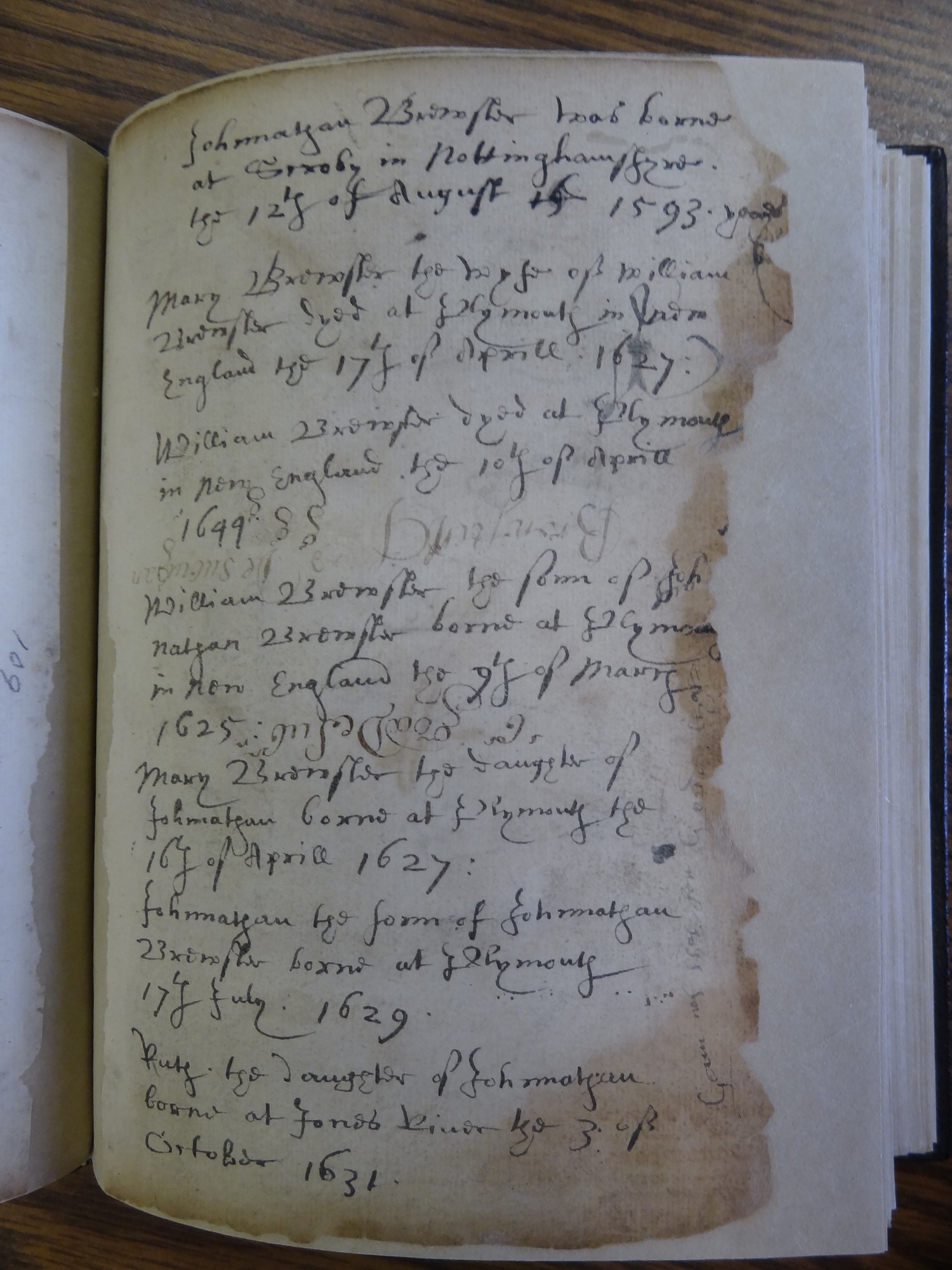
 A page from the "Brewster Book," containing some of the family birth and death records for William and Mary Brewster and their children.
A page from the Brewster family Bible. http://mayflowerhistory.com/brewster-william/


William and Mary Brewster were founding members of the separatist congregation at the heart of the Mayflower voyage. They were in Scrooby until 1608, when they fled with other members of the congregation to Leiden, where William became an elder, teacher, and printer. They were a leading family among those who undertook that first voyage to Plymouth.

William was born around 1566, probably in Scrooby, Nottinghamshire. His father's name was also William Brewster. Mary's maiden name is unknown. They were married by 1593.

William was well educated. He entered Peterhouse, Cambridge, in 1580, although he did not graduate. At the time of his death, an inventory of his estate found nearly 400 books, in English and in Latin, worth 42 pounds.

The Massachusetts colony did not have a formal minister, so William took on many of those duties, including preaching. He continued to do so after the family moved to Duxbury, after Mary's death on April 17, 1627. William died in Duxbury, April 10, 1644. They had six children, one of whom died in infancy. The surviving children were: Jonathan (born in 1593, clearly named before his parents converted), Patience, Fear, Love, and Wrestling. We are descended from his daughter Patience.

William Brewster -- Mary (unknown)
  - Patience Brewster -- Thomas Prence
                 - Mercy Prence -- John Freeman
                     - Edmund Freeman -- Sara Mayo
                         - Ruth Freeman -- Israel Doane
                             - Edmund Doane -- Elizabeth Osborn

                              - Israel Doane -- Desire Nickerson
                                    - Israel Doane -- Mehitable Kinney 
                                        - Olive Doane Kinney -- Simeon Kinney
                                            - Thomas Kinney -- Mary Houghton Kinney
                                                - Julia Kinney Hancock -- Ernest Hancock


References:

Anderson, Robert Charles 1995 The Great Migration Begins: Immigrants to New England 1620-1633. New England Historic Genealogical Society.

Saturday, June 16, 2018

William and Elizabeth Bassett

File:Reverend James Keith Parsonage, West Bridgewater MA.jpg
The Reverend James Keith Parsonage, built in Bridgewater, MA in 1662. It would have been a substantial part of the town where William (and possibly Elizabeth) Bassett lived. Photograph by John Phelan, wikicommons.


I'm continuing my series of ancestors who are documented in Robert Charles Anderson's The Great Migration Begins

There was more than one William Bassett in the Massachusetts colony during the Great Migration. This particular William Bassett was probably born around 1600, based on his marriage age. He and his first wife, Elizabeth, came to the colony in 1621 on the Fortune. While they originally lived in Plymouth, they moved to Duxbury by 1637 and Bridgewater by 1656. William was a blacksmith and a freeman before 1632/3. He must have been educator for his estate included more than twenty books, mostly about theology. 

William served in a number of committees and offices, including on juries and as a constable for Duxbury. He was listed as one of the men allowed to bear arms in 1643. He had an estate of at least 100 acres, and the final inventory of his estate valued more than 123 pounds without the land. More than 9 pounds of that was books, and a substantial amount more were his blacksmiths tools. 

Like, apparently, all inhabitants of the Massachusetts colony, William had occasional run-ins with the law. In his case, he was fined in 1648 for "not mending of guns in seasonable time" and in 1653 for "neglecting to publish and make known an order directed to him from the council of war, prohibiting provisions for being transported out of the colony."

It is unclear when Elizabeth died. She is not mentioned in any documentation after 1627, but William did not remarry until after 1651. Sometime between 1651 and December 12, 1664, he married Mary Tilden Lapham, daughter of Nathaniel Tilden and widow of Thomas Lapham. They did not have children.

William gave an oral will on April 3, 1667, and presumably died soon after.

We are descendants of William and Elizabeth's second son, Nathaniel, born around 1630. He married Dorcas Joyce, the daughter of John Joyce. 

            - William Bassett -- Elizabeth (unknown)
                 - Nathaniel Bassett -- Dorcas Joyce
                     - Hannah Bassett -- Joseph Covell
                         - Sarah Covell -- William Nickerson
                             - Mercy Nickerson -- Heman Kenney
                                  - Isaac Kenney -- Sarah Godfrey
                                      - Mehitable Kenney -- Israel Doane
                                          - Olive Doane -- Simeon Bartlett Kinney
                                             - Thomas Kinney -- Mary Houghton Kinney
                                                 - Julia Kinney Hancock -- Ernest Hancock


References:

Anderson, Robert Charles 1995 The Great Migration Begins: Immigrants to New England 1620-1633. New England Historic Genealogical Society.

Saturday, June 9, 2018

Robert Bartlett and Mary Warren Bartlett

Continuing my series on ancestors who can be found in Anderson's The Great Migration Begins (1995).

Robert Bartlett arrived in Plymouth, Massachusetts Colony, in 1623 on the Anne. He was a wine cooper, a freeman by 1632/3, and probably illiterate, since he signed all deeds with a mark. His origins are unknown, but it is estimated he was born in 1604, based on his date of marriage.

Highlights of his career in Plymouth include being summoned before the court on May 1, 1660, and convicted of "speaking contemptuously of singing of psalms". He also served on various committees, particularly those related to laying out or surveying highways and land. He was on the list of men in Plymouth who were permitted to bear arms in 1643. 

Before 1629, he married Mary Warren, the daughter of his neighbors Richard and Elizabeth Warren. Robert, Mrs. Elizabeth Warren (the mother-in-law) and his brother-in-law Thomas Little appear frequently in documentation pertaining to land and crops in and around Plymouth. He seems to have owned quite a bit of land. He received one acre upon arrival (as did all of Anne's passengers), but subsequent documents mention at least 100 acres of land.

Robert and Mary had eight known children: Benjamin, Rebecca, Mary, Sarah, Joseph, Elizabeth, Lydia, and Mercy. We are descendants of the second son, Joseph, who was born around 1639 and married Hannah Pope, daughter of Thomas Pope.

Robert gave a spoken will on September 19, 1676. In October, the inventory of his estate totaled 170 pounds, 16s, 6d, including 100 pounds in real estate, 2 houses and a barn.

Robert Bartlett -- Mary Warren
     - Joseph Bartlett -- Hannah Pope
          -Robert Bartlett -- Sarah Cooke
               - Lemuel Bartlett -- Mary Doty
                    - Lemuel Bartlett -- Hannah Tinkham
                         - Lydia Bartlett -- Thomas Kinney
                              - Simeon Bartlett Kinney -- Olive Doane
                                   - Thomas Kinney -- Mary Elizabeth Houghton
                                        - Julia Kinney -- Ernest Hancock


References:

Anderson, Robert Charles 1995 The Great Migration Begins: Immigrants to New England 1620-1633. New England Historic Genealogical Society.

Saturday, May 19, 2018

Julia Etta Kinney

Julia Etta Kinney Hancock, 1910

The latest post in my series about my great-great grandparents focuses on Julia Etta Kinney, wife of Ernest Justus Hancock, who was the focus of my last post. She is one of my four great-great grandparents born outside the United States (all four in Canada), but her family's history is in Massachusetts, going back to the Mayflower. The Kinneys were a sea-faring family; most of the men were ships captains, owned ship-building companies, or served as port authorities. Over their history, they tended to move from Massachusetts to Nova Scotia and back again as if the border didn't exist. Julia's grandfather and father, though, eventually re-located to the west coast, which is how she came to living in Coupeville, Washington, and meet her husband.

Julia was born in 1859 in Hall's Harbour, Nova Scotia, the daughter of Captain Thomas Kinney and Mary Elizabeth (Houghton) Kinney. Thomas Kinney was working on the west coast by 1851 (1), while Julia and her mother stayed on the east coast, which may be why Julia was an only child. According to a biography published in the Island County Times in 1947, her family moved to Yarmouth when she was four and then Boston the next year (2). Her parents had been married in Boston, so it is possible that they moved to be near her mother's family. In 1868, when she was 11, she and her mother moved to San Francisco to join her father. In 1871, they moved up the coast to Coupeville.

Julia was unusually well-educated, compared to the other children in Coupeville. She had, after all, gotten her elementary education in Boston and San Francisco, while many of the other Coupeville families had come from less developed areas. Perhaps it was inevitable, then, that she would become a teacher.
______
References:

1) Lewis and Dryden
2) Island County Times

Thursday, January 18, 2018

Edward and Rebecca Bangs, times two

I'm continuing my series of ancestors who are documented in Robert Charles Anderson's The Great Migration Begins. The history of Edward and Rebecca Bangs is much less salacious than that of Stephen Bachiler, but they are part of the reason that we are descended from basically everyone who lived on the outer arm of Cape Cod in the 17th and 18th centuries.

Edward Bangs was born in England sometime around 1591. He arrived in Massachusetts in 1623 on the Anne. He would have been about 32 years old. He initially lived in Plymouth where he was given four acres of land, which suggests his household consisted of four people. If the other three people were a wife and children, they must have died fairly early. By 1633, he married Lydia Hicks, who had also come to Massachusetts on the Anne. She was baptized at St. Mary Magdalen in Bermondsey, Surrey, September 6, 1612, so she would have been 21 or younger at the time of their marriage. The couple had one son, John, who was born sometime between 1631 and 1634. Lydia died soon after. By 1635, Edward re-married to Rebecca (her last name is uncertain) and they had nine children together. Rebecca may have been the daughter of Edmund Hobart, but there's no proof.

The Nauset Lighthouse in Eastham, Massachusetts, which is
only 300 years too young for Edward Bangs to have ever
seen it.
Edward and Rebecca Bangs moved to Eastham by 1645. Eastham is on the outer arm of Cape Cod. They owned land
around an area called "Warren's Wells". I have no idea where that would be. Edward was an innkeeper at least part of the time. At other times he is referred to as a "yeoman". In 1657 he was granted permission to sell wine and "strong waters" in Eastham, but only "for the refreshment of the English, and not to be sold to the Indians." In 1664, there is a record of him importing six gallons of liquor for his establishment.

Innkeeper Bangs was clearly an engaged citizens. He held a number of offices, including deputy to Plymouth Court for Eastham, serving on juries, and serving  many committees, including committees to divide land, assess taxes, and reunite Plymouth and Duxbury. He must have been known for his integrity or at least his willingness to serve.

It's not certain when Rebecca died, but she died before Edward because she is not mentioned in his will. Edward Bangs died between October 19, 1677, when he wrote his will, and March 5, 1677/8, the probate date. He was buried in the Eastham Cove Burial Ground, along with a large number of distant relatives.

We're related to Edward and Rebecca Bangs through two of their children. First, we're related through their eldest surviving son, Jonathan, not be be confused with John, who was the son of Edward's first wife, Lydia.

Edward Bangs -- Rebecca (unknown) Bangs
             - Jonathan Bangs -- Mary Mayo Bangs
                 - Mary Bangs Nickerson -- Thomas Nickerson
                     - Thomas Nickerson -- Lydia Covell Nickerson
                         - Desire Nickerson -- Elisha Nickerson
                             - Sarah Nickerson Kinney -- Nathan Kinney III
                                  - Thomas Kinney -- Lydia Bartlett
                                      - Simeon Kinney -- Olive Doane Kinney
                                          - Thomas Kinney -- Mary Houghton Kinney
                                              - Julia Kinney Hancock -- Ernest Hancock


We're also related through Edward and Rebecca's daughter, Hannah Bangs Doane.

Edward Bangs -- Rebecca (unknown) Bangs
             - Hannah Bangs Doane -- John Doane Jr.
                 - Hannah Doane Collins -- John Collins
                     - Martha Collins Godfrey -- Moses Godfrey
                         - Joseph Godfrey -- Mehitable Hamilton Godfrey
                             - Sarah Godfrey Kinney -- Isaac Kinney
                                  - Mehitable Kinney Doane -- Israel Doane
                                      - Olive Doane Kinney -- Simeon Kinney
                                          - Thomas Kinney -- Mary Houghton Kinney
                                              - Julia Kinney Hancock -- Ernest Hancock


References:

Anderson, Robert Charles 1995 The Great Migration Begins: Immigrants to New England 1620-1633. New England Historic Genealogical Society.

Thursday, January 11, 2018

Reverend Stephen Bachiler, a most notable crank

Bachiler coat of arms
Stephen Bachiler is my 13th great-grandfather. He led quite an interesting life.

He was born around 1560 in England and received a B.A. from St. John's college in Oxford in 1585/6. He was married four times, to progressively younger women, but Deborah was a daughter from his first wife, whose name might have been Anne, and who may have been the sister of Reverend John Bate. They were married by 1590 and she died before 1624.

Reverend Bachiler was frequently in trouble. Scandal and discord followed in his wake. He became the vicar of Wherwell, Hampshire, in 1587. He had puritanical leanings (in the theological sense) and was a notable nonconformist. In 1593 the Star Chamber cited him for making "lewd speeches tending seditiously" about Queen Elizabeth and her government. He was removed from his vicarage during a purge of Puritans in 1605, under James I. In 1614, he was once again before the Star Chamber when Reverend George Wighley accused him, his son Stephen, John Bate (who may have been his brother-in-law and/or cousin), of libeling and ridiculing him in verse. In the 1620s, the Bachilers moved to Newton Stacey a village in Hampshire. Somehow he incited his parishioners to act against the sheriff of the parish, who had to petition for aid to the King in Council.

Reverend Bachiler clearly knew other Puritans. Some of his children moved to the Netherlands, presumably to be part of the Puritan community there. In 1621, Adam Winthrop, father of Governor John Winthrop, made note in his journal of dining with Bachiler. Bachiler would have been well aware of the Puritan colony in Massachusetts.  In the 1630s he joined a group of London merchants to form the Plough Company, which sent two shiploads of settlers to New England.

Stephen Bachiler himself arrived in New England in 1632, aboard the William and Francis, the second of the Plough Company's ships. He was already at least 70 years old. His first wife, Anne, was already dead, and he had married twice more. It's not clear who came with him on this voyage, but his youngest daughter with Anne, Theodate Bachiler Hussey, was already in New England with her husband. Reverend Bachiler first settled at Lynn with her and tried to form a new church. However, there was constant unrest within the congregation. Furthermore, he didn't get along any better with the authorities in New England than he had in England. He is believed to have been the only dissenting vote among the ministers against the expulsion of Roger Williams, the founder of Providence. For these reasons, presumably, Bachiler was pushed out of his position as minister in Lynn by 1636.

He may have moved from Lynn to Ipswitch, but in 1637 he moved to Yarmouth. Rather, apparently, he walked there. In winter. Considering he was about 77 at the time, that's pretty impressive. He didn't stay in Yarmouth long. The next year he left for Newbury. Again, he did  not stay long and moved on to Hampton in 1639. Governor Winthrop noted that "Mr. Batchellor had been in three places before, and through his means, as was supposed, the churches fell to such divisions, as no peace could be till he was removed."

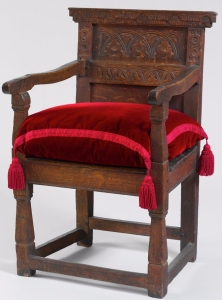
This is the Hussey-Bachiler chair. It is in the Met.
Reverend Bachiler once sat here.
In 1641, Bachiler was pushed out of Hampton when he "did solicit the chastity of his neighbor's
wife." The subsequent scandal kept him from finding employment in other parishes. He moved to Strawberry Bank, which is now Portsmouth. While living there, in 1648, he married Mary Magdalene Bailey, who was some 60 years his junior. Unsurprisingly, the marriage between the 26 year old widow and the 88 year old minister was...rocky. In 1650 they were brought to the Quarterly Court because, essentially, Mary was living with another man. In 1651, when Mary got pregnant despite being estranged from her husband, George Rogers was sentenced to 40 strokes for adultery. His partner, Mary,  "for her adultery shall receive 40 strokes save one at the first town meeting held at Kittery six weeks after the delivery and be branded with the letter A." Some scholars believe Mary Bachiler was the inspiration for Nathaniel Hawthorn's novel, The Scarlet Letter.

Reverend Bachiler returned to England, probably in 1651. He died and was buried in London on October 31, 1656. He was around 96 years of age.

Because some of his children stayed in New England, he counts a number of famous Americans among his descendants. These include Richard Nixon, Jennie Jerome (Winston Churchill's mother), Gerald Ford, H.H. Dow (founder of Dow Chemical), Meghan Markle (soon to marry into the British royal family), Daniel Webster, and John Whittier.

Our relationship to Reverend Bachiler (down to my great-great grandmother):
Stephen Bachiler -- Anne
     - Deborah Bachiler Wing -- John Wing
         - Daniel Wing -- Hannah Swift Wing
             - Lydia Wing Abbot Hamilton -- Thomas? Hamilton
                 - Daniel Hamilton -- Mary Smith
                     - Samuel Hamilton -- Bethia Stewart Hamilton
                         - Mehitable Hamilton Godfrey -- Joseph Godfrey
                             - Sarah Godfrey Kinney -- Isaac Kinney
                                  - Mehitable Kinney Doane -- Israel Doane
                                      - Olive Doane Kinney -- Simeon Kinney
                                          - Thomas Kinney -- Mary Houghton Kinney
                                              - Julia Kinney Hancock -- Ernest Hancock

References:

Anderson, Robert Charles 1995 The Great Migration Begins: Immigrants to New England 1620-1633. New England Historic Genealogical Society.

Stephen Bachiler on Wikipedia