Showing posts with label Rooney. Show all posts

Tuesday, May 21, 2019

A Little More Rooney Info

I have written previous blog posts (here and here) about John and Eliza Rooney, my 3xgreat-grandparents. When I first got interested in genealogy, I was surprised to find that they had died and were buried in Osakis, MN, which is only about 45 minutes from where I live now.

Today, I went to the Douglas County Historical Society, which has a lot of really lovely people who help do genealogical research. On their webpage, it said they had a family file on John and Eliza Rooney. It turned out they didn't have much, and they weren't able to find any obituaries. They did have a page from what is clearly one of those county history books that were so popular in the U.S. in the early 20th century. The page had an entry for A.A. Rooney, John and Eliza's youngest son. Here's what is says that's of interest to the wider family:

A.A. Rooney, one of the well-known and successful farmers of Osakis township, Douglas county, was born in Dodge county, Wisconsin, on September 17, 1870, the son of John and Elizabeth (Kelly) Rooney, who were born in Ireland and there received their education in the common schools, grew to manhood and womanhood and were married. In 1848 they decided that they would leave the land of their birth and seek a home in America, where so many of their countrymen had come. After landing in New York they decided to locate there, and for the next seven years that was their home. In the fall of 1854 they removed to Dodge county, Wisconsin, where they lived until 1887, when they became residents of Minneapolis, where they resided for the next two years. In 1889 they located in Austin, Minnesota, and lived there three years, after which they removed to Farmington, where they remained until 1901. They then removed to Osakis township, Douglas county, and there Mr. Rooney died in 1907. They were the parents of the following children: Patrick, Thomas, Isabelle, Lizzie [This is Elizabeth, who married a Cunningham and is my direct ancestor], Anna, Frank, Stephen, Margaret, Isabelle, Jennie, and A.A. [his name was Ambrose Aloysius]. The first-born Isabelle is now deceased. The family are devout members of the Catholic church.

A.A. Rooney received his education in the public schools of Dodge county, Wisconsin. As a young man he started farming for himself, at Austin, Minnesota. In 1901 he moved to Osakis township, Douglas county, where he is now the owner of one hundred and sixty acres of land, which is well developed and improved with good and substantial buildings.

The genealogy volunteer at the historical society asked me if I was related to the Rooney family that owned the hardware store in town. I had to say "I don't know!" Maybe I'll find out as I trace more of Ambrose's descendants.

The useful new information in this biographical sketch is the description of their movements, which were too frequent to be caught in the census. They moved to Minneapolis around the same time as their daughter, Elizabeth Rooney Cunningham. The Cunningham's stayed, but the Rooney's moved on. Perhaps I'll be able to find more information at the historical society.

Thursday, June 2, 2016

Overview of the Rooneys

This is part of a series from the family history book I wrote for my mother's birthday. To see all the posts, click on the "Mom Book" tag at the bottom of this post.

Rooney

The first of our Rooney line to come to the United States were John Joseph and Elizabeth (Kelly) Rooney who arrived in New York on May 18, 1848, in the steerage compartment of the ship The Constitution, out of Belfast, Ireland. The Constitution was a famine ship, over-crowded with the sick and the dying, those who were fleeing in any way possible an Gorta Mór (the Great Hunger), or what we call the Potato Famine. The peasants of Ireland were dependent on the potato, the only food that could produce enough calories per acre to feed the rapidly growing population. When the potato blight hit in 1845, it caused wide-spread hunger and disease. Although Ireland continued to export food throughout the Famine period, that food belonged to the (largely British, largely Protestant) landowners, and was not distributed to their workers. Millions died or were forced to emigrate. The population of Ireland dropped from a pre-1845 high of ten million to only four million by 1900.

John and Elizabeth were a young couple, only 25 and 21 when they arrived in the United States. Their eldest (surviving) child, Patrick, was born at sea. On average, pre-Famine Irish married young (16 for girls, 18 for boys), so John and Elizabeth may have lost children in Ireland before emigrating. They lived in New York when they first arrived in the United States, but around 1855 they moved to Columbus, Wisconsin, where they owned a small farm. This is where their paths crossed with the Cunninghams, who moved to Columbus shortly after. John and Elizabeth had ten children. Their third child, Elizabeth Theresa Rooney, married Robert Steven Cunningham on November 24, 1880. 

While the Cunninghams farmed a full section of land, the Rooneys had only a quarter section. With their large family, it must have been difficult to make ends meet, and they would have had no land to pass on to their children. Around 1890, most of the family moved to Minnesota, including the Rooney's grown children and their families. Although most of the Rooney siblings -- including Elizabeth Rooney Cunningham --  settled in Minneapolis, John and Elizabeth homesteaded in western Minnesota with their youngest son, Ambrose. They lived with his family until they died in 1906. They are buried in Osakis, Minnesota.

References:

https://en.wikipedia.org/wiki/Great_Famine_(Ireland)

http://thedeanbeaverblog.blogspot.com/2015/08/rooneys-of-columbus.html

Tuesday, March 15, 2016

How Irish Are We?


Lá ‘le Pádraig sona dhaoibh!

That, according to this webpage, at least, means "Happy St. Patrick's Day". My apologies to all Irish Gaelic speakers if it actually says something profane.

In honor of the patron saint of Ireland, today's post will focus on "How Irish Are We?" This is a surprising difficult question because the answer depends on what you mean by "Irish". Does this term refer to everyone born or raised on the island? Does it require a particular ancestry, such as native or gaelic Irish (as opposed to, say, Scotch-Irish)? Does it require a particular religion?

The Feast of St. Patrick is an acknowledged holy day for the Catholic church, but also for the Anglican Church of Ireland, the Lutherans, and some other protestant sects. It is an official holiday both in the Republic of Ireland and in Northern Ireland (still part of Great Britain). Therefore, one could argue that it is a holiday that belongs to all Irish.

That one would not be me, however. The celebration of St. Patrick developed among the (particularly American) diaspora as a celebration of native or Gaelic Irish culture and the Irish Catholic religious traditions. St. Patrick's day was a nationalist holiday, mostly celebrated, for obvious political reasons, by those who no longer lived in the nation in question.

The majority of Irish Catholic, or Gaelic Irish, to immigrate to this country came during or after the Potato Famine, an Gorta Mór (the Great Hunger), during which at least one million people died (many estimates put it closer to two million) and another million found their way to the Americas on the famine ships. My mother, who is 1/4 Gaelic Irish, has one line that exemplifies this history. Her great-great-grandparents, Joseph and Elizabeth Rooney, sailed into New York, in steerage, on a dangerously over-crowded ship, in 1848. Their eldest (surviving) child was born at sea.

The Rooneys spent relatively little time in New York. They soon moved to Wisconsin where they farmed and their eldest daughter, Elizabeth, married Robert Cunningham. Robert and Elizabeth (Rooney) Cunningham were my mother's great-grandparents.

The Cunninghams represent a different path of Irish immigration. Maurice and Elizabeth Cunningham were born and raised in County Cork, but came to this country in 1828, well before the Great Hunger forced so many Irish from their homes. I don't know why they chose to come to this country, but unlike most Irish immigrants of the Famine period, Maurice Cunningham was a skilled worker. He gave his occupation as carpenter at immigration, and he was soon head gardener on a very large and successful estate in New York. I assume, like many immigrants before and after, Maurice and Elizabeth Cunningham came to the United States for new opportunities they were denied back home.

Those two families are the only immigrants from Ireland on my mother's side, making her, as I said, 1/4 Gaelic Irish. My brother and I are, then, 1/8 Gaelic Irish.

On my father's side, the question is harder to answer because most of his Irish ancestry is more remote, and we don't always know their ethnic or religious affiliations. In most cases, however, his Irish ancestry is clearly Scotch-Irish. The Deans, for example, were Ulster Scots who immigrated to the mid-Atlantic region in the early 1700s. In fact, the only possible exception is the Houghton family, whose origins might be in County Cork and who might have been Catholic. That line, however, is not well researched. If we expand the definition of Irish to include all those who immigrated from the island (which I don't necessary advocate, as I said above), then my father is between 11 and 15% Irish, mostly through his mother's Manary line.

How did I calculate that? If we go back to his 6th great-grandparents, then we have (mostly) gone back to or past the first immigrants to the U.S. I can't actually trace every one of his lines back that far, but I assume that an immigrant 5th great-grandparent born in Ireland had parents from Ireland. That might not be true (in particular, they my have been Scots), but it's a reasonable assumption. Unfortunately, I can't trace every one of his lines back to the country of origin. Some of his family lines I know for certain came from Ireland (such as the Deans and the Manarys), but others, like the Dooleys, I'm guessing based on their last name. My father has 28 6xgreat-grandparents who were certainly from Ireland, and another 11 who were probably from Ireland. Since he has 256 6xgreat-grandparents, that makes him 11-15% Irish.

My brother and I, then, are 18-20% Irish.

Tabhair póg dom, táim Éireannach! (supposedly, "Kiss me, I'm Irish". Again with the apologies.)

Tuesday, August 18, 2015

Robert Steven Cunningham

This is one of a series of posts about Maurice and Elizabeth Cunningham, their children and grandchildren, and their lives in Columbus, Wisconsin in the late 1800s. You can find the other posts here: Part 1 (overview), Part 2 (the cemetery), Part 3 (the church and farm), Part 4 (our current state of knowledge) and related posts on the Rooney farm and Wallenstown, Ireland.


Robert Steven Cunningham, my great-great grandfather

Robert was the youngest son of Maurice and Elizabeth Cunningham.  He was born November 22, 1850, in Pelham, Ulster, New York, the last of 9 children, including 7 boys. 

Before the 1860 census, Robert moved with his family to Columbus, Wisconsin. His father died when he was about 17. At the time of the 1870 census, he was living with his widowed mother and siblings on their farm in Columbus(1).

Robert continued to live in Columbus, but by 1880 he was in a boarding house or hotel in Columbus city proper. The census lists his occupation as "wagonmaker"(2). Perhaps he wanted to live in town, rather than out on the farm, because he worked for a business in town?

Robert married Elizabeth Theresa Rooney, the daughter of John Joseph and Elizabeth Kelly Rooney, in St. Jerome's church on November 24, 1880(3). He was 30 and she was 24. Both bride and groom were born in New York, children of Irish immigrants. The Rooneys had come to the United States on one of the famine ships in 1848. 

The young family lived in Columbus until at least 1888. Three of their children were born there: Robert Francis "Frank" Cunningham in 1881; their daughter Maurie in 1886; and Sylvester in 1888(4).

Sometime between 1888 and 1892, the family moved to Minneapolis, Minnesota. As mentioned in a previous post, two of Robert's brothers had moved to Minnesota (to Winona) in the 1860s. Robert and Elizabeth's move, however, was probably prompted more by the movement of the Rooney family into Minneapolis at around the same time.

"Robert S. Cunningham, wagonmaker", appears in the Minneapolis City Directory of 1892-1893. His address was 318 13th Ave. N.E., and he was working for (or with?) M. Lydon(5). This same announcement appears in later directories, but in 1897 his employer changed to James Iverson and son, 825 2nd NE(6).  

Robert and Elizabeth's youngest child, Aloysius, was born in 1896, in Minnesota. He did not have long to know his father. Robert died August 8, 1905, at the age of 54. He is buried in St. Anthony cemetery in Minneapolis, with Elizabeth and Aloysius(7).

Robert and Elizabeth's oldest son, Frank, had two children: my grandfather, Robert Francis Cunningham, and Helen Cunningham Bidwell. Although both have passed away, their children are still living.

In 1913, Robert and Elizabeth's daughter, Maurie, married a man by the unlikely name of Prosper E. Boos. Perhaps unable to stomach the first name of "Maurie" while saddled with a last name like "Boos", she shows up as "Marie" in every subsequent census. She had two sons, Robert Aloysius Boos and Edward Prosper Boos. The family seems to have moved between Minnesota and North Dakota several times. She died in California in 1961.

Robert and Elizabeth's second son, Sylvester Everistus, married Mary Koester, but I could find very little else about his life. He died in 1925 in Red Wing, Minnesota, at the age of 37(8). I do not know if he had children. 

Robert and Elizabeth's youngest son, Aloysius Ambrose, died at he age of 18 and is buried with his parents(9).


References:
(1) "United States Census, 1870," index and images, FamilySearch (https://familysearch.org/pal:/MM9.1.1/MN97-D14 : accessed 21 January 2015), Eliza Cunningham, Wisconsin, United States; citing p. 17, family 118, NARA microfilm publication M593 (Washington D.C.: National Archives and Records Administration, n.d.); FHL microfilm 553,205.
(2)  "United States Census, 1880," index and images, FamilySearch (https://familysearch.org/pal:/MM9.1.1/MN4H-89N : accessed 21 January 2015), Robt Cunningham in household of Julius Foe, Columbus, Columbia, Wisconsin, United States; citing enumeration district 18, sheet 33A, NARA microfilm publication T9 (Washington D.C.: National Archives and Records Administration, n.d.), roll 1420; FHL microfilm 1,255,420.
(3) "Wisconsin, Marriages, 1836-1930," index, FamilySearch (https://familysearch.org/pal:/MM9.1.1/XRLQ-MMH : accessed 21 January 2015), Elizabeth Cunningham in entry for Robert Cunningham and Elizabeth T. Rooney, 24 Nov 1880; citing reference 01352; FHL microfilm 1,275,883.
(4) United States Census, 1900
(7)  "Find A Grave Index," index, FamilySearch (https://familysearch.org/pal:/MM9.1.1/QVLJ-NJDH : accessed 21 January 2015), Robert S Cunningham, 1905; Burial, Minneapolis, Hennepin, Minnesota, United States of America, Saint Anthony Cemetery; citing record ID 96746871, Find a Grave,http://www.findagrave.com.
(8)  "Minnesota, Deaths and Burials, 1835-1990," index, FamilySearch (https://familysearch.org/ark:/61903/1:1:FDQW-QKS : accessed 1 April 2015), Sylvester Everistus Cunningham, 20 Sep 1925; citing Red Wing, Goodhue, Minnesota, reference rn4787; FHL microfilm 2,218,702.
(9)  "Minnesota, Deaths and Burials, 1835-1990," index, FamilySearch (https://familysearch.org/pal:/MM9.1.1/FDS4-K27 : accessed 18 January 2015), Robert Cunningham in entry for Aloysuis A. Cunningham, 05 Aug 1914; citing Minneapolis, Hennepin, Minnesota, reference 19488; FHL microfilm 2,138,915.

Sunday, August 16, 2015

Rooneys of Columbus

This is one of a series of posts about Maurice and Elizabeth Cunningham, their children and grandchildren, and their lives in Columbus, Wisconsin in the late 1800s. You can find the other posts here: Part 1 (overview), Part 2 (the cemetery), Part 3 (the church and farm), Part 4 (our current state of knowledge) and related posts on  Robert Steven Cunningham and  Wallenstown, Ireland.

The Rooney farm, as seen today
This isn't (just) a corn field. This was once the homestead of John Joseph and Elizabeth Kelly Rooney, my great-great-great-grandparents.

They were born and married in County Moneghan, Ireland, and arrived in the United States on one of the famine ships in 1848. Their eldest son, Patrick, was born on the voyage. They originally settled in New York, but by 1860, they, like the Cunninghams, had moved to Columbus, Wisconsin. Their farm was northeast of town (unlike the Cunninghams, who lived southwest of town), so they were in a different county, Dodge.

Map from 1873 showing the Rooney homestead in Dodge County, Wisconsin.

They had ten children. Their eldest daughter, Elizabeth Theresa Rooney, married the Cunningham's youngest son, Robert, and they became my great-great-grandparents.

While the Cunninghams farmed a full section of land, the Rooneys had only a quarter section. This must have made it difficult for them to get by, and eventually the whole family moved west to Minnesota. Most of the family, like my great-great-grandparents, moved to Minneapolis. however, the youngest Rooney son, Aloysius, staked a land claim in western Minnesota, near the town of Osakis, and his parents went with him. They died there in 1906 and are buried less than an hour from where I currently live.

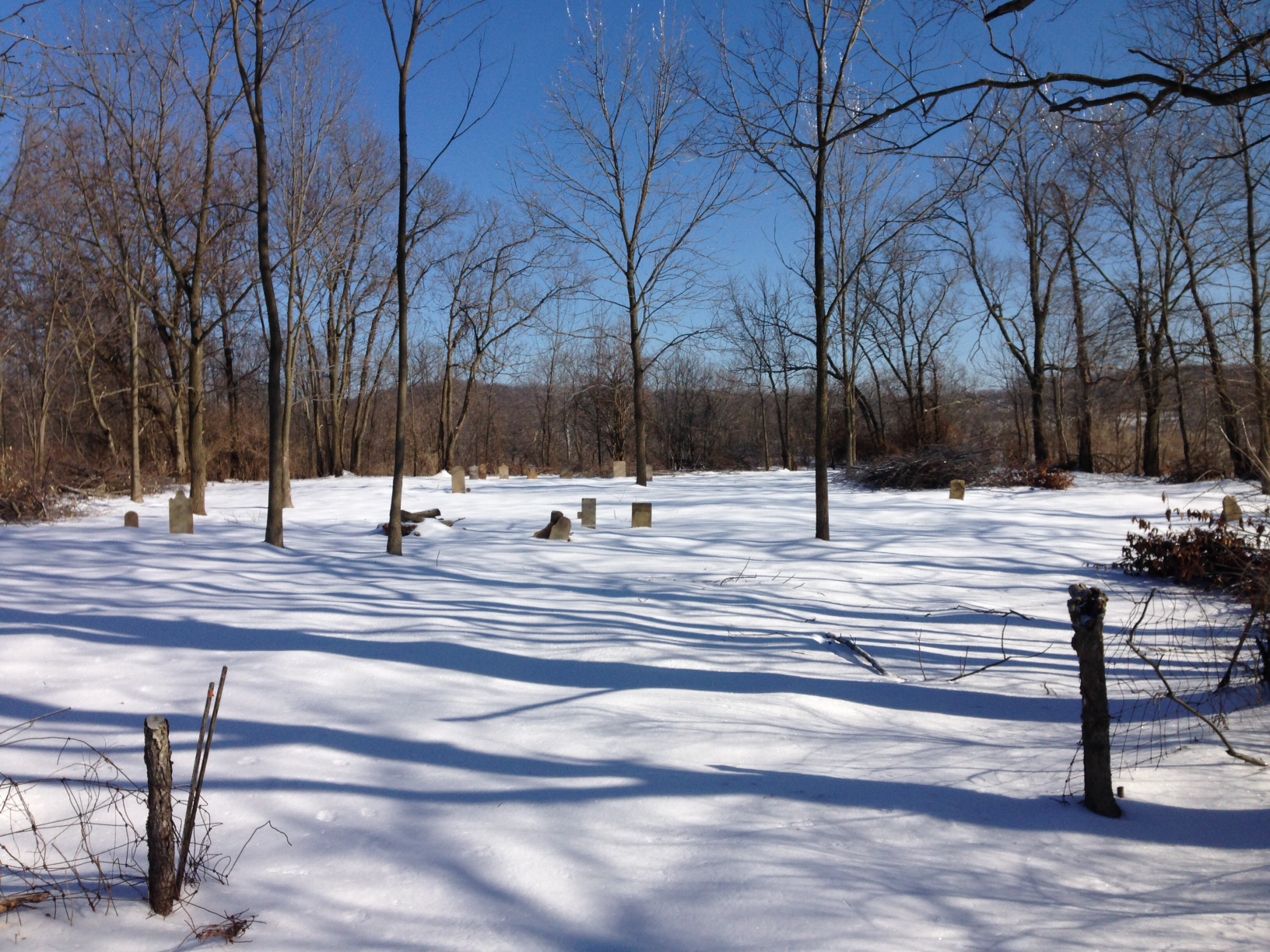
The Rooney resting place in Osakis, Minnesota

Thursday, June 11, 2015

Clan, Community, and Migration


Dean Cemetery, South Salem, Ohio.
Photograph by http://image2.findagrave.com/photos/2014/46/CEM2317245_1392597580.jpg

Since I began working on genealogy, I've been struck by the family migration patterns of my ancestors. We're aware that European colonists moved frequently, spreading out across the continent. But unlike modern migration patterns (for example, my brother and I both moved away from Michigan for jobs), the earlier migrants moved with their large, extended families.

For example, Abraham Dean was born in western Pennsylvania in 1763. In the early 1800's, he moved with his family to South Salem, Ohio. But it wasn't just his immediate family who moved. He moved with his wife's family, including most of Sarah Stewart Dean's siblings. These were adults with their own households, spouses, and children, but they all moved to Ohio together. (Abraham only had one sibling, Margary Dean Canan, and she remained in Pennsylvania, along with her husband and children.) In the next generation, the children and grandchildren of Abraham moved to Des Moines, Iowa. Again, this was not just one nuclear family but the majority of his children, their own spouses, sisters- and brothers-in-law, and children. It was a clan migration.

Clan migrations weren't only typical of Scotch-Irish families in the early 19th century. On the other side of my family, Irish-Catholic Robert Cunningham, born in New York in 1850, spent his childhood in Columbus, Wisconsin. Robert married Elizabeth Rooney, and around 1890 they moved to Minneapolis, Minnesota. They moved with the entire Rooney family, including Elizabeth's parents, and most of her brothers and sisters, along with their families. This is how my great-great-great grandparents came to be buried less than an hour from where I now live.

Not all clan migrations were even based on kinship. One of my students told me that her surname is a town in Germany. Many of the towns' inhabitants emigrated together, and they took their town as their last name, so they could find each other in their new country. Something similar (without the name change) occurred in the Stoecklein branch of my mother's family. The Stoeckleins moved to Dayton, Ohio, from Faulbach, Bavaria. A number of families from that small town moved together, and remained close. Although my 3xgreat-grandfather, Joseph Stoecklein, married in Dayton, his wife, Carolina Zwisler, was the daughter of schoolmates of his parents back in Faulbach.

Surely these migration patterns were based on practicalities, as well as affection. Family members could help each other in a strange new place, whether they were negotiating a newly-conquered landscape or an alien city. It is an important reminder that, as a species, we were never meant to go it alone. We are social animals, and highly dependent on our family, however that is defined.

It's pretty common for academics to end up far from their families, and I personally can attest to the high cost of that separation. Just a couple weeks ago, my mother showed me a picture of her mother, surrounded by a plethora of female relatives - aunts, cousins, and sisters-in-law. Her remark was "Look how much help she had." Certainly, the large family sizes of previous generations were not possible if one woman did it all. As a society, we seem to have forgotten the importance of extended family.