Showing posts with label Washington. Show all posts

Friday, August 16, 2024

What, Exactly, is a Farm?

A colleague with whom I share both anthropological and genealogical interests pointed me toward this webpage of Washington history. I didn't find much specifically about our ancestors, but this post about the origins of Oak Harbor in January, 1851 was interesting. It hits both my family history interests and my anthropological research on land use and historical ecology. Note this section:

Norwegian shoemaker Zakarias Martin Taftezon (also spelled Toftezen and Taftsen, among other variants) (1821-1901), Swiss Ulrich Freund, and New Englander Clement W. "Charlie" Sumner met each other at New Orleans while en route to the 1849 California gold rush. They did not strike it rich in the gold fields and headed north to the Oregon Country. In late 1850, they landed in Olympia and with the help of Samuel Hancock, took an Indian canoe north down Puget Sound to find available land....

According to pioneer Jerome Ely, Taftezon cut steps into the steep bluff at the mouth of the inlet the Skagits called Kla-tole-tsche to climb up and view the area to the north. He spied the Oak Harbor prairie free of the dense stands of trees that covered so much of the region....Much of Puget Sound was covered by dense stands of timber, but the grass-covered prairies where the Indians dug their camas roots offered good prospects for farming.

I love "the grass-covered prairies where the Indians dug their camas roots offered good prospects for farming." Yes, they did. Because they were farms! You will generally see these roots classified as "wild" foods but the boundary between "wild" and "domesticate" or between "prairie" and "farm" is a lot fuzzier than most people realize. Indigenous people of the Pacific Northwest created fields of camas and manipulated soil and roots to make camas more productive. These prairies were created and managed ecosystems for growing camas. Sounds kinda like a farm, doesn't it?

Other crops grown by the Indigenous people of the Pacific Northwest include various fruit-bearing trees, berries, and (my personal favorite) shellfish in aquaculture beds.

So why didn't the Euro-American settlers arriving on Whidbey Island mention that it was covered in farms? Partly because they did not recognize them. These Indigenous fields didn't look like European farms, with fences and plow furrows and red-pained barns. The settlers' ethnocentrism only allowed them to see Europe-style farms as "true" farms. 

But also, settlers often refused to recognize the farms right in front of their faces because that would mean recognizing that they had stolen someone's land. Land grabs in this time period were based on the idea that Euro-Americans were hard-working people who improved and built upon land while Indigenous people were not. As "proof" of this, Euro-Americans pointed to the fact that much of North America was made up of unsettled or unimproved land. And where that wasn't true (which it mostly wasn't) they pretended it was true.

Now for the genealogical connection: note the reference to Samuel Hancock and the implication that he's working with Indigenous people to transport settlers to Whidbey island. Some thirty years later Mr. Hancock helped his great-nephew, E.J. Hancock, to move to Whidbey island, where E.J. married Julia Kinney, the daughter of a local ship captain. They became my great-great-grandparents.

Sunday, July 21, 2019

Julia Kinney Hancock, painter


When she visits, my mother often brings a treasure-trove of genealogical materials from my grandmother's stored belongings. This week, she brought this oil painting. On the back it says "Painted by Julia Kinney as a girl". Julia, who was my great-great-grandmother, was born in 1859. I'd guess her "girlhood" to be anytime before 1880. Before she reached the age of 20, Julia had lived in Nova Scotia, Boston, San Francisco, and Whidbey Island, Washington. This landscape doesn't particularly remind me of any of those areas, but it's more "east coast-y" than west. On the other hand, she very well may have copied some other painting and not seen this landscape in real life.

If you look closely, you'll see that the human figures are a bit stiff but the animals and landscape are quite good. Joe wanted to know if she kept painting, and if the family has any of her other work. Honestly, I don't know. Maybe some of my cousins do?

Saturday, May 19, 2018

Julia Etta Kinney

Julia Etta Kinney Hancock, 1910

The latest post in my series about my great-great grandparents focuses on Julia Etta Kinney, wife of Ernest Justus Hancock, who was the focus of my last post. She is one of my four great-great grandparents born outside the United States (all four in Canada), but her family's history is in Massachusetts, going back to the Mayflower. The Kinneys were a sea-faring family; most of the men were ships captains, owned ship-building companies, or served as port authorities. Over their history, they tended to move from Massachusetts to Nova Scotia and back again as if the border didn't exist. Julia's grandfather and father, though, eventually re-located to the west coast, which is how she came to living in Coupeville, Washington, and meet her husband.

Julia was born in 1859 in Hall's Harbour, Nova Scotia, the daughter of Captain Thomas Kinney and Mary Elizabeth (Houghton) Kinney. Thomas Kinney was working on the west coast by 1851 (1), while Julia and her mother stayed on the east coast, which may be why Julia was an only child. According to a biography published in the Island County Times in 1947, her family moved to Yarmouth when she was four and then Boston the next year (2). Her parents had been married in Boston, so it is possible that they moved to be near her mother's family. In 1868, when she was 11, she and her mother moved to San Francisco to join her father. In 1871, they moved up the coast to Coupeville.

Julia was unusually well-educated, compared to the other children in Coupeville. She had, after all, gotten her elementary education in Boston and San Francisco, while many of the other Coupeville families had come from less developed areas. Perhaps it was inevitable, then, that she would become a teacher.
______
References:

1) Lewis and Dryden
2) Island County Times

Saturday, December 30, 2017

David and Jennie Dean Family Bible


I blogged previously about the serendipitous events that brought the Philip and Catherine Welsheimer Family Bible into my life. For Christmas, I received another priceless gift: the family Bible of David Philip Dean and his wife Sara "Jennie" Brattain Dean. They would be my great-great grandparents. David was the grandson of Philip and Catherine Welsheimer. Their Bible was found among my grandmother's things. I assume it was sent to her by my great-aunt, Lillian Huffstetler.

I wanted to share some pictures and items from the Bible so other family members can see it.

Outside cover


Inside cover. The text reads:
Family Bible of David P. Dean and Sarah Jane Brattain-Dean who were married August 22, 1876
DesMoines, Iowa The above names were written by Eva D. Trowbridge July 14, 1961 at the home of
Manie Dean Edmundson 3227 Wright Ave Bremerton, Wash
[Eva and Manie were daughters of David and Sarah]
Frontpiece of the Bible. It dates to 1863. I don't know
if the Bible belonged to one of them prior to marriage
or if it was purchased for their family from an older printing.
Note the pages pinned on the side. I removed the
pins to prevent rusting and damage to the pages


This is what was written on the back of the tract pinned to the opposite page of the Bible's frontpiece. On the top is the name "Ann Dean" in very faint letters. Ann was David's mother, Anna Welsheimer Dean, who died in 1905, which means she is not the person who wrote the rest of the page. I suspect it was David Dean who did so:

This tract was given to D.P. Dean , about the year 1860 or 61. He was walking along the road on his way to his Uncle Jim Finch's [David's paternal aunt, Sara, had married James Finch], when two men on passing by in a one-horse buggy handed him this tract and one other. This circumstance is very vivid in my mind at this time, Feb 16, 1920, 69-70 years ago. This piece of road was what is now Court Avenue between 20th and 30th sts, DesMoines, Iowa.

The second tract has the same story written on the back, but it was written in March 1916


A number of newspaper clippings were stored in the Bible, including this one from January 30, 1907, describing the wedding of David and Sarah's daughter, Madge, to Herbert Swenson, in Altoona, Iowa. (Clicking on the picture should give you a larger version to read)

Here is a sadder clipping. This is an obituary for David and Sarah's son, Ralph, who died at 18 in June of 1918. From the newspaper account it sounds like he had suffered from illness for much of his life. A number of clippings related to Ralph were in the Bible. He was obviously much missed.

An interesting clipping that showed how David and Sarah kept in touch with their extended family. The article is from a Middletown, Indiana, newspaper and about the wedding of L.K. Wisehart in 1908 or 1909. I don't know who L.K. was, but the article mentions he was the son of Richmond Wisehart. Richmond was Sarah Brattain Dean's maternal uncle, the brother of her mother, Louisa Wisehart.
Here's a fun clip! Apparently in 1936 David Dean grew a 2lb tomato and a 7lb potato! 
This advertisement answered a question I had long had: when, exactly, did the Dean family move to Washington? The answer, apparently, is sometime soon after Dec 7, 1910, when they sold their farm and equipment in Altoona, Iowa
Lillian Dean's wedding to Raymond Stiles in November 1911, Whidbey Island, Washington

The church bulletin announcing Sarah Brattain Dean's death. April 6, 1919

The pages before the New Testament have family records. This is the marriages page. It appears there are two different hands that wrote here. Below, I put the notes by that second hand in {}. That second hand seems to take over entirely after 1907, but perhaps earlier. Although the first hand could be Sarah and the later David, I have an alternative theory: the first hand is Anne Welsheimer Dean's. After her death in 1905 (or perhaps when she was incapacitated earlier), either Sarah or David took over adding to the Bible. That theory is based on a) the fact that the hand seems to disappear before 1905 (I think, some entries are hard to tell); b) the writing has an archaic look to me; and c) the handwriting reminds me somewhat of the Welsheimer family Bible, which was written by one of Anne's parents.

The writing is as follows:
Aug 22nd 1876 Mr. David Philip Dean to Miss Sarah Jane Brattain
{Ceremony took place at residence of J. Wisehart SE Corner 12th and Court Ave. DesMoines, Iowa}

Miss Mary Louanna Dean to Mr. Will Edmundson Dec 29 1897 {At home near Altoona NW4 NW4 12.79.23}

Ethel Gertrude Dean to William Casebeer Dec. 25, 1900 last Christmas of the 19th century {at same house as above described}

[note: not clear if this entry is in the first or second hand]: Madge Estella Dean to Mr. Herbert L. Swenson Jan. 30th, 1907 {at same house as above described}

{Aura Dean to Karl E. Hodges at the house of her uncle Ro E. Fulton 915 Queen Anne Ave. Seattle Washington, Sept. 7, 1910.

Lillian Dean to Raymond C. Stiles. Wesley M.C. NE Corner East 11? Des Moines St. DesMoines Iowa Nov 8, 1911

Eva Dean to Robert W. Trowbridge at M.E.C. in Coupeville Washington Nov. 15th 1911.

Carl Dean to Vera Hancock Sept 1916

Merl to Irene Cotte in Chicago June 1919


Another mystery solved! I have often wondered how David and Sarah met, since she was from Indiana and he was from Iowa. I wondered if he'd visited some of his mother's kin who lived not far from Sarah's family. However, based on this entry, it appears that Sarah was actually in Iowa visiting her mother's Wisehart kin, although I'm not sure who.

The second page of Family Records includes the births. Most of this page is written in the original handwritting from the first page, perhaps Sarah's. There are some notes of deaths, but I think those come from Eva and Marnie, as noted on the inside cover of the Bible. I've put their notes in {} below.

Mary Louanna Dean July 26, 1877
Madge Estella Dean, Sept 14, 1878 {D- April 12 '66}
Ethel Gertrude Dean, Oct. 29, 1879
Daisy Dean, May 8, 1881.
Harvey Edwin Dean, April 18, 1883
Aura Dean, Sept. 10, 1884 {D - Aug 5 '64}
Eva Dean, Aug. 31, 1886
Edna Dean, Oct. 10, 1887
Jimmie [Jimmie is crossed out and James written in} Dean, Feb. 16, 1889
Infant Son, Aug. 10, 1890.
Lillian Dean, July 21, 1891 {D - May 9 '62}
David Merlin Dean, Feb. 24, 1894.
Carl Phillip Dean, Dec. 14, 1895.
Ralph Hiram Dean, June 18, 1899.

I suppose it's good they stopped having kids, as they'd completely run out of room on the page! I will note that this is 14 children in a span of 22 years

The final page of the Family Records is the saddest, the list of deaths. The first five names are in the same hand. The next two may be in the same hand that wrote the comments and later entries on the marriage page. The final deaths, those of Sarah and David themselves, appear to have been written by Eva and Marnie in the 1960s.

First hand:
Harvey Edwin Dean, Feb. 7, 1885.
Daisy Dean, Feb. 8, 1885.
Edna Dean, Feb. 5, 1890.
Jimmie Dean, Feb. 9, 1890.
Infant Son, Aug. 10, 1890.

Second Hand:
Ethel Gertrude Dean, Feb. 11, 1901.
Ralph Hiram Dean, June 12, 1918

Eva and Marnie:
Sarah Jane (Brattain) Dean, B. Nov 7, 1854, D. 1919
David Philip Dean, B. Feb 16 1852, D. Apr 16 1941
The deaths page is particularly heartbreaking. Six of their fourteen children died young. Harvey and Daisy died on subsequent days in 1885. Perhaps there was some disease that went through the family? Harvey would have been six and Daisy three. Something similar happened five years later, in February of 1890, when two children died within days of each other. Edna would have been two and Jimmie just shy of his first birthday. Later that year, the unnamed son was likely a stillbirth. And, as discussed above, their youngest child died at eighteen. We forget, sometimes, how lucky we are to live in this age of medical miracles. 

Friday, January 20, 2017

Ernest Justus Hancock


Edward, Earnest, and James Hancock
No date on the photo, but must be in the early to mid 1860s

This is part 3 of my series on my great-great grandparents. Ernest Justus "E.J." Hancock, and his wife, Julia Etta Kinney, could not have been more different from the subjects of my first two posts, David and Jennie (Brattain) Dean, although their children married. The Deans and Brattains were descendants of Midwestern farmers, from families that been earlier colonizers of the areas that had been conquered from Native peoples in Ohio, Indiana, and Iowa. In some cases, earlier generations of Deans/Brattains had left the South because of their opposition to slavery. The Brattains, for example, were original Quaker. Some members of both families were active members of the abolitionist movement. Although their lineages included Revolutionary War soldiers and other brave and resourceful men and women, they didn't come from a background of particular wealth or fame.

The Hancocks and Kinneys, on the other hand, came from older and more patrician stock. They were descendants of the Jamestown and Plymouth colonists, respectively, with all of the positives and negatives such descent implies. Ernest and Julia met and married in the state of Washington, as some of the first members of their family to leave Virginia or New England.

Ned, Ammon, Ernest, Charlotte, and Lilly Hancock
Around 1865 (Lilly was born May 1864)
Ernest Justus "E.J." Hancock was born November 24, 1854, in Lynchburg, Virginia, the son of Ammon Goode and Elizabeth Charlotte (Hewitt) Hancock. I won't write much about his childhood because I discussed his father in great detail in an earlier post. Suffice to say, he was born seven years before the start of the Civil War into a family with a tobacco factory, large tobacco plantations and, therefore, they had enslaved a large number of people. The Hancocks were wealthy. E.J.'s father had to petition President Johnson for a pardon in 1865 because he owned more than $20,000 in property. I don't know exactly how much his father was worth, but $20,000 in 1865 is worth nearly $300,000 today. In other words, the Hancocks were one of the families whose wealth was based on forced labor, who had the most to gain by keeping their workers enslaved, and who were in a position to finance the fight to maintain the slave economy. Although E.J. and his siblings were too young, and his father was apparently too old, several of their cousins were officers in the Confederate army.

Despite Gone-With-the-Wind-inspired fantasies of poor white folks devastated by war (a war, remember, that they had started because labor extracted through terror was cheaper than paying people), the Hancocks were clearly well off after the war. Undoubtedly, some of their wealth was lost, (wealth, again, extracted through violence from the bodies of enslaved people), but in 1870, they were still living in the same house, still owned the same tobacco factory, still owned at least some tobacco plantations (I'm not sure about all of them), and still employed Black servants (1). Ernest. and his brothers could afford to go to college; both Ernest and his younger brother, Ned, attended the Virginia Military Institute, matriculating in 1875. Ned graduated in 1879, but E.J. left the university without graduating and moved west to Coupeville, Washington (2).

Why did he go there? His uncle, Samuel Hancock was on Whidbey Island by 1860, and in the Pacific Northwest significantly earlier (3). Another uncle, Francis "Frank" Hancock, who was married to Hester Hewett, likely a cousin of E.J.'s mother,  lived there from 1862-1870, before moving to Stillaguamish flats (4). Presumably, the good reports from his family, and having a support network already in the region, inspired Ernest's choice of location.

Aloha Farm in 1899. The people are E.J., Julia, and Vera Hancock.
The woman in the center was a local teacher.
According to his profile in An Illustrated History of the State of Washington by Harvey Kimball Hines, (published 1893, p. 568), Ernest moved to Washington in 1879, then returned to Virginia in 1881. He apparently spent the next couple of years making arrangements for a permanent move back to Washington, which took place in 1883. He bought 45 acres on Whidbey Island and built Aloha Farm. My great-aunt Lillian, his granddaughter, wrote that the family no longer remembers why the farm was named "Aloha". E.J.'s wife, however, had some connections to Hawai'i, so it's possible that the farm got its name after their marriage.

There were plenty of racial tensions in Washington, just as there had been in Virginia. Most centered around the status of Chinese immigrants. Like many immigrant groups, the Chinese community on the west coast met with social and political barriers put up by white Americans. The Chinese Exclusion Act of 1882 was the most significant anti-Chinese legislation of American history. Interestingly, Ernest denounced the Act, writing, "The Chinese, by industry, pay strict attention to their own business, and studying their employers' interest, have created a demand for their labor, and it is only justice that they be allowed to fill the demand." (6).


Justus, Virgil, and Vera Hancock, who all miraculously
survived to adulthood
Ernest married Julia Etta Kinney on March 3, 1886. Julia has a fascinating history of her own, which I'll discuss in another blog post. Genealogically speaking, though, their marriage combined the Hancock's First Families of Virginia line (going back to Jamestown) with the Kinney's Great Puritan Migration lineage (going back to the Mayflower). Ernest and Julia had four children. Their three sons were Eugene Ammon, Justus "Jut" Lee [that Lee middle name just kills me], and Virgil Kinney. Their only daughter, Vera Houghton, was my great-grandmother. 

Ernest. was clearly successful in Whidbey Island, no doubt helped along by his family's ill-gotten money. He was one of the founders of the Island County Bank of Coupeville in 1892, and elected its first vice-president. Unfortunately, the bank closed in 1893, when "the cashier absconded with the funds, spending them in the 'most disreputable dives in Seattle'" (7). The bank building itself still stands, however. Ernest also owned "an immense amount of city property, and [had] many other profitable investments" (5) in addition to Aloha Farm. 

Ernest died on August 1, 1924, in Coupeville. He was 69 years old.
_______
References:

1) "United States Census, 1870," database with images, FamilySearch (https://familysearch.org/ark:/61903/1:1:MFLK-NVT : accessed 25 September 2015), S G Hancock, Virginia, United States; citing p. 62, family 468, NARA microfilm publication M593 (Washington D.C.: National Archives and Records Administration, n.d.); FHL microfilm 553,137.

2) VMI Roster Archives, available here: http://archivesweb.vmi.edu/rosters/index.php?LastName=Hancock&FirstName=&VMIClass=&keyword=

3) https://qmackie.com/2010/02/20/samuel-hancock-witnesses-smallpox-among-the-makah-1853/

4)  http://www.findagrave.com/cgi-bin/fg.cgi?page=gr&GRid=98503324

5) An Illustrated History of the State of Washington by Harvey Kimball Hines, 1893, p. 568

6) quoted in Coupeville, by Judy Lynn, Kay Foss, and the Island County Historical Society.. . Arcadia Publishing, 2012.

7) Self-Guided Walking Tour of Historic Coupeville - National Park Service

Thursday, January 5, 2017

Sarah Jane "Jennie" Brattain Dean

This is a continuation of my series of posts on my great-great-grandparents. Last time, I wrote about David Philip Dean. This post is about his wife, Jennie Brattain.

Sarah Jane Brattain, known as "Sally" or "Jennie", was born November 7, 1855. I had always heard the name pronounced as "Bruh-TAYN", but on-line sources suggest it's usually rhymes with "satin". I don't know if our family line pronounced it differently than others, or if her maiden name came down through the generations with an incorrect pronunciation. In the census of 1860, the family name was spelled "Bratton", suggesting the census worker, at least, heard it more like the "satin" pronunciation (1).

Jennie was the eldest child of Hiram and Louisa May Wisehart Brattain. Unlike her husband, who was born in an area that had only recently been conquered for white settlement, Jennie grew up in an area that was already well integrated into the United States. Indiana had been a state since 1816. Both of Jennie's parents had been born in Indiana and came from families that had moved there from the South in the 1820s or 30s. Family records claimed Jennie was born in Alexandria, Indiana, however, I cannot confirm that with primary documentation. Her family was living in Alexandria in 1880 (2), and perhaps they had been there at the time of her birth, but my first record of the family is in the 1860 census, when they were living in Fall Creek Township, Henry County, Indiana (1). This is where Louisa grew up and where many of her siblings lived.

Jennie was born six years before the start of the Civil War, in which her father served. Hiram Brattain joined Company F, 8th Indiana Volunteers, at the beginning of the war. Later that summer, he fought in the battle of Rich Mountain, West Virginia, where his brother-in-law, Jennie's uncle Philander Wisehart, died in his arms. His regiment mustered out of service on August 6, 1861. Hiram remained in Indiana until August of 1862 when he was commissioned as second lieutenant of Company H, 69th Indiana Infantry, just in time to fight in the battle of Richmond, Kentucky, one of the most complete Union defeats of the war. Most of the men in his regiment were captured by the Confederates, but he luckily escaped. He served until March 27, 1863, when he was forced to resign for health reasons (3).

I can imagine it was a difficult time for Jennie, with her father away and her mother left to manage Jennie and her younger siblings, Augustus and Catherine. (Eventually, the couple had a total of eight children). Luckily, her mother's family was nearby, and her father's family was not much farther. Her father had a farm in those early years, but after the war they relocated to Middleton, Indiana, where in 1870 Hiram listed his occupation as "druggist" (4), and in 1880 as "running sawmill" (5) (Clearly, the degree of specialization required to be a druggist was not what it is now.)

Jennie married David Philip Dean on August 22, 1876, in Des Moines, Iowa, at the age of twenty (6). One mystery I have yet to solve: how did they meet? Did Jennie spend some time in Iowa? Her father had lived there briefly as a child, so perhaps he had friends or relatives there with whom she was staying? Or did David travel to Indiana? This seems more likely. David's maternal grandfather, Philip Welsheimer, lived in Ohio, but he had bought land for his sons in Indiana. David had several Welsheimer uncles in northern Indiana in the 1870s. Perhaps he went to visit or to work for one of them and met Jennie while there? Regardless, they were married in Iowa, not Indiana.

I wrote about their married life and their large family in my previous blog post. I won't repeat it here. I will end with one more mystery, however. Jennie is buried in Coupeville, Washington, next to her husband. According to her Find-A-Grave site, she died March 27, 1919, in Seattle. However, I can find no death certificate or other proof that she died in Washington and not in Iowa. If she did die in Washington, she must have done so very soon after moving there.

[Update]: I guess I just hadn't looked recently for her death certificate. I can't find an image of the original, but FamilySearch has the record for Sarah J. Dean, daughter of Hiram Brattain and Louise Wisehart, dying in Seattle, Washington, March 27, 1919. No cause of death is available in the index record, at least.


_____
References:

1) "United States Census, 1860," database, FamilySearch (https://familysearch.org/ark:/61903/1:1:M4FB-NF3 : accessed 27 August 2015), Hiram Bratton, Fall Creek Township, Henry, Indiana, United States; from "1860 U.S. Federal Census - Population," database, Fold3.com (http://www.fold3.com : n.d.); citing p. 126, household ID 74, NARA microfilm publication M653 (Washington, D.C.: National Archives and Records Administration, n.d.); FHL microfilm 803,266.

2) "United States Census, 1880," database with images, FamilySearch (https://familysearch.org/ark:/61903/1:1:MH9K-VRN : accessed 27 August 2015), Hiram Brattans, Alexandria, Madison, Indiana, United States; citing enumeration district 21, sheet 103B, NARA microfilm publication T9 (Washington D.C.: National Archives and Records Administration, n.d.), roll 0293; FHL microfilm 1,254,293.

3) Harden, Samuel. 1888. Those I Have Met, or Boys in Blue. William Mitchell, Publisher. Available On-line here: http://webapp1.dlib.indiana.edu/inauthors/view?docId=VAC2091&brand=ia-books

4)  "United States Census, 1870," database with images, FamilySearch (https://familysearch.org/ark:/61903/1:1:MXXT-VMF : accessed 27 August 2015), Hiram B Brattain, Indiana, United States; citing p. 13, family 100, NARA microfilm publication M593 (Washington D.C.: National Archives and Records Administration, n.d.); FHL microfilm 545,822.

5) "United States Census, 1880," database with images, FamilySearch (https://familysearch.org/ark:/61903/1:1:MH9K-VRN : accessed 27 August 2015), Hiram Brattans, Alexandria, Madison, Indiana, United States; citing enumeration district 21, sheet 103B, NARA microfilm publication T9 (Washington D.C.: National Archives and Records Administration, n.d.), roll 0293; FHL microfilm 1,254,293.

6) "Iowa, County Marriages, 1838-1934," index, FamilySearch (https://familysearch.org/pal:/MM9.1.1/XJFP-Z8X : accessed 11 January 2015), David P. Dean and Sarah Brattian, 22 Aug 1876; citing Des Moines, Polk, Iowa, United States, county courthouses, Iowa.

Monday, January 2, 2017

David Philip Dean

David and Sarah "Jennie" Dean


So far, my blog topics have been haphazardly chosen, based on whatever interests me at the moment. To try to be more systematic, while also improving the quality of information I have on Wikitree.com, I'm going to create blog posts for each of my great-great-grandparents. Why my great-great-grandparents? Well, since most of them died before 1940, most of the documentary evidence is old enough to be publicly available. I'd like to write about my great-grandparents, as well, but that will be a collaboration with  my parents who have personal memories of them. 

So, on to my first great-great-grandparent: David Philip Dean

David Philip Dean was born February 16 (or 18th), 1852, on his parents' farm in east Des Moines, Iowa, on the banks of what is still known as Dean Lake (at the end of Dean St.). David was the youngest child of Abram Stewart Dean and Anne Retta Welsheimer Dean. His first name may have been in honor of his mother's brother, David Welsheimer, and his middle name, Philip, was in honor of his maternal grandfather. He had four siblings, three of whom were born in Ross County, Ohio, where the family was living before they joined David's grandfather, John Stewart Dean, in claiming land that had been recently conquered from Native people, who were forced into Oklahoma to make way for white settlers. Unfortunately, Abram died in January of 1859, not long before David's seventh birthday. His mother never remarried, but David's grandfather and multiple uncles and aunts lived nearby.

His childhood was far from easy. According to the Portrait and Biographical Album of Polk County, Iowa. (Lake City Publishing Co., Chicago, 1890), David was born in a "commodious house of hewed logs...on the north bank of...Dean Lake. Many privations and hardships were endured by the family, but they labored on, and at length had a good home." The book specifically mentions that David's father had to haul his grain 65 miles for a mill, and that there were no barrel-makers in the area so he created three troughs from a large linden tree to salt down pork, hold lard, and make soap. David's mother cooked on a large fireplace, "slapjacks, corn-dodgers, jonnie cake and lye hominy." The family were devout Presbyterians. One history (but not others) claims the first Presbyterian Church in Des Moines met in David's grandfather's house (1). David's father was an ardent Republican, at a time when that meant supporting the literal party of Lincoln, founded with the goal of ending slavery. Fifteen acres of the family farm were donated to the state for state capitol building. 

Although there must have been plenty of work around the farm, especially with Abram's early death, David and his siblings all attended school. In the 1860 Census for Lee Township, Polk County, Iowa, Anne Dean heads a household of five children, aged 8 to 17, all of whom indicated that they'd attended school within the previous year (2). Ten years later, in the 1870 Census, David was the only child still at home with Anne, but even at 18 and as his mother's only child, he had attended school within the year (3). Clearly, like many of their descendants, the family put a high priority on education.

David married Sarah "Jennie" Brattain on August 22, 1876, in Des Moines (4). He was 24; Jennie was 20. They spent most of their adult lives farming in Polk County, Iowa, but they may have moved within the county. In the 1880 Census, they were in Grant Township, Polk County, Iowa (at which time David's mother, Anne, was living with them) (5). However, by 1884, when their daughter Aura was born, they were listed as living in Clay Township (6). Presumably, this is near the town of Altoona, where they farmed Township 79, Range 23, Section 14, NW1/4 by the 1885 Iowa Census (7). This is where they lived until at least 1910 (8). 

David and Jennie had a large family, although they lost a number of children at a young age. Their children were:

  • Mary Louanna (Manie) (1877-1974), married William Henry Edmundson
  • Mary Estella (1878-1966), married Herbert L. Swenson
  • Esletta (1879-before 1895)
  • Ethel Gertrude (1879-1901), married William Casebeer
  • Daisy (1881-1885)
  • Harvey Edwin (1883-1885)
  • Aura (1884-1964), married Karl Edward Hodges
  • Eva (1886-1982), married Robert Wallace Trowbridge
  • Edna (1887-1890)
  • James (1889-1890)
  • Infant Son (born and died August 10, 1890)
  • Lillian (1891-1962), married Raymond Claire Stiles
  • David Merlin (1894-1972), married Irene Louise Greaves and Marie Simpson
  • Carl Philip (1895-1971), married Vera Houghton Hancock
  • Ralph Hiram (1899-1918)

Sometime between 1902 and 1905, David and Jennie's eldest daughter, Manie Edmundson, moved to Coupeville, Washington, with her husband and children. Sometime after the 1910 Census, David and Jennie moved there, too. Jennie died and was buried in Coupeville, in March, 1919. The following year, David was living with Manie and her family (9). 

Later that year, David remarried, to Abbie Dean, in Washington, Ohio (10). Abbie remains something of a mystery to me, and I wish my Aunt Lil was still here to explain her relationship because I'm sure she knew. "Dean" was Abbie's married name. On their marriage certificate, she is listed as 64 and widowed, the daughter of William W. Perdew and Sarah Seffens. Her original husband, whom she married in Washington, Ohio, in 1876, was John T. Dean, but the marriage record does not include his parents' names (11). My suspicion is that John T. was a cousin of some sort of David's, which is how David met Abbie. After their marriage, David lived part-time in Washington, where he had his own home according to the 1930 Census (12), and part-time at his wife's house in Marietta, Ohio (13).

I've always been interested in David because he was (one of?) the first dedicated genealogists in the family. He was mentioned in several of the family references I found, include the book by Edith Welsheimer (13) about David's mother's line, in which she wrote: "David was the perfect gentleman - kind and gracious, and interested in all with whom he came in contact and able to converse with young and old. To him goes the credit for most of the work on his branch. Though eight years of age, he exchanged many letters with the author, which she values very highly."  

David died in Seattle on April 16, 1941, aged 82 years.

_____
References:
1) Wilson-Baird History by Fran C. Shepherd, 1942, p.2 (available on-line: http://baird-bard-beard.org/BB/downloads/Volume5-March1995.pdf):

2) "United States Census, 1860," index, FamilySearch (https://familysearch.org/pal:/MM9.1.1/M82L-9MQ : accessed 11 January 2015), David P Dean in household of Ann Dean, Lee Township, Polk, Iowa, United States; from "1860 U.S. Federal Census - Population," Fold3.com; citing p. 161, household ID 1172, NARA microfilm publication M653, National Archives and Records Administration, Washington, D.C.; FHL microfilm 803,338.

3) "United States Census, 1870," database with images, FamilySearch (https://familysearch.org/ark:/61903/1:1:MDV5-DTF : 17 October 2014), David Dean in household of Ann Dean, Iowa, United States; citing p. 8, family 56, NARA microfilm publication M593 (Washington D.C.: National Archives and Records Administration, n.d.); FHL microfilm 545,914.

4) "Iowa, County Marriages, 1838-1934," index, FamilySearch (https://familysearch.org/pal:/MM9.1.1/XJFP-Z8X : accessed 11 January 2015), David P. Dean and Sarah Brattian, 22 Aug 1876; citing Des Moines, Polk, Iowa, United States, county courthouses, Iowa.

5) "United States Census, 1880," database with images, FamilySearch (https://familysearch.org/ark:/61903/1:1:MDLZ-4KN : 24 December 2015), David T Dean, Grant, Polk, Iowa, United States; citing enumeration district ED 170, sheet 489B, NARA microfilm publication T9 (Washington D.C.: National Archives and Records Administration, n.d.), roll 0360; FHL microfilm 1,254,360.

6) "Iowa, County Births, 1880-1935", index, FamilySearch (https://familysearch.org/pal:/MM9.1.1/XVZL-FYZ : accessed 11 January 2015), David P. Dean in entry for Aura Dean, 1884.

7)  "Iowa State Census, 1885," database with images, FamilySearch (https://familysearch.org/ark:/61903/1:1:HWZL-XMM : 15 November 2014), David Dean, Altoona, Clay, Polk, Iowa; citing p. 235, 1885, State Historical Society, Des Moines; FHL microfilm 1,020,172.

8) "United States Census, 1910," database with images, FamilySearch (https://familysearch.org/ark:/61903/1:1:MG99-TYR : 29 October 2015), Carl P Dean in household of David P Dean, Clay, Polk, Iowa, United States; citing enumeration district (ED) ED 66, sheet 11B, NARA microfilm publication T624 (Washington, D.C.: National Archives and Records Administration, n.d.); FHL microfilm 1,374,431.

9)  "United States Census, 1920," database with images, FamilySearch (https://familysearch.org/ark:/61903/1:1:MHFY-X1B : 14 December 2015), David P Dean in household of William H Edmundson, Coupeville, Island, Washington, United States; citing sheet 6A, NARA microfilm publication T625 (Washington D.C.: National Archives and Records Administration, n.d.); FHL microfilm 1,821,923.

10) "Ohio, County Marriages, 1789-1997," index and images, FamilySearch (https://familysearch.org/pal:/MM9.1.1/VNQM-CJ7 : accessed 11 January 2015), Abram Dean in entry for David P Dean and Abbie A Dean, 23 Nov 1920; citing Washington, Ohio, United States, reference p 431; county courthouses, Ohio; FHL microfilm 2,320,085.

11) "Ohio Marriages, 1800-1958," database, FamilySearch (https://familysearch.org/ark:/61903/1:1:XDXT-KYL : 8 December 2014), John T. Dean and Abbie A. Perdew, 01 Jun 1876; citing , Washington, Ohio, reference ; FHL microfilm 0941959 V. 4-6.

12)  "Washington Death Certificates, 1907-1960," database, FamilySearch (https://familysearch.org/ark:/61903/1:1:N3RJ-SQS : 5 December 2014), David P. Dean, 16 Apr 1941; citing Seattle, King, Washington, reference 1448, Bureau of Vital Statistics, Olympia; FHL microfilm 2,023,903.

13) "A History of the Welsheimer Family", by Edith Welsheimer, Bronson Printing, Las Cruces, New Mexico, 1969. https://dcms.lds.org/delivery/DeliveryManagerServlet?dps_pid=IE97573

Wednesday, September 9, 2015

The Deans in a Nutshell

I've been going back through the WikiTree pages and filling in the siblings and their first-generation children for every one of my direct ancestors. I've finished the Deans (that is, the straight patronymic line, not including all of the wives who married in), so this seems a good time to summarize the Deans in America.*

The Deans were Scotch-Irish, an ethnic/religious group mostly from northern England and southern Scotland. They were Protestant dissenters, strong Calvinists, who were first settled in Ulster in the 1500s (because they were causing too much trouble as border raiders in England), and later encouraged or forced to migrate to the American colonies, particularly in the 1700s. Over 300,000 Scotch-Irish migrated from Ulster to the Americas between 1710 and 1810, mostly to Pennsylvania, which had the most welcoming religious laws, or south along the Appalachian mountains, particularly into the Carolinas.

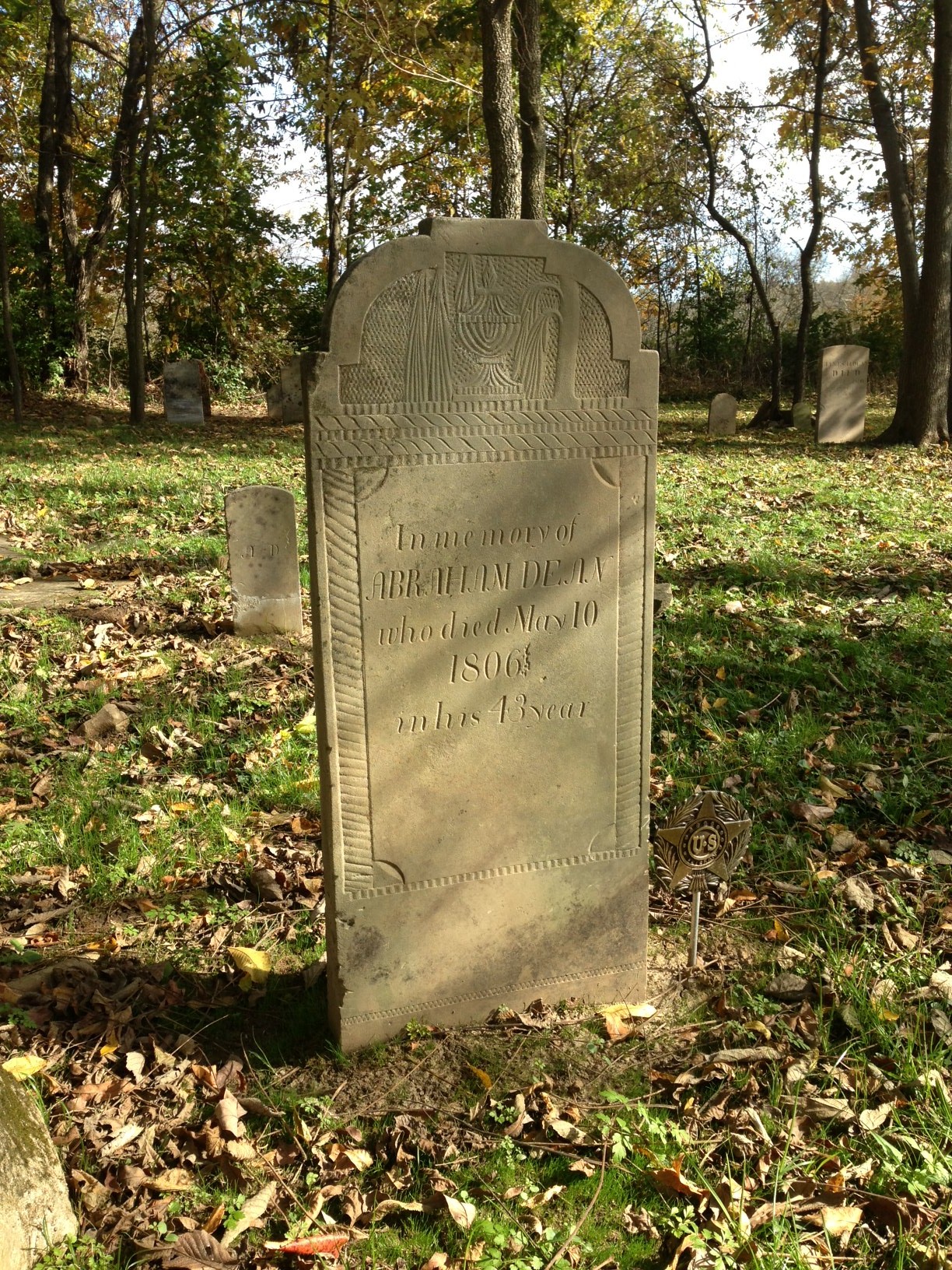
James Dean (about 1740-?) and Catherine Gamble (about 1740-?): These were the first Deans in the Americas. They were both born in Ireland, almost certainly in Ulster, and settled in Pennsylvania. They were married after their arrival in the Americas, which suggests that Catherine's parents and siblings could also be somewhere in Pennsylvania, although I haven't found them. They arrived sometime before 1760, since that was the year their first child, Margary, was born. In History of Huntingdon and Blair Counties, Pennsylvania, by J. Simpson Africa (p. 329), James is listed under the pioneers of Oneida Township, with his son, Abraham. This is an area of central Pennsylvania that was badly hit during the Seven Years War (aka French and Indian War). In the generation before, it had been largely cleared of people, Native and European alike. When the war ended, the Scotch-Irish were particularly prevalent among the new settlers. The same source says James was a member of the first board of elders elected by the congregation of Hart's Log Church, Sept. 10, 1787. He and Catherine may very well have settled elsewhere in Pennsylvania earlier, but there is no record of them before their arrival in Oneida Township. His farm was located near what is today Alexandria, Pennsylvania.

Old Hartslog Church
We only have records of two children, Margary and Abraham (see below). Margary married Colonel John Canan, who was also Scotch-Irish, and stayed near her parents in Pennsylvania. I blogged about the Canan family previously. John Canan was a Revolutionary War soldier and served in the General Assembly and as state senator for Pennsylvania. He developed coal and iron deposits, building one of the first furnaces in the region. Small families were very rare at this time, although childhood mortality was high. It is possible/likely that there were other children born to James and Catherine, but we have no record of them.

Tombstone of Abraham Dean, Ross County, Ohio
photograph by Scott
http://www.findagrave.com/cgi-bin/fg.cgi?page=mr&MRid=47082416
Abraham Dean (1763-1806) and Sarah Stewart (1766-1837): Abraham and Sarah were both born in Pennsylvania to Scotch-Irish families. He served as a private 3rd class in the 7th company, 1st battalion, of the Cumberland County Militia during the Revolutionary War (1). In 1784 he bought land north of present-day Alexandria, Pennsylvania, and named the tract "Mexico" (2). He and Sarah were married sometime around 1790. By 1811, however, they had moved their family to South Salem, in Ross County, Ohio. Ohio had been Shawnee and Lenape land (along with other tribes), and under military occupation by the French until the Revolutionary War. Freed from restraint by the British government, the new United States started pushing westward soon after independence. The first major Euro-American colony in Ohio was at Marietta in 1788, with statehood following in 1803 (after decades of war to enforce Euro-American rule). The Deans entered an Ohio that was only recently conquered and sparsely inhabited by Euro-Americans.

At least one of Sarah Stewart's sisters, Margaret Stewart Brown, and her family, also moved to South Salem. More of her siblings may have joined them. As I mentioned in a previous post, this type of clan migration was common. Abraham and Sarah had eight children who scattered throughout the Midwest. Their fifth child (and second son) was John Stewart Dean.

John Stewart Dean (1792-1872) and Hannah Baird (1800-1828): John was born in Lancaster County, Pennsylvania. He was a child when his family moved to Ohio. Hannah was probably born in Lincoln County, North Carolina, near King's Mountain, where her father fought during the Revolutionary War (3). In fact, he was one of the original signers of the Tryon Resolves, an early declaration of resistance to British rule. The Bairds were another Scotch-Irish family that had originally been from Pennsylvania. The Bairds moved into Ohio in the early 1800s, partly because of their opposition to slavery, Many Bairds were participants in abolitionist activities.

Hannah and John were married in Brown County, Ohio, in 1819. Hannah's older brother, John Hill Baird, was a good friend of John Stewart Dean. They served together during the war of 1812 (3). After returning to their homes (they had to walk across Ohio after being discharged), John Hill Baird married the eldest Dean sister, Catharine, and John Stewart Dean married his friend's sister, Hannah. Hannah and John had three children, the oldest of whom was Abram Stewart Dean. Unfortunately, Hannah died quite young and was buried in the Dean cemetery in South Salem, Ohio. John went on to marry twice more.

In 1847, John led a group of five families (mostly his relatives) from South Salem to Polk County, Iowa(4). They were among the first families to settle in the area. The U.S. Army had built a fort on the Des Moines River in 1843. (Fun fact, the fort was originally going to be called Fort Raccoon, after the other river that joins the Des Moines at that point. Only by the grace of the War Department was Iowa saved from having Raccoon as its state capital.) The fort was there to control the Sauk and Meskwaki tribes, who had been forcibly resettled there from eastern Iowa. It wasn't long, however, before the army moved the tribes farther west, and in 1846 the fort was abandoned as Native people were denied land rights in Iowa. The city was opened to settlement as the seat of Polk County in May of 1846, and the Deans arrived in November of 1847.

Walnut Street Bridge, Des Moines, Iowa, 1866
On the far side of the bridge was the site of the original
Dean household in Iowa.
The John Stewart Dean became a leading man in Des Moines (4). He was known as "Uncle Johnny" throughout the area. He and his family settled on the east side of the river, and were founders of the Presbyterian church, which met for the first time in his home. He was instrumental in getting the state capital located in east Des Moines, donating some of his land to the project. To this day, the state capital sits at the end of Dean Street, just to the west of Dean Lake. The Dean's original homestead was in downtown Des Moines, along the river. In 1851 a massive flood destroyed much of the area. The Deans resettled a few miles east, closer to where John's son, Abram, had placed his farm.

Abram Stuart Dean (1820-1859) and Anne Retta Welsheimer (1819-1905): Abram was born in Ohio, where he met and married Anne Welsheimer. Anne was a first in the direct Dean line: a wife who was not primarily of Scotch-Irish stock. In fact, her mother was probably Scotch-Irish (there's very little known about her), but her father was German (5). The Welsheimers had settled in Pennsylvania in the 1760's. They came from Berlin, probably for religious reasons (they were Calvinists). Anne's grandfather and great-grandfather had fought in the Revolutionary War, then her father had moved westward into Ohio.

The Dean plot in Sims cemetery, Des Moines
Abram and Anne had five known children, three born while they still lived in Ohio. They were about 27 when they moved to Des Moines. They spent the first winter in an old barracks, then built a log cabin on the north shore of Dean Lake (6). Their last two children were born there. Like his father, Abram was a devout Presbyterian and founding member of the church in Des Moines. Unfortunately, he only lived about a decade after their move to Iowa. He was 39 when he died in 1859. He lived long enough to see the city incorporated in 1851, and the capital moved to part of the land he donated in 1857. Anne never remarried. They and many of their children are buried in Sims Cemetery in Des Moines.

David Philip Dean (1852-1941) and Sarah Jane "Jennie" Brattain (1855-1919): David was the youngest child of Abram and Anne, born after their move to Des Moines. His father died just before his 7th birthday. Luckily, he had an extensive network of cousins, aunts, uncles, and grandparents in Iowa. I wonder if that is what turned him into such an avid genealogist.

The Brattains deserve their own blog post, but, briefly, they were another Scotch-Irish family. The Brattains, like the Deans, had married into Protestant German families. Jennie Brattain was born and raised in Henry County, Indiana, then married David in Des Moines, Iowa in 1876. I don't know how she met David. Jennie's father, Hiram, had spent time in Iowa as a child. In the 1850 census, he was living with his family in Van Buren County. Perhaps the families had met then, but Van Buren is not very close to Des Moines. My guess is that David was working in Indiana and met Jennie there.

However they met, their marriage was very successful. They had fourteen children, nine of whom survived past early childhood. Sometime between 1910 and 1919, the family moved to Coupeville, Washington, where they stayed until the current generation. Honestly, I have no idea why they moved there. One of the things I've learned from genealogy is that, in some ways, I know more about my distant ancestors than my more recent ones. David, his children, and his grandchildren were so busy discovering the Deans of the distant past that they didn't always document the Deans of the 20th century. Either that, or the documentation was gathered by my great aunt, Lillian Dean Huffstetler (David's granddaughter) whose materials I have not yet had a chance to see.

References:

1. American Revolutionary Soldiers of Franklin County Pennsylvania, by Virginia Shannon Fendrick, p. 59

2. History of Huntingdon and Blair Counties, Pennsylvania, by J. Simpson Africa, p. 329

3.  "Wilson-Baird History" by Fran C. Shepherd, 1942 (exerpt on page2 here: http://baird-bard-beard.org/BB/downloads/Volume5-March1995.pdf):

4. From "Portrait and Biographical Album of Polk County, Iowa", 1890, p. 428, (https://archive.org/stream/portraitbiograph08chic#page/428/mode/2up)

5. "A History of the Welsheimer Family", by Edith Welsheimer, Bronson Printing, Las Cruces, New Mexico, 1969.https://dcms.lds.org/delivery/DeliveryManagerServlet?dps_pid=IE97573

6. Portrait and biographical album of Polk County, Iowa, Lake City Publishing Co., Chicago, 1890

_____
*I can't summarize the Deans before America because I have nothing in the way of records prior to their arrival here.