Thursday, June 11, 2015

Clan, Community, and Migration


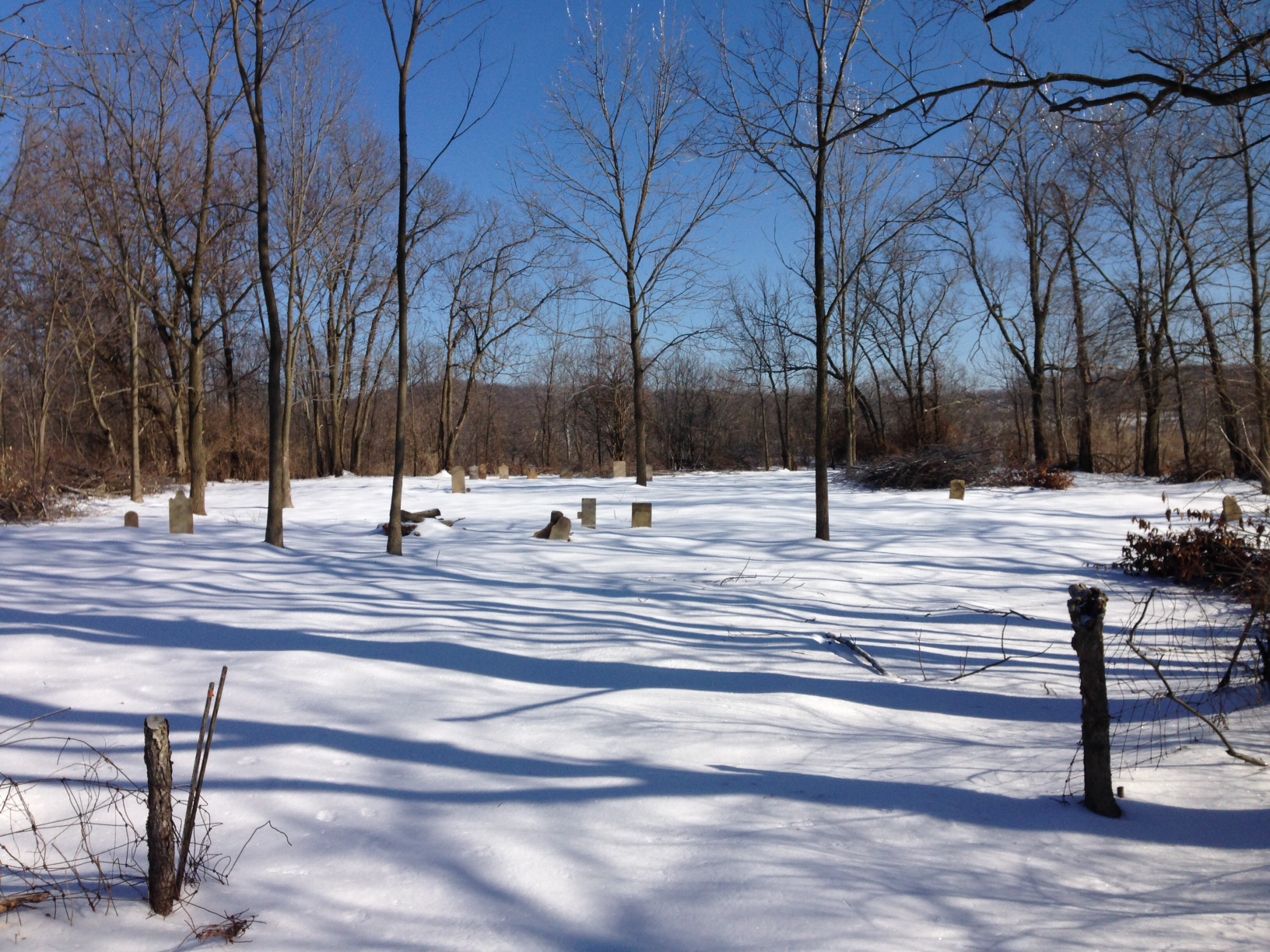
Dean Cemetery, South Salem, Ohio.
Photograph by http://image2.findagrave.com/photos/2014/46/CEM2317245_1392597580.jpg

Since I began working on genealogy, I've been struck by the family migration patterns of my ancestors. We're aware that European colonists moved frequently, spreading out across the continent. But unlike modern migration patterns (for example, my brother and I both moved away from Michigan for jobs), the earlier migrants moved with their large, extended families.

For example, Abraham Dean was born in western Pennsylvania in 1763. In the early 1800's, he moved with his family to South Salem, Ohio. But it wasn't just his immediate family who moved. He moved with his wife's family, including most of Sarah Stewart Dean's siblings. These were adults with their own households, spouses, and children, but they all moved to Ohio together. (Abraham only had one sibling, Margary Dean Canan, and she remained in Pennsylvania, along with her husband and children.) In the next generation, the children and grandchildren of Abraham moved to Des Moines, Iowa. Again, this was not just one nuclear family but the majority of his children, their own spouses, sisters- and brothers-in-law, and children. It was a clan migration.

Clan migrations weren't only typical of Scotch-Irish families in the early 19th century. On the other side of my family, Irish-Catholic Robert Cunningham, born in New York in 1850, spent his childhood in Columbus, Wisconsin. Robert married Elizabeth Rooney, and around 1890 they moved to Minneapolis, Minnesota. They moved with the entire Rooney family, including Elizabeth's parents, and most of her brothers and sisters, along with their families. This is how my great-great-great grandparents came to be buried less than an hour from where I now live.

Not all clan migrations were even based on kinship. One of my students told me that her surname is a town in Germany. Many of the towns' inhabitants emigrated together, and they took their town as their last name, so they could find each other in their new country. Something similar (without the name change) occurred in the Stoecklein branch of my mother's family. The Stoeckleins moved to Dayton, Ohio, from Faulbach, Bavaria. A number of families from that small town moved together, and remained close. Although my 3xgreat-grandfather, Joseph Stoecklein, married in Dayton, his wife, Carolina Zwisler, was the daughter of schoolmates of his parents back in Faulbach.

Surely these migration patterns were based on practicalities, as well as affection. Family members could help each other in a strange new place, whether they were negotiating a newly-conquered landscape or an alien city. It is an important reminder that, as a species, we were never meant to go it alone. We are social animals, and highly dependent on our family, however that is defined.

It's pretty common for academics to end up far from their families, and I personally can attest to the high cost of that separation. Just a couple weeks ago, my mother showed me a picture of her mother, surrounded by a plethora of female relatives - aunts, cousins, and sisters-in-law. Her remark was "Look how much help she had." Certainly, the large family sizes of previous generations were not possible if one woman did it all. As a society, we seem to have forgotten the importance of extended family.

Thursday, May 28, 2015

Walter Houser Brattain


Another of my occasional posts on famous (distant) relatives. Walter Houser Brattain won the Noble Prize in Physics in 1956 for his work on transistors.

Walter Brattain would be my fourth cousin, three times removed. His 3xgreat-grandfather, Robert Brattain, was my 6xgreat-grandfather. Robert's great-great-great granddaughter, Sarah Brattain, married into the Dean line. She was the wife of David Philip Dean.

Sunday, May 24, 2015

The Genealogy Gene

OK, I don't actually believe there is such a thing as a Genealogy Gene. However, while going through some of the records my mother brought to me this Spring, I found the earliest evidence (so far) of an interest in genealogy. It's a letter, dating to 1861, from Philip Welsheimer III (my 4xgreat-grandfather) to his daughter, Anna Welsheimer Dean (my 3xgreat-grandmother), giving her a list of all of his children and their birthdates. I don't know why she wanted it (perhaps to add to a family bible?), but the interest was there many generations ago.

Thursday, May 14, 2015

On the Importance of Lost Moments Found

Puritan men drinking (from https://seventreesfarm.wordpress.com, but I couldn't find
the artist). OK, so my ancestors (or at least these ancestors) weren't Puritans, but it's
surprisingly hard to find a picture of colonial men drinking.


While researching the family of Margary Dean Canan, the daughter of my 6xgreat-grandfather, James Dean, I came across a book, The History of Centre and Clinton Counties (Pennsylvania), by J.B. Linn (1975).  The book re-prints the journal of James Harris, who surveyed the area in 1784 (p.21-22). James Harris appears to have worked with, and possibly boarded with, John Canan, Margary Dean's husband. I was intrigued by the following journal entry:

"27th [of November], Mr. Brown goes for his horse to the Warrior Marks and returns to Mr. Canan's. I drink cyder with Mr. Canan at Mr. Mitchell's and Mr. Dean's his father-in-law."
A simple sentence, "I drink cyder with...Mr. Dean...", but so evocative. I imagine the men huddled close to the light and warmth of a hearth, the crude plank house dark around them. I can almost smell the wood smoke, tangy apples, and wet wool of homespun clothes. Perhaps they could hear Margary and her mother in the kitchen, or were the ladies sitting with them near the fire, working by it's light? The Revolutionary War had ended earlier that year. Did they talk about the new government, or old conflicts with their neighbors?

There is something visceral about this sentence. It captures the imagination and the senses in a way that no historical overview of colonial Pennsylvania ever could. It brings the dead to life in a way that no tombstone, no formal portrait could match.

Here, then, is the link between ethnohistory and archaeology. These records affect me much as I am affected by holding a the remains of an ancient pot, or tool, or meal. A person (not a number, not a label, but a person) once created or shaped the object, and now a person holds it again and wonders, remembers. A physical connection is made to the past. We are cultural creatures, and that cultural connection binds us to the people of the past just as strongly as the flimsy strands of DNA.


Thursday, May 7, 2015

Revolutionary War Soldiers


As I work through the genealogies, I'm keeping lists, so I can easily find information about people who, for example, were all Scotch-Irish, or lived in North Carolina. Most of these lists are not share-worthy, but I think this one is interesting: a list of family members who fought in the Revolutionary War.

(Note: I'll keep updating this as I get more information)

James Baird, Captain under Col. William Graham, Tryon County Regiment, 1776-1779. From 1779-1780 served in the Lincoln County Regiment (note: this is the same county, it just changed it's name). Fought in the battle of King's Mountain, South Carolina, and in the Cherokee Expedition.(1) See also my post on his life. James Baird is my 6xgreat-grandfather. His grand-daughter, Hannah Baird, married into the Dean line.

William Hill, Colonel in the militia (which one? I don't know!). Served in the battle at Rocky Mount and wounded at Hanging Rock, August 6, 1780. Also fought in King's Mountain and Cowpens.(2) Perhaps a more important contribution would be his Ironworks. William Hill is my 6xgreat-grandfather. His daughter, Jane, was the mother of Hannah Baird, who married into the Dean line. [Update, Feb 14, 2016: Oops! Turns out Jane Hill wasn't the daughter of William, she was the daughter of John and Jane Hill of Lincoln County, North Carolina. More on this as I figure it out]

Abraham Dean, Private 3rd Class, 7th Company, 1st Battalion, Cumberland County Militia, 1780-1781, under Captain John Woods.(3) Abraham Dean is my 5xgreat-grandfather, in the direct Dean line.

William Stewart. Private 4th Class?, Cumberland County Militia. It is unclear when he served, but he is listed as part of the militia in 1778 and 1780. There is an existing pass from Captain Philip Mathias, saying "Permit the Bearer William Stewart to pass unmolested to Cumberland County as he hath served 2 months honestly and faithfully in the 4 class of Cumberland Militia. Given under my hand this 4th Day of January 1778" (4) My great aunt Lillian Dean Huffstetler has records that list him as "Captain of a troop of Dragoon", or "second lieutenant in the Cumberland County, PA militia", but it is not clear if either of these are true.

James Addair. He is mentioned as a Revolutionary War soldier in several genealogies, but the source isn't clear. He did serve in the Virginia militia before the war, and he also took the oath of loyalty in 1777. (7) 

Philip Welsheimer, Sr. Rank and File in the 3rd Battalion of the York County Militia. Listed in the roster of April 15, 1778, under Captain Michael Kohn.(5)

Johannes Philip Welsheimerin Captain Andrew Graff's company from Pennsylvania, mustered in Philadelphia in July 16, 1776, with the remark "appointed gunsmith."(5)

"Colonel" Samuel Hancock. He served as a sergeant and private for more than two years during the Revolutionary War. The description of his service, which he gave as part of his pension application, can be found here. He seems to have spent much of the war marching around and being deathly ill. His brother Simon died in 1776 in Chester, PA, during military service. Samuel was not actually a Colonel, but like Colonel Sanders, he was a southern gentlemen of means and military background, so he was given the courtesy title. His brother, Edward, was similarly called "Captain" after serving three terms during the Revolution. Their eldest brother, William, also served. (10)

These were all the men from the Dean lineage who fought in the war. The other major branch off this side of the tree was the Brattains, who married into the Dean line when Sarah Jane Brattain married David P. Dean (my great-great-grandfather). The Brattains were Quakers, and did not fight in the war, although Sarah Brattain's great-grandfather, William Milliken, was burned out by Loyalists who objected to their support for independence.(6)

It appears that some of her non-Quaker ancestors did fight in the war, however:

Johann Georg Kissling. He served in Pennsylvania under Captain Kemp, in the Berk's County Militia, along with sons George Jr. and Conrad (8)

Jean (John) Chastain - he was too old to serve, but he is considered a "patriot" by the DAR for supplying the Bedford County, Virginia, militia with pounds of beef(9)

John Hewitt - there is a John Hewitt, of the right age and place, who was in the Revolutionary War, although it is not clear that this is the same John Hewitt as our ancestor.

The other line, that of the Kinneys, moved to Nova Scotia before the war, although it is possible some of them were loyalists and moved there afterward. I'm still looking into that possibility. 

References:
(1). Information from "The American Revolution in North Carolina" http://www.carolana.com/NC/Revolution/nc_patriot_military_captains.html, accessed April 18, 2015

(2). Roster of South Carolina Patriots in the American Revolution, Volume 1, A-J. By Bobby Gilmer Moss. 2009

(3). "AMERICAN REVOLUTIONARY SOLDIERS OF FRANKLIN COUNTY PENNSYLVANIA", compiled by Virginia Shannon Fendrick, p.59 (Available online:http://lcweb2.loc.gov/master/gdc/scdser01/200401/World_Almanacs_1903_1923/american%20rev%20sold%20frank

(4).  "History of that part of the Susquehanna and Juniata valleys, embraced in the counties of Mifflin, Juniata, Perry, Union and Snyder, in the Commonwealth of Pennsylvania..."Edited by F. Ellis and A. N. Hungerford. Published in Philadelphia by Everts, Peck & Richards, 1886, Pages 865-874.

(5) "A History of the Welsheimer Family", by Edith Welsheimer, Bronson Printing, Las Cruces, New Mexico, 1969.https://dcms.lds.org/delivery/DeliveryManagerServlet?dps_pid=IE97573

(6) "Notes on the Milliken Family", by Millard F. Hudson, California Genealogy Society, Issues 1-3, 1900, p.55 https://play.google.com/store/books/details?id=oW8wzD32obkC&rdid=book-oW8wzD32obkC&rdot=1

(7) Blog by Kenny Adair: http://www.genealogy.com/forum/surnames/topics/adair/2999

(8) http://mcclure.freeservers.com/geokeas.htm

(9) Pierre Chastain and Descendants, Vol. 1, p.24

(10) Dorman, John Frederick. 2004. Adventurers of Purse and Person: Virginia 1607-1624. Genealogical Publishing Company, p. 287.

Thursday, April 30, 2015

The Life of James Baird, (and was his wife a Meaney)?

The signature page of the Tryon County Resolves, from allthingsliberty.com.
James Baird's signature is on the left page, second column, third from the bottom


James Baird was the grandfather of Hannah Baird Dean, and therefore my 6xgreat-grandfather. As discussed in a previous post, his relationship to the Dean line is fairly well documented (unlike his relationship to his probable father, John Baird).

What is known about James Baird?

Most genealogies list him as born in Pennsylvania in 1740, but the location is based on his father's residence there. It's not actually known if he was born in Pennsylvania or in North Carolina, where his family had moved by 1753. Originally, their property was in the county of Mecklenburg, North Carolina. In 1768, Mecklenburg was divided up, and the Baird property was in the section re-classified as Tryon County. In 1779, for various political reasons, the part of Tryon County where the Bairds lived was re-named Lincoln County.

Tryon county was known for its role in the Revolutionary War. The Tryon County Committee of Safety was one of the first militia groups to declare support for independence in the wake of the Battle of Lexington. The Tryon County Resolves, declaring a willingness to fight the British, was signed by 49 Tryon men on August 14, 1775. One of the signers was James Baird.

Can we be 100% certain this is the same James Baird as our ancestor? No, but it is a James Baird in the right place and at the right age. And our ancestor did fight in the Revolutionary war, as a captain in the Tryon County militia, making it quite likely that he was, indeed, the signer of the Resolves.

James Baird's wife's last name was "Meney". Her first name is variously given as Nancy, Anne, or Margaret, but her name wasn't given in his will.

The name "Meney" is quite rare, and searching for information about a Meney family in North Carolina has turned up almost nothing, certainly nothing that corresponds to what we know about the Baird family. However, names were not spelled consistently in that time and place. Baird, for example, was sometimes spelled Beard or Bard. Perhaps "Meney" was not the standard spelling?

I searched through the history of Tryon/Lincoln County North Carolina for a family with a similar-sounding name. I found only one: Mauney. One of the other signers of the Tryon Resolves was Valentine Mauney. If on-line genealogies can be trusted (and they can't!), Valentine Mauney was born around 1740, which would make him about ten years older than James Baird's wife. He was the middle of three brothers (Jacob and Christian being the others) who moved to North Carolina from Switzerland, via Pennsylvania. Could "Nancy Meney" Baird be an undocumented sister? Alternatively, Jacob Mauney was old enough in 1750 that she could possibly be his daughter.

Or, of course, she could be unrelated. Still, further research is justified. There is a book, Three Mauney Families, by Bonnie Eloise Mauney Summers, that might be able to clarify the situation. If anyone happens to run across a copy in their local bookstore, let me know.

Thursday, April 23, 2015

The (Distant) Ties between the Deans and Zebulon Baird Vance

Zebulon Baird Vance, digitalheritage.org
I was "backfilling" the Baird family on wikitree.com (meaning I was adding in the siblings of those who were direct ancestors of mine), when I noticed a Zebulon Baird. Immediately, I thought, "That name sounds familiar." Indeed. Zebulon Baird Vance was a Confederate military office, twice the governor of North Carolina in the post-war years, and a U.S. senator. While he's not exactly a connection I'm thrilled to own, I try to recognize both the positives and negatives of the (very extended) family.

Zebulon Baird Vance and I are third cousins, six times removed. John Baird was Zebulon's great-great grandfather through his mother. That same John Baird is my eight great grandfather along the Dean line.